
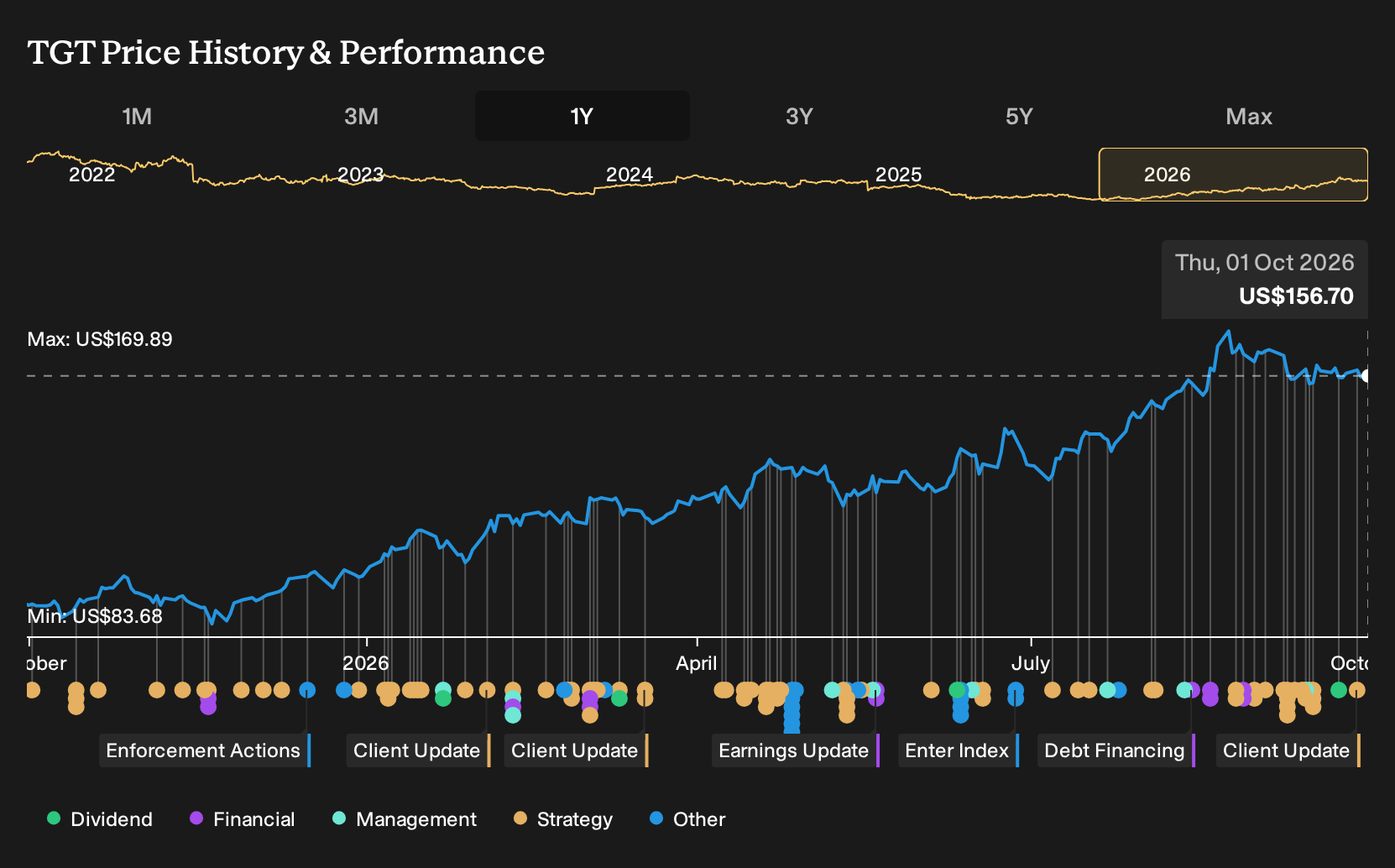
If Target was on your watchlist rather than in your portfolio, the past year may feel like a missed shot. Investors who held Target over the past year are up 82.2%, including dividends. That return arrived while many worried that giants like Walmart and Amazon would cap Target’s potential and compress its margins. If the starting thesis was that competition would win, what early evidence could have suggested that Target’s heavy spend on technology and store upgrades might play out differently?
The easy part of this move is behind Target. Zero in on 28 high quality undervalued stocks for companies trading below our estimates.
The Argument Target Investors Were Really Weighing
The shares cost US$89.14 at the start of the period, and anyone looking at Target then had to choose between two very different but credible stories.
On the bullish side, one thesis said investment in technology, private labels, and digital platforms could lift efficiency and help Target win share from rivals, backing a Fair Value of US$103, a price those assumptions implied. That view leaned on ideas like revenue growing 1.4% a year and profit margins easing to 3.4%.
The bearish narrative focused on e-commerce pressure, aging demographics, and rising labor costs, arguing these forces might steadily squeeze profitability. That camp anchored on a Fair Value of US$82 and built its case around revenue drifting 0.6% lower each year and margins declining to 3.0%, with heavier capital spending also weighing on free cash flow.
 NYSE:TGT 1-Year Stock Price Chart What The Target Results Actually Tested
Target’s Q2 2027 figures gave the bullish case some backing. Revenue reached US$26.54b versus US$25.21b a year earlier, while net income moved to US$1.88b from US$935m and net margin shifted from 3.7% to 7.1%. Activist pressure and governance concerns pulled the other way, so the evidence cut both ways rather than fully settling the argument.
The key assumption under review was whether heavy tech, supply chain, and store spending would translate into better profitability. For another retailer, you would track net income and net margin a year or two after large capital and operating outlays to see if that story is really landing in the numbers.
What Target’s Current Price Already Assumes
Target now trades at US$157, and the selected Narrative’s Fair Value sits below that quote. The gap reflects a view that cost growth, capital intensity, and governance worries may limit how much recent traffic gains and merchandising changes translate into lasting earnings power.
A buyer at today’s price is effectively assuming Target converts stronger store traffic and high margin side businesses into durable, higher quality margins. The Narrative asks how rising SG&A, heavier project spending, and reputational risks might interfere with that outcome.
“Key Takeaways: Bearish analysts expect Target to see its merchandising overhaul, value investments, and heavy store and supply chain spending weighed down by rising SG&A and lingering weakness in home and apparel, which could pressure revenue growth and profit margins. The main thing that has to go right is that Target converts its merchandising-led transformation and growing AI, retail media, and membership businesses into sustained traffic gains and higher quality margins that offset elevated operating costs and governance concerns.”
One Narrative disagrees with today’s price. → See where this Narrative says Target should trade
Before The Next Story Makes Headlines
You may be late to this rally, but that does not have to mean arriving late to every opportunity. Start with companies whose prices leave room for a different view of their future. Here are three trading below our estimates.
Company 1 – 36% below our estimate – converts modular industrial and data center projects into recurring infrastructure services work. Company 2 – 24% below our estimate – supplies integrated GPU rack systems and software stack for advanced AI data workloads. Company 3 – 37% below our estimate – shortens subsea tieback schedules while expanding higher margin long duration services contracts.
Three companies from the same screener. Open all 25 companies with the balance sheet to back it up →
This article by Simply Wall St is general in nature. We provide commentary based on historical data
and analyst forecasts only using an unbiased methodology and our articles are not intended to be financial advice. It does not constitute a recommendation to buy or sell any stock, and does not take account of your objectives, or your
financial situation. We aim to bring you long-term focused analysis driven by fundamental data.
Note that our analysis may not factor in the latest price-sensitive company announcements or qualitative material.
Simply Wall St has no position in any stocks mentioned.
Valuation is complex, but we’re here to simplify it.
Discover if Target might be undervalued or overvalued with our detailed analysis, featuring fair value estimates, potential risks, dividends, insider trades, and its financial condition.
Have feedback on this article? Concerned about the content? Get in touch with us directly. Alternatively, email editorial-team@simplywallst.com