
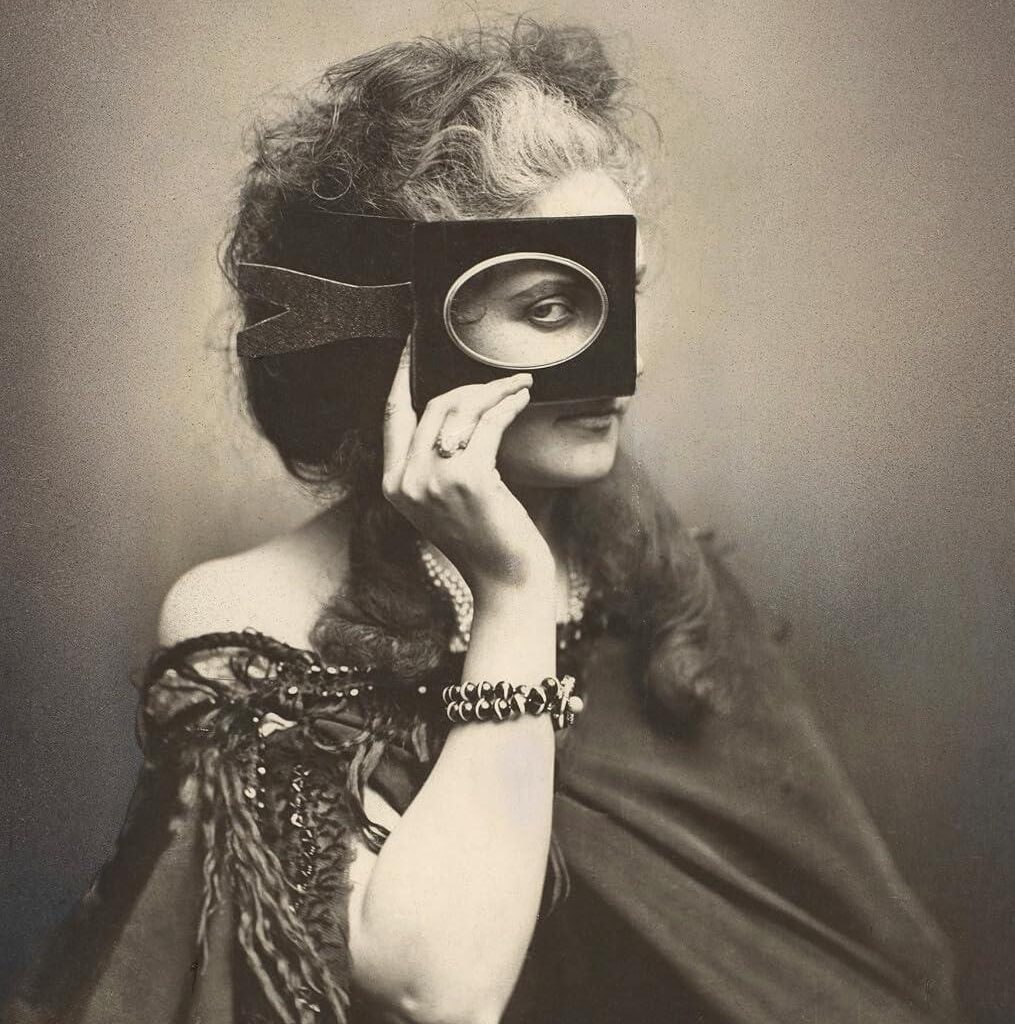
A newly translated biography of Virginia Oldoini, Countess of Castiglione, aims to reveal the real woman behind the subject of everyone’s gaze.
The Contessa by Benedetta Craveri. Translated by Alex Andriesse. New York Review Books, 2026. 520 pages.Buy on Bookshop.org
Become a member for 15% off at Bookshop.orgDid you know LARB is a reader-supported nonprofit?
LARB publishes daily without a paywall as part of our mission to make rigorous, incisive, and engaging writing on every aspect of literature, culture, and the arts freely accessible to the public. Help us continue this work with your tax-deductible donation today!
I WAS LED UP through the back entrance and into the Metropolitan Museum of Art’s Department of Photographs, which, at my request, had been turned into something like a shrine to a beautiful woman. Long dead, she was everywhere, her image laid out on the table and lining the wall. I had called her up from her archival depths, and now here she was, Virginia Oldoini, the Countess of Castiglione, considered one of the most beautiful women of the 19th century. The museum possesses some 433 photographs of the countess, all taken by Pierre-Louis Pierson, a fashionable photographer of the Second Empire, and donated by the poet Robert de Montesquiou, who obsessively collected them after her death.
I was told to limit my selection to just 25 images, but even so, her gaze was oppressive. She was playing tricks on me: in one photo, dressed as Elvira, she looks into a mirror, watching me watch her. She was often playing a part: here, as the Queen of the Night, here again as Béatrix. These images seem to contain within them the whole contested history of photography, self-portraiture, and performance. In perhaps the most famous of these photos, the countess raises a small black frame to her eye, fixing her gaze on the photographer—on the viewer—in a protosurrealist play of gazes. The photo is titled Scherzo di Follia. The game of madness.
The Countess of Castiglione—spy for Italy on the eve of Italian reunification, lover of Emperor Napoleon III of France, scandal-sheet darling—has inspired books, films, and poems, but the first work devoted to reproducing her beauty was her own corpus of images. Now, into this lineage, comes Benedetta Craveri’s The Contessa (2021), a major biography now translated from the Italian by Alex Andriesse. The book draws on new archival sources to create a deeply researched, richly detailed account of the countess’s life.
The book is structured almost linearly, punctuated by short chapters about particular devotees—her adoring son, her attentive mother, an unidentified lover who referred to himself as “L’Esclave.” This structure is inventive and fitting for the subject, who prided herself on her ability to capture the affections of others without giving too much of herself in return, though at times, it makes the book difficult to follow. In her exhaustive efforts to trace the countess’s complicated web of relationships, financial dealings, and political intrigues, Craveri is forced to remind the reader that we have “already met” certain figures or “already seen” certain events unfold; some chapters begin before the events of the previous chapter have even ended. This struggle to keep things straight, to remember who knows which version of the countess and which of her secrets, whom she is close to and when, whom she has alienated or is angry at, seems to replicate the lively experience of juggling various schemes, but it is also inelegant and awkward in a way the countess rarely was.
As her star waned and she began to retreat from French society, the Countess of Castiglione, always on the edge of financial ruin, became consumed with the stock market. She never gave up her political intrigues and her relationships with powerful men—after her relationship with Napoleon III ended, she had affairs with prominent princes, bankers, and King Victor Emmanuel II of Italy, allowing her to play a role in brokering peace in the Franco-Prussian War. Still, her life lost some of its charm after her days at the peak of Second Empire society, and Craveri’s account suffers the same fate. Thrilling early chapters documenting Oldoini’s glittering rise and daring behavior give way to a hectic itemization of her financial dealings, elaborately detailed in her letters. Interchapters exploring specific relationships provide a welcome dose of drama in these later pages.
In her preface, Craveri pledges that she will be “yielding the floor whenever possible to Virginia,” and she quotes liberally from the countess’s extant letters and diaries, a gesture that reads as a deliberately feminist act, letting her subject speak for herself where so many men have spoken for her. Craveri’s discovery of new archival sources is also a testament to the depth and rigor of her research, as only fragments of Oldoini’s diary remain, and she, always prone to “persecution mania,” had a tendency to request that her lovers burn her letters.
But for all this, it is still difficult to grasp a clear picture of the woman herself—of what she felt and wanted, of what compelled her extraordinary act of creation—through her words. Her diary is, as Craveri notes, “less remarkable for its puerility (as is generally claimed) than for its disaffection,” and her letters vary dramatically in style and tone, sometimes displaying a “crude realism,” at other points “a mastery of classic French epistolary art, eschewing ‘five-penny’ literary formulae in the name of originality and surprise.” Craveri’s is a thorough account of the countess’s life, and still she struggles to make sense of Oldoini’s many contradictions, by turns portraying her, disdainfully, as a “capricious, spoiled, unstable little provincial,” and heroically, as an “authentic feminist […] avant la lettre” torn between revulsion and respect.
The countess—witty, secretive, paranoid, and capricious—could write well, but she spoke most compellingly, if enigmatically, through her photographs.
¤
The future Countess of Castiglione was born Virginia Elisabetta Luisa Carlotta Antonietta Teresa Maria Oldoini Rapallini in Florence in 1837, a minor noble and a major beauty. She wrote in her diary that, as a child, she successfully bartered her charm for a mill (“complete,” Craveri writes, “with notarized deed”). The legend of her beauty only grew. Her mother, in a letter to her distant father, whose elusive love Oldoini would spend her life chasing, wrote that the girl’s esteemed beauty was matched only by a reputation “for having no feeling for anyone.” The Count d’Ideville once wrote that Oldoini’s “strange beauty […] seized and surprised, but this admiration excluded all other sentiment.”
Craveri, like so many of her admirers, considers the countess a lovely narcissist, full of spite and self-pity, casually cruel to the people who cared for her. She traces the broken hearts the countess left in her wake, not least those of her abandoned husband, neglected son, and unloved mother. In Craveri’s depiction, the countess is almost inhuman; at one point, she openly wonders whether the countess was capable of love, while at another she calls the question of whether she ever regretted treating her mother poorly “not worth asking.” It’s obvious to Craveri that the countess regretted nothing. The image of the countess that emerges can be astonishingly cruel, and Craveri is not especially interested in psychological theorizing. But since everyone, her whole life, acted like she was so beautiful that it hurt to look at her, it could hardly have been surprising when she caused so much pain.
Put another way: Would you be a nice, normal, well-adjusted girl if the children you played with called you “the living Madonna” and your parents treated your teenage beauty as “serious business,” like a stock tip? The power of beauty, its ability to captivate, is a depreciating asset. The countess spent her life struggling, and only sometimes succeeding, to convert it into the currency of wealth and influence. At 17, she married Francesco Verasis, the Count of Castiglione, a man who promised to bear any cost in service of her happiness but, after their wedding, turned out to be controlling and jealous, prone to complaining to her parents about her failings as a wife. She bore him one son, to whom she was largely neglectful, occasionally abusive, and intermittently kind.
She soon began to take lovers. In 1855, her cousin (and later, also her lover), the Count of Cavour, along with Victor Emmanuel II, then King of Sardinia, persuaded her to put her beauty in service of a greater cause: Italian unification. They asked her to seduce Napoleon III. As Craveri writes,
she was being asked to put herself at the service of her country and invested with a task that exempted her from respecting the moral regulations and social conventions that held women captive. She was also learning to navigate the ruthlessness of politics and the brutality of power, for which her body was a commodity to be disposed of at will.
The countess and her husband moved to Paris, and within weeks of her arrival, she succeeded in seducing Napoleon III, who went on to support the Sardinian king. She quickly became the star of the Second Empire. She turned up to balls in elaborate costumes designed to highlight her beauty. She could be scandalous and witty, wearing outfits that knowingly skirted bad taste. She dressed once as the Queen of Hearts, an obvious allusion to the many hearts she had captured, one heart prominently placed at her pubic bone. The Empress Eugénie is said to have remarked, somewhat primly, that the heart was a bit low.
The costume reads as an arrogant, knowing joke about her sexual charisma, but it was also a direct challenge to Eugénie, the countess’s obvious romantic rival. Craveri notes that “besides contravening the rules of modesty—she wore no corset—it expressed ‘a clear, tangible protest against the crinoline’ defended to the bitter end by the empress.” She was a natural in the two-faced world of politics and parties, “a born actress,” the social scene of the Tuileries her stage.
But, as Nathalie Léger wrote in L’Exposition (2008), her slim, elliptical study of the countess’s life, translated into English by Amanda DeMarco in 2019, “like any great actress, she is pretending to be pretending.” It is this iterative performance that makes the countess so difficult a biographical subject. Craveri’s detailed accounting of the facts of her life does not quite add up to a portrait of the woman looking out from the photographs. It is easy to assume that the task of her biographer is to find the woman beneath the roles she played, but the countess is at once obscured beneath who she pretended to be and sincere in her pretending. Craveri makes clear that Oldoini knew how to play a part to get what she wanted. At times, what she wanted was a friend or lover who might “understand her and love her just as she was”—but who was she if not a consummate actress?
The primary phase of the affair lasted from 1856 to 1857, and it was during that time, at the height of her fame, that she made her way to the studio of Mayer and Pierson, where the demimonde went to have themselves photographed. Here, she began a collaboration with Pierson that would span decades and result in hundreds of photographs. This partnership made the countess the most photographed woman of her time and preserved her image for ours.
Her affair with the emperor was the beginning of a storied femme fatale career, trading in sex, state secrets, and stocks. Throughout her biography, Craveri treats sex work with disdain, deriding the countess for plotting her romantic conquests using “language of the brothel”; Craveri speculates that, perhaps, the countess pretended to be in love with Napoleon III while “count[ing] the minutes, like a prostitute before the money changes hands.” This scorn for sex work restricts the author’s ability to analyze the countess’s complicated position at the juncture of money, desire, and power. She struggles to understand the countess’s own desires, seemingly unable to decide if she was frigid, seeking material gain or a confirmation of her own attractiveness, or libidinous, indulging in pleasurable games. Craveri does eventually set her judgment aside, drawing a distinction between the countess and a courtesan that relies on an analysis of class rather than morality.
¤
Oldoini’s affair with the emperor took a sharp turn in 1857 when, while leaving her apartment, Napoleon III was attacked by Italian revolutionaries. The scandal around the assassination attempt, including the countess’s falsely rumored role, along with her impending, shambolic divorce from the publicly disgraced and financially ruined Count of Castiglione, led the countess to retreat first to Turin, Italy, and then to the Parisian suburb of Passy. She kept in touch with close friends and important contacts and even made new conquests. But, isolated from Paris society, she grew increasingly embittered, if no humbler. “The day will come,” her husband wrote to her, a curse and an inevitability, “when your fatal beauty fades.”
Death was often on her mind. She wrote to a friend that she wanted only one word as her epitaph: “FATALITÉ.” To another, she wrote: “I want the world to consider me already dead, but until I really am dead my life deserves respect.”
In a bid for this respect, the countess agreed to perform as part of a charity show of tableaux vivants—a living picture show, a popular “form of entertainment brought back into vogue by the empress,” in which performers held poses often inspired by works of art. It was a natural fit for a woman so experienced at holding a pose and, in its fleeting vivacity, an inversion of photography, her favored means of self-display. Her impending return made her the talk of the town once again. It was rumored that she would appear as the Etruscan queen, one of her most famous costumes, or that she would be naked. Instead, ever the wit, she appeared in a nun’s habit, underneath a sign reading “Hermitage of Passy.”
In cloaking her much-desired body, Oldoini undid the expectation of the salivating crowd. This gesture anticipates countless contemporary examples. At the 2021 Met Gala, Kim Kardashian wore a face-obscuring, body-covering black robe, another famous woman emphasizing her body’s recognizability through its effacement. There are other similarities between Kardashian and the countess—the elaborate costumes, the sense that both are “famous for being famous,” the endlessly photographed faces. But unlike the omnipresent Kim, the hermit of Passy, alone in her rooms, enacted her greatest punishment on a society that she felt had not given her extraordinary beauty its due: she withdrew her image.
Later in life, Oldoini moved back to Paris, into apartments on the Place Vendôme. She remained a recluse. Her rooms were all done up in black, like, it is often said, a tomb. But also: like a darkroom.
¤
The most beautiful photos from her collaboration with Pierson come from the early years, at the height of her fabled beauty. One photo, laid out on the table before me at the Met, shows the countess seated, dressed in black. Her torso emerges from a profusion of tulle, jutting forward like the figurehead on a ship. Her left hand, perfectly formed, lies in her lap. Her right frames her face, the dead center of the image her cold, steady stare. A work of art—that is what this is, that is what this looks like. She could be a sculpture, so still and unfeeling.
To create a photograph like this took effort, took time. Photography in its early years was a durational art. The countess would have had to be still. This photo, Craveri writes, is “considered one of the most beautiful portraits in the history of photography.” Léger writes that “this woman was to all appearances a very good photographic subject, excellently disposed to be positioned, such a beautiful figure, so fixed in her beauty, an ideal death-bed subject.”
Oldoini’s foremost collector, Montesquiou, titled it Le Regard—the gaze, the subject of so many of Pierson and the countess’s best photographs, the Scherzo di Follia among them, emblematic of their complex collaboration. The countess has been compared to Cindy Sherman, and has been considered a self-portraitist par excellence, but these are not precisely, it must be said, self-portraits. (Léger: “The fact that a man is watching isn’t irrelevant, is it?”) In these images of her, looking at him, there is also his gaze, and the eye of the camera.
But if these early photographs make the case for the artistic and historic significance of the collection, it is the late photographs that disrupt the countess’s body of work; too often dismissed by critics and historians as simple exercises in vanity, the images from the 1890s turn the archive of photographs into something stranger and more compelling. “On September 1, 1893, after twenty-six years’ absence,” Craveri writes, “she returned to Pierson for a long series of photo sessions that would go on for another two years.” In these photos, she is visibly wearied, her mouth turning down, her body swollen with illness. She replicates many of her previous poses, dons the same costumes, even repeats a series of scandalous photos of her bare legs.
The earlier photos, her face cropped from the shot, grant her an insouciant deniability, a charged, lively eroticism. By the end of the century, the disembodied limbs look, as Craveri writes, “like the feet of a dead woman in a coffin.” For Craveri, the earlier photos are easily explained by the countess’s narcissism, but she finds it “hard to fathom” what drove Virginia to sit for these late photos, to direct these images of her own decline, beyond an unshakable belief in her own beauty.
But these photos suggest that narcissism is too simple and too dismissive an explanation for Oldoini’s corpus, as it often is for women who take themselves as subject. Maybe she was, as Craveri suggests, delusional. “Did she still feel beautiful[?]” Craveri asks. “Locked in her isolation, unconcerned about the passage of time, had her self-image become frozen in that remote era?” Or was it all a joke, another mad game, as Craveri suggests only a page later, “no longer a question of concealing her physical decline but of pillorying it, in one last act of defiance”? In either case, what is remarkable is the countess’s unflinching gaze, steady through her rise and fall. She wanted to show her photographs in the 1900 Exposition Universelle. She wanted to be credited as an artist, a designation denied to her when Pierson showed a photo of her in 1867. She deserved the title.
In her 2026 study of the eponymous celebrity family, Dekonstructing the Kardashians: A New Media Manifesto, MJ Corey analyzes Kim Kardashian’s efforts to transform herself into various bygone celebrities, from Cleopatra to Marilyn Monroe, asserting that one “precondition of glamour [is] being something other people strive to emulate.” In the late photos, the countess, returning to her familiar dresses and her favored poses, emulates her younger self, invoking what is no longer there. The late photos confirm the beauty of the early ones; they are photographs of the death drive.
“Celebrity,” Michael Schulman wrote in a New Yorker piece on the profile as genre, “is, among other things, a way of marking time.” This is true, too, of any beautiful woman, and the countess was both. Her youthful beauty, like all life, contained within it a reminder of its inevitable end. It is this bare fact that gives her gaze its cruelty, its “cold fire.” In 1899, her triumph long behind her and the Second Empire a memory, she reentered public life to attend the funeral of one of Empress Eugénie’s former ladies-in-waiting.
“That woman was a piece of living history,” a contemporary remarked at the time. “Her mere presence was enough to evoke a distant past.”
LARB Contributor
Meghan Racklin is a writer and editor based in Brooklyn. She has written for The New Republic, The Baffler, The Brooklyn Rail, and more.
Share
Copy link to articleLARB Staff Recommendations
In a preview of the new LARB Quarterly, no. 39: “Air,” Meghan Racklin considers the life and imperfectly rendered image of Empress Elisabeth of Austria.
Nathan Scott McNamara considers Nathalie Léger’s “The White Dress,” out now from Dorothy in a translation by Natasha Lehrer.