
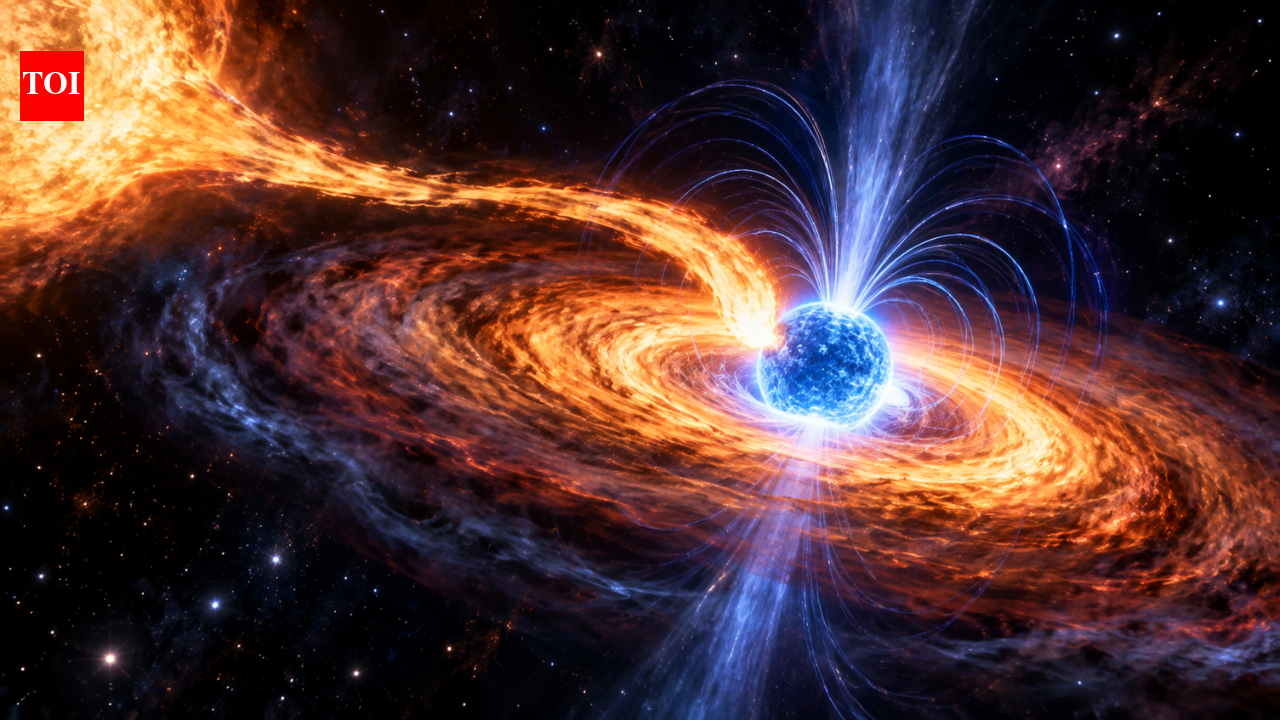
 Astronomers have, for the first time, watched gas fall onto a neutron star. A team led by Roi Rahin used the Resolve instrument aboard the XRISM space telescope to observe GX 301–2, an accreting X-ray pulsar paired with the massive hypergiant Wray 977. According to a new study published in Science Advances, titled ‘Direct spectroscopic observation of matter falling onto a compact stellar object’, the observation, made on 1 February 2025, caught the end of a flare and revealed iron lines that shifted from absorption to emission over time. The authors describe it as the first direct spectroscopic observation of accretion onto a neutron star, and say it offers a direct test of long-standing ideas about how such systems feed.
How did XRISM detect gas falling onto neutron star GX 301–2
XRISM observed GX 301–2 on 1 February 2025 for around 100 kiloseconds, with a net exposure of 50 kiloseconds. According to the paper, the observation caught the end of the pre-periastron flare. The team detected redshifted hydrogen-like and helium-like iron lines, along with transitions from lower ionisation states. These features changed over the course of the observation, appearing as absorption lines at the start and as emission lines at the end, with mixed phases in between.The authors say earlier telescopes, including Chandra and XMM-Newton, offered only moderate spectral resolution in the 6 to 7 keV band, so previous studies of this system focused on fluorescence lines. They also state that clear indications of wind matter falling onto a compact object had never been observed before. In the first 13 kiloseconds, the study reports, the iron absorption lines were redshifted by several hundred kilometres per second, with the most prominent lines at about 430 kilometres per second.
Why did scientists say the gas was falling onto the neutron star
The paper sets out several reasons for reading the absorption as matter being accreted. The redshift indicates inflow, and the absorber sits within the neutron star’s accretion radius. The luminosity expected from this accretion is in line with what was observed, and once absorption was no longer detected, the luminosity dropped rapidly. The authors interpret the signal as a clump of matter pulled from the dense stream as the neutron star passed through it. They add that this is the first observation in which X-ray absorption is detected from an ionised inflow rather than an outflow.The researchers also considered other explanations and describe them as physically inconsistent. These included a clump of wind reversing direction and falling back towards the star, and spontaneous shocks in the wind. Given the system’s slow wind, at around 300 kilometres per second, the paper says shocks heating gas above 10 million kelvin are difficult to explain and are not supported by observations. The emission lines, by contrast, showed lower redshift and greater broadening, which the authors take to suggest a different origin, possibly a sparser stellar wind.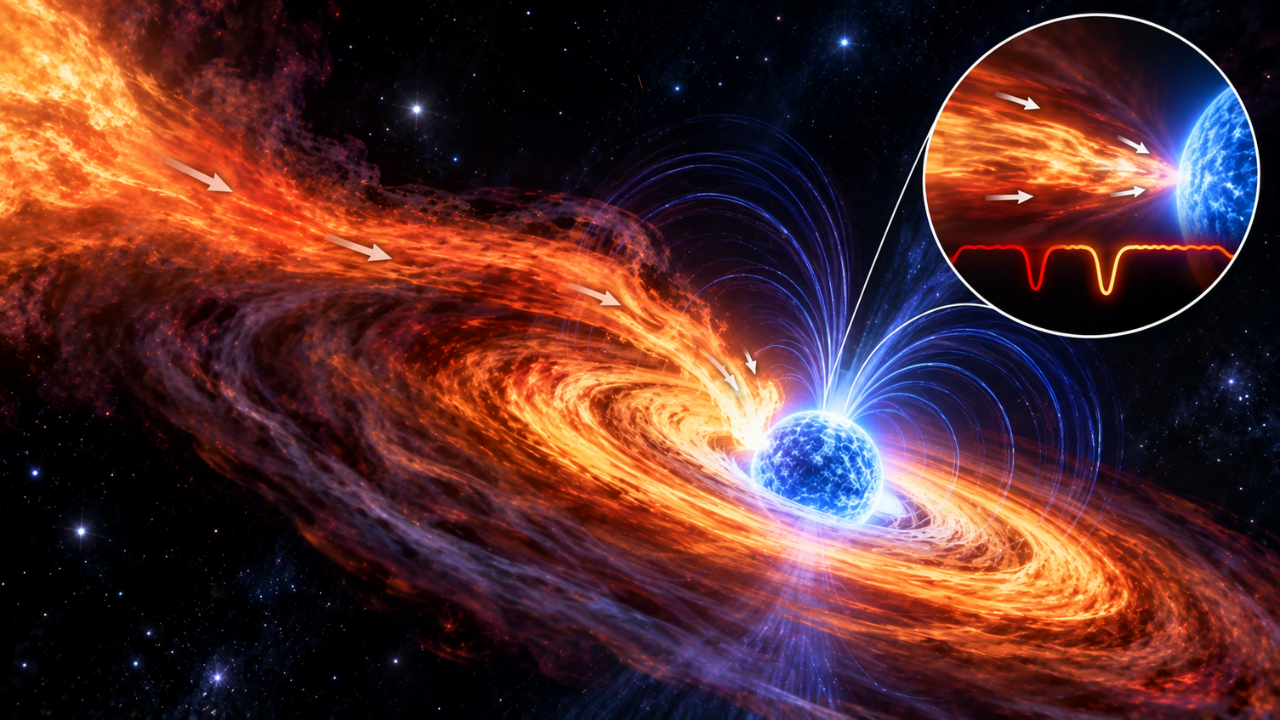
Image AI generated
What happened to the gas later in the observation
Later in the observation, the study reports, absorption lines reappeared alongside emission lines. They were still redshifted, but substantially less than at the start, and the inflow velocity was consistent with zero. The light curve behaved differently too. It plateaued for around 10 kiloseconds and then decayed gradually, rather than dropping sharply as it had earlier. The authors say they “speculate” that the two events differ in the angular momentum of the inflow, with the later one being simpler to explain as a disk-like in-spiral than as a near-radial flow. They note that GX 301–2 has previously been hypothesised to create short-lived accretion disks.To test the idea, the team examined long-term Fermi/GBM data on the pulsar’s spin and flux, and reported a correlation between changes in pulse period and changes in flux around the start and end of flares. They argue that the evidence favours multiple forms of accretion in the system.