
At six o’clock on a June Wednesday morning in Century City, a group of Neon executives gathered at the headquarters of CAA for a secret screening. They did not know what they were about to watch. It had been made clear the surprise would be worthwhile. The lights dimmed, and there before them was Artificial, Luca Guadagnino’s provocative new film about the birth of OpenAI and two of its founders, Sam Altman and Ilya Sutskever. Amazon MGM Studios had just decided, despite developing the project, they would not release it; one of the year’s buzziest, most controversial titles was suddenly up for sale.
Neon was immediately interested. The Tom Quinn-led independent studio was the first to screen it, before competitors like Netflix, Searchlight and A24 had their look. Their reactions varied, but skewed very positive; all, with the exception of Neon and Mubi, eventually passed. Speculation ran rampant as to why: Was the movie not good? Too expensive, at its $40 million budget? Or were certain companies unwilling to take on the incendiary film due to their increasingly direct connections to Big Tech? (Amazon, for its part, had announced a planned investment of $50 billion in OpenAI months before deciding to sell off Artificial.)
These questions hung in the air all summer. The first, at least, is about to be answered, with Artificial set to bow Monday night at the New York Film Festival. Neon, which ultimately acquired the movie in a unique deal in which they paid nothing up front but committed to a $15 million marketing spend, will then release it in theaters on Christmas Day. The other rumors remain sticky — though the filmmakers aren’t without their opinions on them.
“The concept of a conflict of interest is a very important, let’s say, elephant in the room here,” Guadagnino tells The Hollywood Reporter of his experience screening Artificial for various studios. “Once you understand the nature of every company’s business, despite and beyond their love for the movie, you realize that some decisions are not the decisions they would’ve made in a vacuum. …. When the landscape of the studios is morphing and the studios are dealing with interests from Silicon Valley — let’s say tycoons — that is something that makes the idea of art, the idea of representation, very slippery. The famous example of Orson Welles: a movie like Citizen Kane could probably not be done under the climate of today.”
Andrew Garfield, who gives a hauntingly transformative performance in the film as Altman, isn’t aware of any specific internal conversations among companies that passed on Artificial — but echoes Guadagnino’s larger point: “The fight is on to make sure that we are allowed to make things freely. The centralization of power that we’re witnessing happen can have a very, very chilling effect on how art is being allowed to live.”

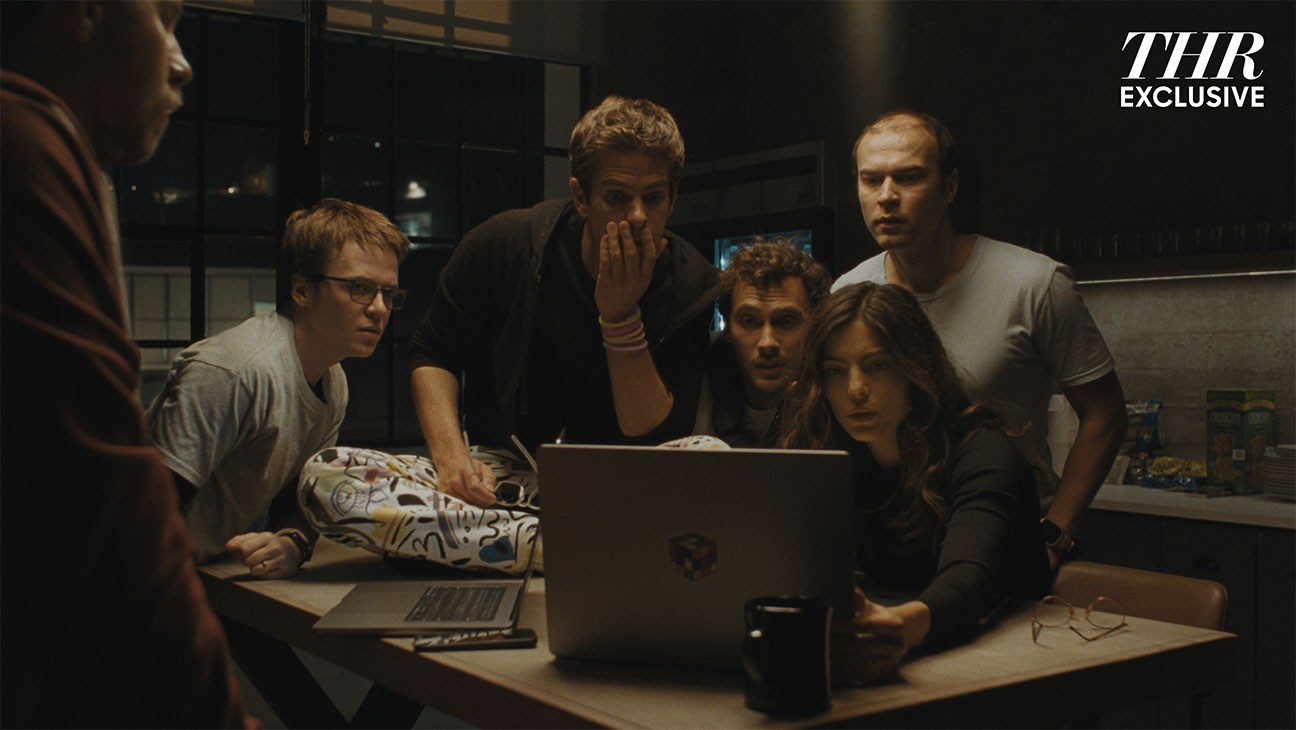
Monica Barbaro, Andrew Garfield, Cooper Hoffman, and Yura Borisov in Artificial.
Neon
**
Over the last few weeks, leaders of OpenAI and other companies in the space have sounded the alarm on the acceleration of generative AI, on the need to slow their own work down to keep it safe. Artificial’s timeliness in that regard is striking, even disturbing. The movie traces decades in the lives of Ilya (Anora’s Yura Borisov) and Sam (Garfield), men from completely different worlds who bond and plot to change the world for the better in the sunny glow of Obama-era tech optimism, then find themselves at odds as the enormous — eventually, dangerous — capabilities of their technology reveal themselves in the Trump and Biden years. Several scenes and conversations in the film, set years ago, speak eerily to headlines of the past month alone.
Artificial is written by humorist and Saturday Night Live alum Simon Rich, and was developed at Amazon before Guadagnino was hired to direct it. The shapeshifting director, whose credits range from the Oscar-winning romance Call Me by Your Name to the horror remake Suspiria, had worked with the company regularly, on commercial smashes (Challengers) and misfires (After the Hunt) alike. “They’re family to me,” Guadagnino says of Amazon. He reiterates this remains the case.
Sources say Rich’s script was more broadly comic than Guadagnino’s darkly funny final film. (Though you’ve still got Ike Barinholtz’s Elon Musk, often reduced here to little more than an obscenely wealthy punchline.) Artificial is introduced as Ilya’s story before Sam takes charge of the narrative; accordingly, the tone turns almost sinister, with Ilya and eventual OpenAI CTO Mira Murati (Monica Barbaro) looking on in disempowered horror.
Guadagnino and his D.P. Malik Hassan Sayeed give Artificial a true analog feel, shooting on 35mm with a playful liveness in the camerawork that contrasts with the gleaming, exactingly re-created Big Tech office spaces that hold much of the drama. The director approached the material as a Medusa’s Touch-esque tale, with Ilya as the way in. “You start as a person, then you get touched by something that corrupts you inside out — and these corruptions start to spread and create a landscape of destruction all over,” he says.
Luca Guadagnino behind the scenes of ‘Artificial.’
Neon
“There is a purity that Ilya seems to have and that Yura definitely accesses in a very beautiful, profound way, a kind of almost childlike awe,” Garfield adds. “And with Sam, I was like, ‘What does it take to not only run one of these companies, but make decisions that are going to hurt people, no matter how you slice it, as long as you are committed to winning the race and being the one to hold the Holy Grail in your hand? What does it take in order to sleep at night?’”
Guadagnino saw his actor, who also starred in After the Hunt, go there from moment one: “We tested him with prosthetics — fake nose, fake cheeks — and we filmed it and we thought it was totally ridiculous,” he says. “Then he played the movements of Altman, the neck of Altman, the walk of Altman, and we filmed that — and it was uncanny, with a simple, strategic usage of makeup in terms of shadow and light. In that moment I felt like, ‘Wow, we’re onto something with him here.’”
The filmmakers hired outside counsel to ensure Artificial stayed legally ironclad, while not pulling any punches in its portrait. (After production, key moments dramatized in the movie were backed by Ronan Farrow’s sprawling, damning profile of Altman in The New Yorker.) “Everything that we say in the film is completely vetted and could be proven and double-proven,” says Oscar-nominated producer Jennifer Fox (Michael Clayton). “Without that, Amazon corporately would not have allowed us to make the film.”
The parameters changed as the shoot went on. Garfield would rein certain scenes in after legal had flagged them as “hyperbolic”; others were added in and expanded upon based on new public information. They also had primary sources on set for color and accuracy. (Fox politely declines to name names.)
“Hopefully what we’ve done is that we’ve pushed the envelope as far as possible without the risk of being taken to court,” Garfield says. “And hopefully we’re speaking to something universal and deeper about the anxiety that we’re all feeling about the future. This is maybe as far as we can take our obsession with not being human before we return to honoring the body, honoring a descent rather than a constant ascent. I feel it in myself. I feel it in my own soul. I want to be in the mud, in the muck.”
Garfield also viewed Artificial as the closing of a chapter in another way, going back to his turn in The Social Network as Facebook co-founder Eduardo Saverin — there, portraying more of the Ilya than the Sam. Initially, this was not to be the case. “I was auditioning for Mark [Zuckerberg], and I was kind of told that the part was as good as mine,” Garfield says. Then Jesse Eisenberg auditioned and proved undeniable for director David Fincher. “So this kind of scratched that itch for me. There was a dangling remaining itch that I wanted to dive into, really walk into and explore and leave no stone unturned.”
Garfield with Hoffman in ‘Artificial.’
Neon
**
“Zero AI” was used in the making of Artificial, Guadagnino says. That goes for all of his movies, in fact. “I’m an old-fashioned guy. I’m analogic. I shoot on 35. I believe in good old performance,” he says. “Jean Renoir used to say: ‘You have to leave the door open to reality on a movie set.’ And how do you do that if you are sending prompts to a computer?” This philosophy, of course, extends to the very core of the film — of what it has to say, and why it may have scared some companies off: “It’s not just that AI can wipe off humanity from planet earth in four years — we are destroying the environment and we are doing so mindlessly, and someone is getting more and more power into their hands while others are just digitizing questions to the ChatGPT.”
Artificial derives its power from its frankness — and so in the months leading up to Amazon’s decision to sell the movie, opinions among the filmmakers varied as to where it stood. “I can say that once I saw the development of dealmaking, and business-making, between Amazon and OpenAI, that was an interesting moment for me,” Guadagnino says.
Once the sale news landed, Garfield adds, “I was really impressed by Amazon that they were doing it in the first place, so I wasn’t incredibly surprised that they were like, ‘OK, maybe this isn’t for us to release’ — and then I was doubly impressed when they didn’t kill it.”
Fox felt differently as a producer: “We were all very surprised. They didn’t only write us a check to do the movie, they collaborated creatively with us and were great partners,” she says, a sentiment echoed by sources familiar with the production process. Fox adds that the rationale provided by the studio to the filmmakers was roughly the same as the statement put out by the studio in June: “We believe that Artificial will be better served if it were released by a different studio.” (Amazon had no further comment for this story on its decision to not release the film.)
Once the sales process began, rumors swirled around the making and quality of Artificial. A Vulture report, for instance, claimed that the movie required “extensive reshoots” following “all sorts of disasters” during production. “Absolutely untrue and easy to check,” Fox says. “We lost our actors to other films. We had contractual stop dates for them. It wasn’t possible to have reshoots.” Production materials reviewed by The Hollywood Reporter indicate that, at the end of the 34-day shoot in September 2025, the film was considered on-schedule. A source familiar with Amazon’s oversight of Artificial corroborates that there were no reshoots and adds, “The film did not go over budget.”
Another insider notes, however: “[Amazon] made the movie for too much money.”
“We live in an age of post-truth and so anybody’s opinion, and let’s say pseudo-information, becomes information,” Guadagnino says. “I personally would never speculate on something that I don’t know the actual facts of. So for me, it’s a little bit frustrating.”
All involved clearly feel Artificial has wound up at the right home, at the right time — with a tastemaking, independent company galvanized by the intense relevance of the storytelling.
For Garfield, even the mad dash to find a new buyer felt fitting. “I was kind of excited — it felt spicy,” the actor says. “I was like, ‘Hell yeah, this is kind of punk rock.’” Now, after all the noise, viewers can finally have their say. “Unless you’re Spider-Man, it’s really, really hard to know how an audience is going to respond,” Garfield says. “But I want it to reach people. I want as many people to see it as possible. The universe is spinning forward, everything is going the way it’s going — and we have a responsibility to ourselves to look at who’s turning the wheel.”