
Theoretical prediction of light-induced phonon-driven magnetism in a non-magnetic bilayer MoSe2
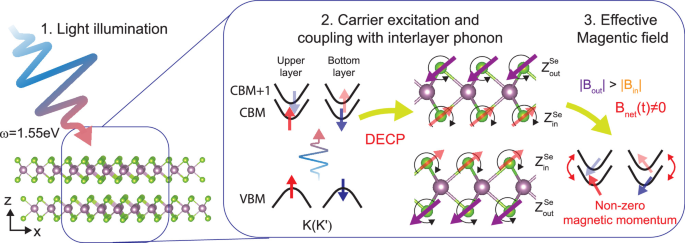
We consider an AA′-stacked bilayer MoSe₂, where Mo and Se atoms alternate between the upper and lower layers (Fig. 1). A monolayer MoSe₂ exhibits a large spin splitting (ΔVB = 267 meV) between the valence-band maximum (VBM) and VBM-1 and a small splitting (ΔCB = 49 meV) between conduction-band minimum (CBM) and CBM + 1 at the K and K′ (= –K) points18. Notably, the VBM and CBM have the same spin state and are utilized for light-driven valley polarization19. This monolayer electronic structure is maintained in a bilayer. For example, AA′-stacked bilayer MoSe₂ shows degenerate spin states. On the other hand, each spin state can be assigned to each layer, as shown in the middle panel of Fig. 1. This property is known as the spin-layer locking effect in the multilayer transition metal dichalcogenides (TMDs), which induces the spin polarization of each valley and layer20,24. With this electronic structure, light-driven dynamics were simulated using real-time time-dependent density functional theory (TDDFT) under a linearly polarized light at 1.55 eV. The pump light resonantly excites spin-degenerate states between the VBM and CBM states at the K and K′ (= –K) points of the Brillouin zone. This excited electronic structure launches coherent phonons (See Fig. 2a-c and Supplementary Information S1 for a detailed description of the phonon excitation mechanism). The out-of-plane ionic motion exhibits a 0.9 THz interlayer breathing mode (Fig. 2a). In-plane ionic displacements reveal both a low-frequency (0.56 THz) large-amplitude oscillation and a high-frequency (5.1 THz) small-amplitude mode, as shown in Fig. 2b. These oscillations are driven by the DECP mechanism, in which photoexcited carriers shift the potential-energy surface and drive cosine-like phonon oscillations. Note that a stronger laser pump induces larger phonon displacements.
Fig. 2: Light-induced magnetic dynamics in TDDFT and Ehrenfest dynamics model simulation.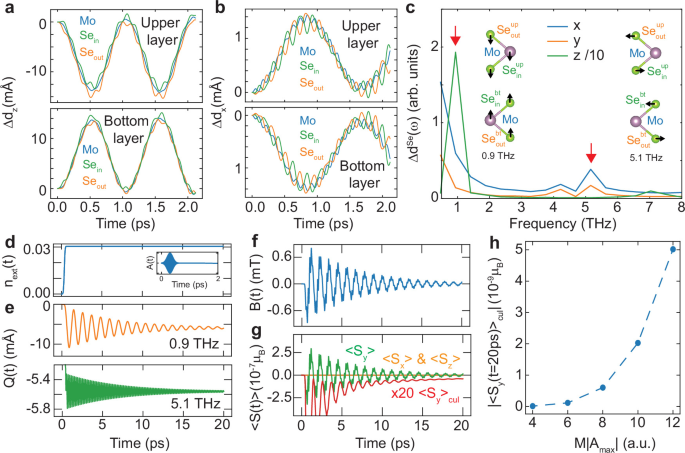
TDDFT simulations of atomic displacements (∆d(t) = rτ (t)-rτ (0)) along the (a) out-of-plane (z) and (b) in-plane (x) directions. c, Fourier spectra of Se displacements revealing the frequencies of light-induced phonon modes: 0.9 THz corresponds to the out-of-plane layer-breathing mode, and 5.1 THz to the in-plane Se stretching mode. d Light-induced excited carrier population (next); the inset shows the time profile of the E-field of the light pulse. e Temporal evolution of the 0.9 THz breathing mode and 5.1 THz in-plane stretching mode with dissipation rate (γ = 0.05 THz). Temporal profiles of (f) the effective B field induced by the beating of the phonons and (g) the temporal of spin expectation value (\(\left\langle {\hat{S}}_{j}(t)\right\rangle\)) and cumulative spin expectation values along the y direction (20\(\times {\left\langle {\hat{S}}_{y}(t)\right\rangle }_{{cul}}\)) induced by the oscillating effective magnetic field. h Dependence of \({\left\langle {\hat{S}}_{y}(t)\right\rangle }_{{cul}}\) at t = 20 ps on the light-matter coupling strength (\(M\left|{A}^{\max }\right|\)).
To explore light-induced magnetism in a bilayer MoSe₂ on the longer timescales, we performed Ehrenfest dynamics model simulations by simultaneously solving the time-dependent Schrödinger equation for electron carriers and Newton’s equations of ionic motion (see “Methods” for details). The spin-up and spin-down components at the VBM, CBM, and CBM + 1 (\(|0,s > \), \(|1,s > ,\,|2,s > \)) at the K and K′ (= –K) valley are considered for the basis set. The singlet state at the VBM (Fig. 1) is considered as the initial state for zero spin magnetization \(\left\langle \hat{S}\right\rangle=0\). Coherent 0.9 THz and 5.1 THz phonon modes are treated as classical harmonic oscillators25,26. Electron-phonon coupling strengths (\({g}_{0.9{THz}}\) and \({g}_{5.1{THz}}\)) for the interaction between the excited states (\(|1,s > \) and \(|2,s > \)) and two phonon modes are extracted by fitting the TDDFT results. A dissipation factor of phonons (γ = 0.05 THz) is achieved from an experimental report27. Under the illumination of a 1.55 eV light, the excited carriers (Fig. 2d) drive the 0.9 THz and 5.1 THz phonons via the DECP mechanism. Notably, the oscillation origin of the phonon modes is rigidly shifted by the electron-phonon coupling term with the excited carrier (\({V}_{{el}-{ph}}={\sum}_{i}{g}_{i}{Q}_{i}{n}_{{ext}}\))28 (Fig. 2e), where \({Q}_{i}\) is phonon displacement. The effective magnetic field generated by each Se atom is defined as \({{{\bf{B}}}}_{{Se}}\left(t\right)=\frac{{Z}_{{Se}}}{2}{{{\bf{Q}}}}_{{Se}}\left(t\right)\times {\dot{{{\bf{Q}}}}}_{{Se}}\left(t\right)\)29 (Fig. 2f), while we assign the atomic displacement in the z-direction to the 0.9 THz mode (\({Q}_{{Se}}^{z}\left(t\right)={Q}_{0.9{THz}}\left(t\right)\)) and in the x-direction to the 5.1 THz in-plane mode, (\({Q}_{{Se}}^{x}\left(t\right)={Q}_{5.1{THz}}\left(t\right)\)). The in-plane and out-of-plane phonon modes have substantially different frequencies (0.9 THz and 5.1 THz), so the resulting atomic motion cannot form a circular trajectory on longer timescales (T > 1 ps). Instead, the superposition of these modes produces a more complex, non-closed trajectory with pronounced beating behavior (See Supplementary Information S2 for details). Importantly, this beating motion, together with the difference in Born effective charges of inner and outer Se atoms (\(\triangle Z={Z}_{{in}}^{{Se}}-{Z}_{{out}}^{{Se}}=0.042e\)), generates a time-dependent effective magnetic field that oscillates in a complex manner with a non-vanishing average (Fig. 2f). This result unravels that even linearly polarized light can transiently induce an effective oscillating magnetic field in a bilayer MoSe₂ via interlayer coupling of phonon modes. It is noted that the polarization direction of the coherent in-plane phonon is determined by the polarization of the pump light, which is incident at an angle of 30° with respect to the surface normal and breaks the threefold symmetry of MoSe2. (See the Supplementary Information S3 for details).
Under the spin-layer locking effect, the effective magnetic field couples the spin states between \(|1,\uparrow > {{\rm{and}}}\) \(|2,\downarrow > \) for the upper layer and \(|1,\downarrow > {{\rm{and}}}\) \(|2,\uparrow > \) for the bottom layer. The oscillating magnetic field induces spin rotation in the electronic system, whose spin magnetization along the y-direction is not vanishing, as revealed by the temporal profile of spin magnetization \(\left(\left\langle {\hat{S}}_{j}(t)\right\rangle={\sum }_{i,s}\left\langle i,s \left({t}^{{\prime} }\right)|{\hat{S}}_{j}i,s\left(t^{\prime} \right)\right\rangle \right)\) (Fig. 2g). Hence, the cumulative spin magnetization along the y-direction \(\left({\left\langle {\hat{S}}_{y}(t)\right\rangle }_{{cul}}=\frac{1}{t}{\int }_{0}^{t}\left\langle {\hat{S}}_{y}(t^{\prime} )\right\rangle {dt}^{\prime}\right)\) shows non-zero values in a wide range. It increases with the field strength as shown in Fig. 2h, where \(\left({\left\langle {\hat{S}}_{y}(t=20{ps})\right\rangle }_{{cul}}\right)\) at 20 ps is plotted against the light-matter coupling strength. The light-matter coupling strength is defined as M|Amax | , which represents the combined effect of the maximum field amplitude (|Amax | ) and the transition matrix element (M), which governs electronic transitions. On the other hand, as discussed in Supplementary information S4, without the spin-layer locking effect, the interaction between \(|1,\uparrow > {{\rm{and}}}\) \(|1,\downarrow > \) for CBM and \(|2,\uparrow > {{\rm{and}}}\) \(|2,\downarrow > \) for CBM + 1 provides negligible light-driven spin magnetization. Furthermore, the dynamics without phonon dissipation do not produce meaningful cumulative and time-averaged magnetic momentum. These simulations indicate that light-driven two-phonon processes under spin-locking and phonon dissipation can generate an oscillating effective magnetic field and thereby transient non-zero magnetism in non-magnetic bilayer MoSe2.
Experimental demonstration of light-induced phonon-driven magnetism
Time-resolved Faraday rotation measurements at room temperature (T = 293 K) were set out. The results reveal light-induced magnetism in bilayer MoSe₂ (Fig. 3). For fair comparison, the pump fluence was maintained during the measurements. The induced magnetization strongly depends on the pump polarization (Fig. 3a). In particular, bilayer MoSe₂ exhibits distinct responses to right- and left-circularly polarized light so that even a linearly polarized light induces magnetization (Fig. 3c). This behavior is consistent with the theoretical expectation resulting from the interlayer coupling of two coherent phonon modes. Helicity-dependent Faraday rotation appears only within the first 500 fs time window. For comparison, the identical measurements on monolayer MoSe₂ (Fig. 3b) show no magnetization under linearly polarized excitation, even though circularly polarized light induces a strong magnetic signal with opposite sign depending on helicity. These contrasting results highlight the essential role of bilayer-specific vibrational modes, namely the layer-breathing and shear modes, and their interlayer coupling in enabling light-induced magnetization, which is absent in a monolayer. To probe the ionic dynamics underlying this phenomenon, we isolated the oscillatory components of the Faraday rotation signal via bi-exponential fitting (Fig. 3c) and Fourier-analyzed them (Fig. 3d). The spectra reveal two vibrational modes: the layer-breathing mode at 0.9 THz and the in-plane Se stretching mode at 5.1 THz. Note that the Faraday rotation signal persists for several picoseconds, which is also the time scale of the coherence of the coupled phonon beating. It is another compelling evidence that the effective magnetic field is generated by the coupled phonon beatings, which hence governs the time scale of the decay of Faraday rotation signal. All of these findings provide compelling evidence for a non-equilibrium magnetic state uniquely induced by phonons in a bilayer MoSe₂.
Fig. 3: Experimental measurement of light-induced phonon-driven magnetism in bilayer MoSe2.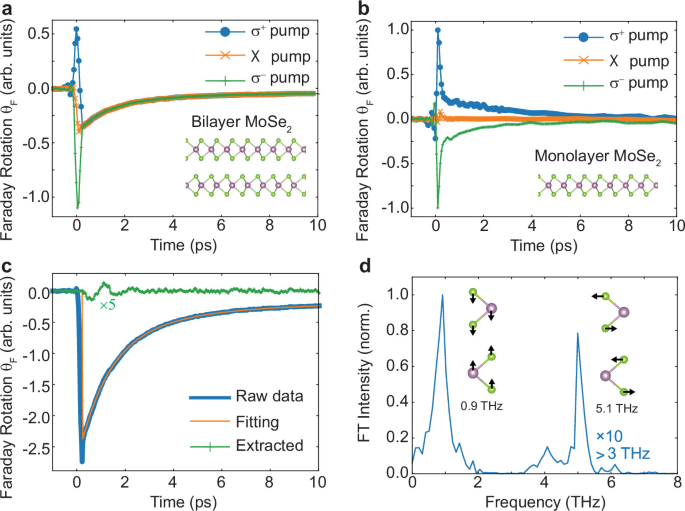
Time-resolved Faraday rotation (θF) measurement in (a) bilayer and (b) monolayer MoSe₂ under linearly (X) and circularly (σ±) polarized light, showing light-induced magnetism only in the bilayer. c Faraday rotation signal (blue) for bilayer MoSe₂ under linearly polarized light; the vibrational component (green) is extracted via bi-exponential fitting (orange). d The Fourier spectra of the vibrational components of Faraday rotation signals, where the spectrum is multiplied by a factor of 10 for frequencies greater than 3 THz.
Characterization of light-induced phonon-driven magnetism in bilayer MoSe₂
We performed time-resolved Faraday rotation measurements under linearly polarized light with various fluences and photon energies. Figure 4a shows the θF signals at different fluences. As the pump fluence increases, corresponding to a higher peak density of photo-injected excitons, the magnetization gets stronger at early delay times (<1 ps), and a nonzero signal persists for over 30 ps, demonstrating the strong dependence of induced magnetism on the pump fluence. The correlation between the pump fluence, the maximum θF and the transmission change (Fig. 4b) further indicates that the emergent magneto-optical response is intrinsically governed by exciton generation and its dynamics. To probe the connection between excitonic resonances and induced magnetism, we measured θF for various photon energies (Fig. 4c). The maximum θF (Fig. 4d) peaks at 1.55 eV, coinciding with the A-exciton resonance of bilayer MoSe₂, which closely follows the photoluminescence spectrum. This synchronous evolution highlights the strong coupling between excitonic processes and phonon-driven magnetization.
Fig. 4: Correlation between excitonic properties and induced magnetism.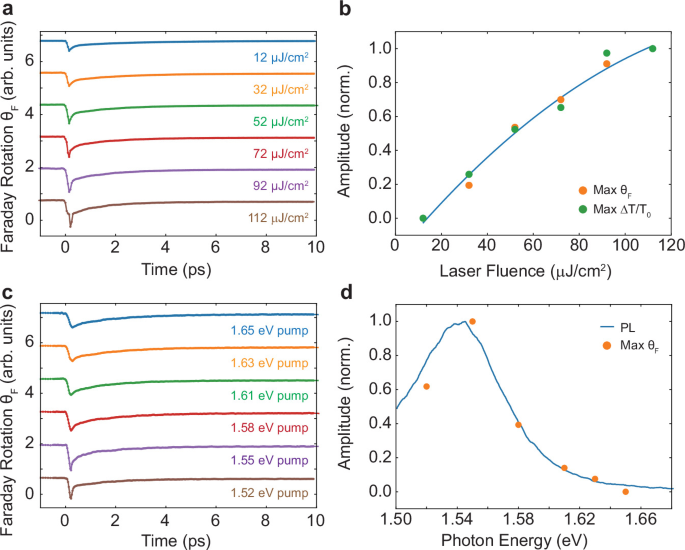
a Time-resolved Faraday rotation (θF) for different pump fluences. b Maximum θF and transmission change (ΔT/T0) as a function of pump fluence; blue lines indicate trends. c Time-resolved θF for various excitation photon energies and pump fluence. d Maximum θF as a function of photon energy, compared with the photoluminescence (PL) spectrum (blue curve).
Temperature-dependent measurements reveal an unexpected trend in the phonon-driven dynamics. Unlike monolayer MoSe₂, where low temperatures typically enhance valley lifetimes, the bilayer exhibits a reduction of the early-time magnetization and an accelerated decay at lower temperatures (Fig. 5a). This counterintuitive behavior points to the dominant role of phonons in sustaining magnetization. Indeed, the analysis of the oscillatory components (Fig. 5b and 5c) shows that the breathing and in-plane vibrational modes grow with temperature, correlating with the enhanced Faraday rotation and slower decay observed at room temperature. These findings demonstrate that the non-equilibrium magnetism in bilayer MoSe₂ arises from a delicate interplay between excitonic resonances and temperature-dependent dynamics.
Fig. 5: Temperature-dependent behavior of light-induced magnetism.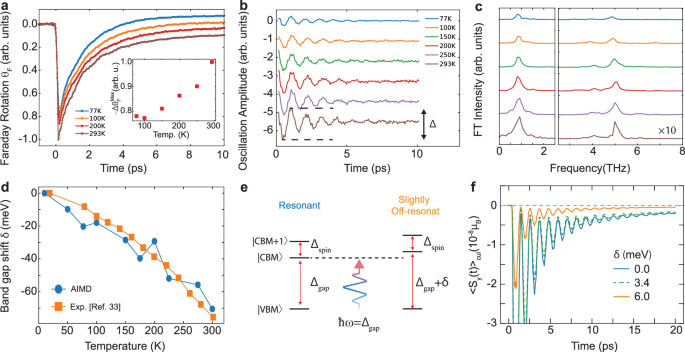
a Time-resolved Faraday rotation (θF) at different temperatures. Inset: maximum θF at early times. b Temperature dependence of the oscillatory components extracted from the signals through a bi-exponential fitting and subtraction. c Fourier spectra of the oscillatory components, revealing two distinct phonon modes, where the spectrum is amplified by a factor of ten for frequencies greater than 3 THz. d Band gap shift (δ) achieved from ab initio MD simulation and ref.30 at given temperatures. e Schematic image of an electronic structure modulated by thermal effects on resonant and off-resonant conditions. f Dependence of light-induced spin dynamics on the band gap shift modulated by interlayer spacing.
As temperature increases, thermal fluctuations arising from lattice vibrations can alter the electronic structure. For example, it has been reported that the direct optical band gap of TMD layered systems decreases at elevated temperatures30. Using ab initio molecular dynamics simulations, we evaluate the modified direct band gap of bilayer MoSe2 (Fig. 5d). Our results indicate that thermal vibrations of the ionic lattice reduce the direct band gap of bilayer MoSe2. Note that the reduction of the averaged band gap obtained in our simulations is on a similar scale to experimental observations30. This modification turns out to affect the light-induced magnetic momentum in bilayer MoSe2. The effective band gap shift affects the photo excitation and light-induced magnetism. As shown in Fig. 5e, two electronic configurations are considered to describe the effect of this band gap shift: one under resonant conditions and the other under off-resonant conditions with respect to the pump photon energy. Under resonant conditions (δ = 0), the pump light induces significant magnetic momentum due to sufficient carrier excitation (Fig. 5f). In contrast, slightly off-resonant condition (δ = 6 meV) leads to reduced magnetic momentum. This behavior indicates that resonance is crucial for light-induced magnetism in bilayer MoSe2. These results are consistent with experimental observations of photon energy and temperature dependencies (Figs. 4d and 5a). In our experimental observations, the electronic structure at 293 K (Fig. 5a) may correspond to a resonant condition under a fixed pump photon energy, whereas lower temperatures modify the band gap, leading to off-resonant conditions with reduced induced magnetism. Furthermore, the maximum Faraday rotation signal is achieved with a 1.554 eV laser pump, while off-resonant conditions result in a reduced amplitude (Fig. 4c and 4d). The results not only underscore the unique nature of bilayer systems, where interlayer vibrations provide a pathway for light-induced magnetization, but also open new possibilities for engineering magneto-optical responses through the tuning of exciton-phonon coupling.
With respect to the possible role of pump-induced local heating in the observed magnetic response, particularly in relation to temperature-dependent band gap shift, if the enhancement of the magnetic response were dominated by pump-induced local heating (e.g., via lattice heating and subsequent band gap shift), the signal would be expected to develop on a slower timescale (typically several picoseconds), corresponding to electron-phonon equilibration and a rise in lattice temperature. However, we experimentally observe that the Faraday rotation signal rises rapidly within ~100 fs of the pump pulse arrival, followed by an exponential decay on the picosecond timescale. The ultrafast onset of the signal, therefore, indicates that the enhancement originates from a non-thermal, light-driven process rather than from thermal effects. In contrast, the subsequent picosecond decay is consistent with relaxation processes, including possible contributions from lattice heating and associated band structure changes.