
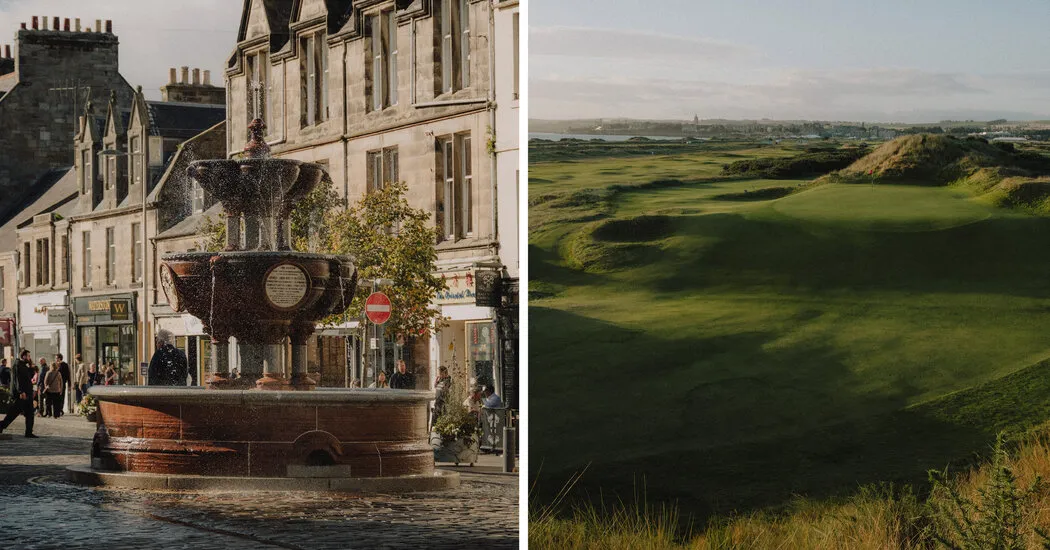
Don’t get me wrong — Alexandrina Victoria, Queen of the United Kingdom of Great Britain and Ireland from 1837 to 1901, was quite the monarch, wielding the scepter influentially while the British Empire expanded hungrily around the globe. For 63 years she rocked the crown hard, all while managing to elude eight — eight! — assassination attempts.
What she didn’t do is play golf.
Which has me wondering, as I stand on the first tee of the Jubilee Course in St. Andrews, Scotland, if it’s fair that this beautiful, intricate links was named in honor of the famously prim and proper queen’s Diamond Jubilee, her 60th year on the throne, when it opened in 1897.
These thoughts are dancing in my mind as I take my first swing of the day, bunting a drive down the first fairway of the Jubilee links, and that, really, is the point: You can’t play the older courses of St. Andrews and not feel history swirling almost palpably around you.
It is most true, naturally, on the renowned Old Course, which dates to the 1400s and is the oldest course in the world. Walking its centuries-old fairways, the memory of thrilling exploits by the game’s greatest players, from the father and son tandem of Old and Young Tom Morris to modern giants like Jack Nicklaus and Seve Ballesteros, practically oozes up into your shoes.
But the spell of history is cast everywhere you go in this small seaside village, whether you’re on the golf courses or the cobblestone streets, where plaques and monuments and ruins abound, pulling you into the astonishing story of St. Andrews at every turn. And alternating rounds of golf with explorations of the town’s past — at times a shockingly bloody past — is in some ways the ultimate Scottish sojourn.
Largely because of the Old Course, golf and St. Andrews are practically synonymous.
Yet the New Course, which opened in 1895, and the Jubilee Course, debuting two years later, are fascinating links with intriguing stories of their own. And on this trip I’m determined to give all three of these historic courses their due and at the same time dig a little deeper into some enduring mysteries of St. Andrews itself.
My 22-year-old son Dash and I arrive on a Sunday morning, when the Old Course is closed to golfers but open to all others, and the links are swarming with townspeople and their dogs out for a romp. We make our way across Grannie Clark’s Wynd (the path that cuts across the first and 18th fairways), then up past the West Sands beach where the opening of “Chariots of Fire” was filmed, to the New and Jubilee clubhouse. We hadn’t made tee times in advance, but the two courses set aside a fair number of places for walk-ups, and Dash gets an afternoon spot on the New Course.
Designed by Old Tom Morris, golf’s first great player and course architect, the New Course was the second one laid out on the peninsula. It is in some ways similar to the Old Course, sharing a few characteristics like several double fairways (each extra-wide and shared by two holes) and one double green (ditto), though it is shorter and has fewer dramatic contours. Dash steps to the tee and, after one quick practice swing, blasts a drive down the right side of the hillock- and gorse-lined fairway, then heads off after the ball, pushing his clubs on a rental trolley (the greens fee was 155 British pounds, or about $205).
Following his round and a post-round pint in the clubhouse, we walk back to our Vrbo flat, but pause at the stone obelisk located behind the Old Course’s 18th green, and it’s here that the town’s turbulent history first makes itself known. “Martyrs’ Monument,” I read on a small plaque for “those put to death for asserting their religious beliefs.”
“Hmm,” I say idly. “Must have been hanged.”
“Nope,” says Dash, reading words carved higher on the tower. “Death by fire!” And that’s indeed what it says, naming four Protestants who were burned at the stake in 1528 — just the first taste of the violent local history we would encounter over the next four days.
On the Jubilee Course
Day two finds us out on the Jubilee Course and me in my first-tee reverie. With us on this round are two visiting Americans and the two caddies Dash and I had hired, one of whom, Paul Appleton, is an experienced English bag man. He is full of wit and charm as well as excellent advice, precisely selecting clubs for Dash and giving him great reads on the greens. (Greens fees were £155 plus £120 for each of the caddies, including tips.)
Paul says that good players regard the Jubilee as “better than the Old Course,” and indeed the “Jube,” as we come to call it, is a revelation.
Originally a 12-hole “pitch-and-putt” course for women and children, it has been modified many times over the decades and is now a glorious links and a stern test of championship golf. Each hole is a beauty, especially with the gorse in bright yellow bloom, and the finishing stretch in particular is stunning as it winds through the dunes. Playing from the forward tees with my injury-afflicted swing, I manage a respectable round and finish a few shots ahead of Dash. “Hah,” I proclaim as we leave the 18th green, “pretty good for an old hack!”
Following the caddie Paul’s advice, that night we end up at Tailend on Market Street, for the best fish and chips we’ll find in town. On another evening we have an excellent curry at Jahangir (again, thank you, Paul!), although we decline to partake of the haggis pakora. Most every night we wash up at the Central, a lively Market Street pub frequented more by locals and college students than tourists, it seems, and an ideal spot for a dram before bed.
Exploring Off the Greens
As great as the golf, food and drink were, however, my thoughts continually crept back to the town’s history.
With fewer than 20,000 residents, St. Andrews is a remarkably small town, given the oversize role it plays in Scotland’s history. It was named for St. Andrew the Apostle, who with his brother was one of the Galilean fishermen whom Jesus enticed to, “Follow me, and I will make you fishers of men.”
Various versions of the story exist, but the gist is that sometime in the fourth century a religious character known as St. Rule (or St. Regulus) was shipwrecked off the coast of Scotland while bearing a tooth, kneecap, humerus and three fingers from St. Andrew’s remains, having been commanded by an angel to take them, “to the utmost part of the world.” Thus did the town come by its saintly name.
Visiting the cathedral grounds where these gruesome relics were originally enshrined is a haunting experience. At one time the largest, most important cathedral in Scotland, its Gothic remains still tower over the town. Its construction began in about 1160 and took centuries to finish, suffering major destruction from storms, wars and a fire. Finally completed in 1440, it was only in use for a century before it was ransacked by a Protestant mob and fell into disrepair.
Wandering through these stone remains, I come across the graves of Old and Young Tom Morris, the father and son pair who put golf on the map in the 19th century. Contemplating their headstones, it occurs to me that 1440 was also roughly the time that golf was reportedly first played on the links at the other end of town.
Afterward, I stroll to the neighboring St. Andrews Castle, another intriguing, spooky place. Begun in the 1100s and serving for centuries as the main residence of Scotland’s top clergymen, its remains sit on a dramatic headland on St. Andrews Bay. Two aspects of it are particularly compelling.
The first is the “mine and countermine.” In short, in 1546 Cardinal David Beaton burned a Protestant preacher at the stake in front of the castle, only to be assassinated by an angry gang that then hung his body from a window. The assailants occupied the castle and settled in for a long siege, until they heard the cardinal’s avengers digging a mine into the rock to get at them. So the occupiers started a countermine, and for a year these two fervid parties chipped away at the stone until they at last broke through into each other’s wrathful arms.
Another memorable feature of the castle is the “bottle dungeon,” a 24-foot-deep hole cut into the rock that widens out into its eponymous shape. This wretched pit was where the rebels threw Beaton’s corpse, covering it in salt to “keap him frome styncking.”
A Chance on the Old Course
The highlight of our trip comes on the third day, when Dash wins a tee time on the Old Course through the daily lottery (unless you have a spot reserved well in advance through a golf travel operator, the lottery is the only way I know of to get on the much-in-demand course). We had entered every day, both as a pair and Dash as a single. He had been wait-listed at number 17, but caddies had recommended that he show up at 7 a.m. ready to play. Sure enough, at 8:15 or so the starter calls Dash’s name and tells him he is next on the tee (greens fees were £355, plus £120 for the caddie). He rushes out to join three others waiting, says hello to his caddie, and promptly hooks his tee shot nearly out of bounds across the 18th fairway.
And that, wonderfully, is almost the last bad shot he hits. Paired with another seasoned Scottish caddie, a wry and wise character named Neil, Dash plays the round of his life, into the teeth of a brutal North Sea wind. Following Neil’s advice, Dash navigates the gorse-lined hillocky fairways, the diabolically situated bunkers, and the wildly undulating greens to the tune of 40 on the outward nine holes and 41 coming home. Most memorably, with a strong following wind he bombs his tee shot on 17 over the famous railway shed, leaving only a pitching wedge to the green, ending up six feet from the cup for birdie.
“How is it possible,” Dash asks as we exit the 18th green with a brisk rain beginning to fall, “that the first golf course ever built is still the best?”
“Great question,” I say. “I think we’ll have to come back to figure it out.”