
Two-photon stimulated Raman transitions in the XUV
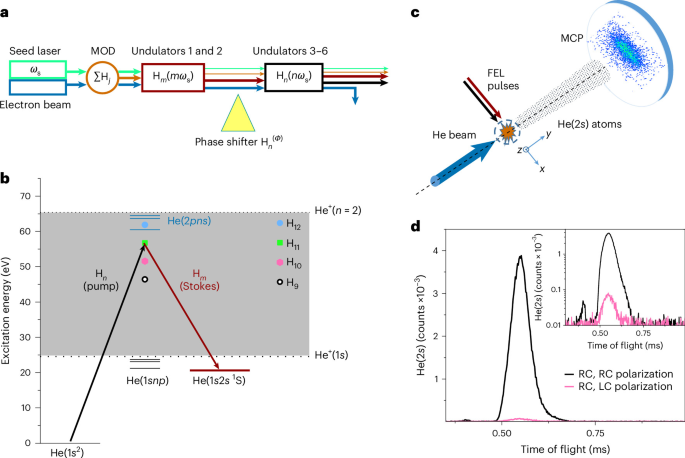
The generation of two-colour FEL XUV radiation is shown schematically in Fig. 1a. The photon energies of the two XUV pulses (harmonics Hn and Hm) are multiples of the seed laser photon energy, En = nℏωs and Em = mℏωs, where ℏ is the reduced Planck’s constant and ωs is the angular frequency, and provide the pump and Stokes photon, respectively. Independent of the characteristics of the intermediate state, a two-photon Raman resonance condition is fulfilled if the photon energy difference between the pair of harmonics is equal to the excitation energy of the final state, En – Em = Eb, or, in terms of the seed laser photon energy, (n − m)ℏωs = Eb. To realize this scheme, we chose He as the ideal target atom for our purpose. The long-lived metastable He(1s2s 1S) in the singlet state, which we label as He(2s) from here on, has an excitation energy of Eb = 20.615 eV (ref. 38) and can be favourably used as the final state. Choosing n − m = 4 for the difference of the order of the harmonics, the seed laser photon energy (Es) needs to be Es = ℏωs = 5.154 eV, which is within the technically available range39.
Fig. 1: Scheme and experimental set-up for demonstrating the two-photon XUV stimulated Raman excitation of He.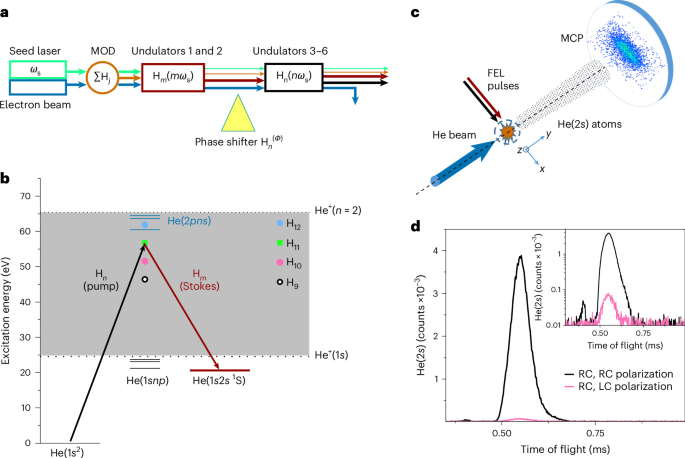
a, Schematic diagram of harmonic generation in the XUV. A seed laser beam with angular frequency ωs is sent through a modulator (MOD) together with a high-energy electron beam. It induces a coherent energy modulation, which is then converted into a density modulation (bunching) at frequency ωs and its integer harmonics Hj. Downstream undulators are set to support the coherent emission of the bunched beam to the desired harmonic. Dividing the undulators into two sets, tuned at harmonics Hn and Hm, enables the generation of ‘pump’ and ‘Stokes’ pulses, respectively. The phase shifter Hn (Φ) shifts the phase Φ of harmonic Hn. b, Level diagram of He (singlet states) and scheme of stimulated Raman excitation of the metastable He(1s2s 1S) state via pairs of harmonics. He(1snp) denotes the first states of the bound Rydberg series. The grey area depicts the continuum, which includes the autoionizing resonances He(2pns). c, Experimental set-up. We use a supersonic beam of He atoms, which is intersected by the two focused XUV pulses (Methods). Excited long-lived metastable He(1s2s 1S) atoms, abbreviated as He(2s), travel within the atomic He beam towards the position-sensitive MCP detector, where they are detected after a travel time of about 500 μs. The electric field plates across the interaction region, which deflect ions and electrons perpendicular to the atomic beam in the z direction, are indicated by the dashed circle. d, Time-of-flight spectrum of He(2s) atoms excited, on Raman resonance, by the pair of circularly polarized harmonics (H7, H11) with intensities of 118 and 984 TW cm−2, respectively. The black line denotes the He(2s) yield for the harmonics with the same helicity, that is, dipole-allowed excitation. The pink line shows the He(2s) yield for opposite helicities, that is, dipole-forbidden excitation. Inset: main diagram, but with the yield plotted on a logarithmic scale. RC, right circular; LC, left circular.
In the experiments we used pairs of harmonics (Hm=5,6,7,8, Hn=m+4). These correspond to Stokes photon energies between 25 and 40 eV and pump photon energies between 45 and 60 eV. As visualized in Fig. 1b, they drive the two-photon Raman transition between the ground state He(1s2) and the final excited metastable He(2s) state via the continuum. We note that, strictly speaking, the continuum is a superposition of bound and continuum states (Supplementary Information, Section 4). As all harmonics are above the single ionization limit of He, \({I}_{{\mathrm{He}}^{+}(1s)}=24.587\,\mathrm{eV}\), both the pump and the Stokes pulses can ionize He and produce a substantial background of photoelectrons and photoions.
Owing to the small two-photon cross-section compared with the single-photon ionization cross-section, a crucial experimental issue is the sufficiently background-free detection of the final state. This can be achieved with our experimental set-up, displayed in Fig. 1c, which follows the arrangement used in other recent experiments with metastable atoms19,40,41. The two-photon Raman excited metastable He atoms travel together with He atoms in the ground state, eventually hitting a (position-sensitive) multi-channel plate (MCP) detector. In contrast to ground-state He atoms with no internal energy, the detection of metastable He(2s) is enabled due to its high internal energy. All photoelectrons and ions that are produced in the interaction are deflected perpendicular to the atomic beam by a small static electric field across the interaction volume, and do not reach the detector.
In the first investigation we tuned the two undulator sets to amplify the seventh (first set) and eleventh harmonics (second set), thus generating XUV pulses with energies of 12 and 40 μJ and pulse widths of 61 and 52 fs (full-width at half-maximum (FWHM)), respectively (Methods and Supplementary Information, Sections 1 and 2). The Stokes pulses preceded the pump pulses by 15 fs. The photon energy of the seed laser was tuned such that the difference in the photon energy of the pair of harmonics matches the excitation energy of the metastable state, that is, they were tuned on Raman resonance. The FERMI FEL enables full polarization control of the two pulses separately42. We chose to make both harmonics circularly polarized. In this case, the dipole selection rules require that, to drive the two-photon transition, the harmonic pulses be of same handedness (either both right-circularly polarized or both left-circularly polarized).
With both beams right-circularly polarized we measured a time-of-flight spectrum, which shows a strong yield of metastable atoms relative to the background signal (Fig. 1d). To prove the fact that the signal indeed depends on the polarization as expected, we changed the circular polarization of one of the XUV laser pulses to be left-circularly polarized. In this case the Raman process is forbidden according to the dipole selection rules. As displayed in Fig. 1d, the measured He(2s) yield drops down to a few percent of the yield obtained when using the correct configuration of polarization. The residual yield can be largely attributed to the imperfect circular polarization. The data clearly show the stimulated Raman process at work.
We measured the He(2s) yield for four pairs of circularly polarized harmonics across the Raman resonance by fine-tuning the seed laser photon energy Es. The results are shown in Fig. 2a. Inspecting the experimental data, we find that in all spectra the lineshapes of the Raman resonance are basically very close to a Gaussian lineshape centred at the predicted transition excitation energy of the metastable state. Furthermore, we observe experimentally that the resonance position does not shift noticeably within the available XUV pulse intensities, and the lineshape remains unaltered. This is somewhat expected, as the Raman cross-sections for continuum transitions are rather low; concomitantly, the Stark shift is minimal, as also confirmed quantitatively in our subsequent calculations.
Fig. 2: XUV stimulated Raman excitation spectra and theoretical analysis.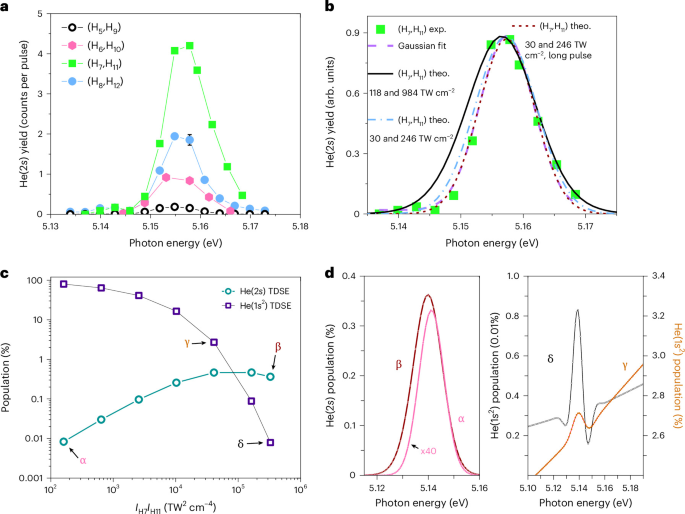
a, Measurement of the Raman resonance for four harmonic pairs (m, n) at the maximum respective pulse energies generated: (5, 9) at 1.3 and 10 μJ (open black circles), (6, 10) at 20 μJ total energy (pink hexagons), (7, 11) at 12 and 40 μJ (blue circles) and (8, 12) at 11 and 30 μJ (green squares). The He(2s) yield is plotted as a function of the photon energy of the seed laser Es. The black error bar denotes the standard deviation of the mean of three measurements, and represents the reproducibility. The statistical counting error of each data point is within the size of the data point. b, Comparison of the experimentally obtained (exp.) (H7, H11) Raman resonance with the theoretical (theo.) results. Calculations were performed with XUV pulse durations of 61 and 52 fs, respectively, at intensities of 118 and 984 TW cm−2 (black line) and 30 and 246 TW cm−2 (blue dot-dashed line). Results of the calculation with longer pulse durations (67 and 57 fs) and respective intensities of 30 and 246 TW cm−2 are shown by the dashed dark-red line. For the experimentally measured data, the measured He(2s) yield (green squares) is fitted with a Gaussian curve (violet dashed line). As the calculated resonance position deviates from the experimental one, we have shifted the theoretical data in energy accordingly (Methods). c, Calculated He(2s) population (open green circles) and He(1s2) ground-state population (open violet squares) as a function of the intensity product of H7 and H11, at a fixed intensity ratio. α, β, γ and δ indicate the data points for which spectral distributions of the populations are plotted in d. d, Left: He(2s) population (curves α and β) as a function of the theoretical seed laser photon energy. Right: He(1s2) population (curves γ and δ) as a function of the theoretical seed laser photon energy.
We solve the time-dependent Schrödinger equation (TDSE) using a single-active-electron approach43 (Methods; Supplementary Information, Section 3). In Fig. 2b we present the calculated Raman resonances for the harmonic pair (H7, H11) as a function of the seed laser photon energy using different XUV pulse intensities. As we did not measure absolute yields, the maximum of the theoretical yield was fitted by eye to the experimental result. In the calculation we used the XUV pulse intensities 118 and 984 TW cm−2 for the harmonics H7 and H11, respectively, which were determined from experimental parameters and the pulse duration (Methods). We performed three additional calculations, halving the intensities in each case. Only at the highest intensities (black curve in Fig. 2b) do we observe a slight Stark shift. For lower intensities, we obtain no resonance shift and Gaussian-like resonance profiles, with a fixed width for all intensities below 30 and 246 TW cm−2. The best agreement with the experimental lineshape is found at these intensities when we used slightly longer pulses, that is, increasing each XUV pulse duration by 10%. We note that the pulses in the calculation are Fourier-limited pulses, although this is not fully true for the XUV pulses generated at the FERMI facility.
To elucidate the intensity dependence of the He(2s) yield and of the lineshape of the resonance further, we carried out calculations for the H7, H11 pair of harmonics over a broad range of pulse intensities. In Fig. 2c we display the final-state populations of the ground-state He(1s2) and the final He(2s) state as a function of the intensity product IH7 × IH11. The laser frequencies were tuned to the Raman resonance. We recognize the nearly linear behaviour of the He(2s) yield for values of the intensity product of ≤104 TW2 cm−4. At the upper limit of linearity, He is substantially ionized, leaving a residual population of about 20% in the ground state. At higher intensities the He(2s) yield saturates and notably remains nearly constant at a population level of slightly below 1%. At the same time the ground-state population is completely depleted. Notably, the excited He(2s) population is shielded during the whole Raman process from being ionized, and can also be observed in the fully saturated regime. This is due to the fact that, at high intensities, it is produced at the beginning of the pulses, when there is still a high population of ground-state atoms and its ionization is much less than for ground-state atoms.
Furthermore, the calculations reveal that the Stark shift of the He(2s) resonance remains negligible up to an intensity product of about 105 TW2 cm−4. Only at even higher intensities does the resonance position shift slightly, although the resonance lineshape remains unaltered—see the left panel of Fig. 2d. The residual populations of He(1s2) are displayed in the right panel of Fig. 2d. They reveal the characteristic Fano-like lineshape in the ground-state population12 (curve γ), and show a slight change only at the highest intensity by exhibiting an additional minimum (curve δ).
Interfering stimulated Raman pathways
We recall that the phases of fields and dipole moments cancel in a simple coherent two-colour Raman transition and are not observable. The matrix element M for this transition, which is given in second-order perturbation theory explicitly in Supplementary Information, Section 4, can be written in the abbreviated form M = ∣M∣e−iϕ, where ϕ comprises all phases of the fields and the matrix element, e is Euler’s number and i is the imaginary unit. The excitation cross-section, which is proportional to the square of the matrix element, σRaman ∝ ∣M∣2, is independent of the phases, as expected.
If two coherent Raman pathways simultaneously excite the final state, even though the pathways proceed via two different continuum states, they are, in principle, indistinguishable and phases become observable. To show this, we emphasize in the abbreviated form of the second transition matrix element, M′, the phase Φ of one of the Stokes or pump fields explicitly, and comprise all other phases in ϕ′, so that M′ = |M′|e−iϕ′e−iΦ. The cross-section then reads
$$\begin{array}{l}{\sigma }_{\mathrm{Raman}}^{\mathrm{two}\textit{-}\mathrm{way}}\propto | | M| {{\rm{e}}}^{-{\rm{i}}\phi }+| {M}{{\prime} }| {{\rm{e}}}^{-{\rm{i}}{\phi }{{\prime} }}{{\rm{e}}}^{-{\rm{i}}{\it\Phi} }{| }^{2}=| M{| }^{2}\\\qquad\qquad+| {M}{{\prime} }{| }^{2}+| M| | {M}{{\prime} }| \cos({\it\varPhi} -(\phi -{\phi }{{\prime} })).\end{array}$$
The cross-section \({\sigma }_{\mathrm{Raman}}^{\mathrm{two}\textit{-}\mathrm{way}}\) exhibits a cosine modulation as a function of the phase Φ of the field, shifted by the constant difference between the other phases of the two pathways.
With our experimental set-up, we were able to generate interfering Raman pathways and, as shown in Fig. 1a, we also had the capability to vary the phase of the harmonic that is amplified in the second undulator set. Owing to the nature of our excitation scheme, all pairs of harmonics with (m = n − 4, n) of a properly tuned seed laser drive a Raman resonance. If the intense Stokes laser photon of the main Raman pathway (harmonic Hm) is taken to serve as the pump photon of the second pathway (Fig. 3a), an additional weak harmonic Hl of harmonic order l = m − 4 provides the Stokes laser photon for the second pathway. Although the unamplified harmonic is rather weak, the total efficiency of the second pathway is boosted by the much larger cross-section for the second pair, including the weak lower harmonics (Hl, Hm), than for the pair of intense harmonics (Hm, Hn). The increasing Raman excitation cross-section involving lower harmonics photon energies is displayed in the Extended Data Fig. 1.
Fig. 3: Interfering Raman pathways.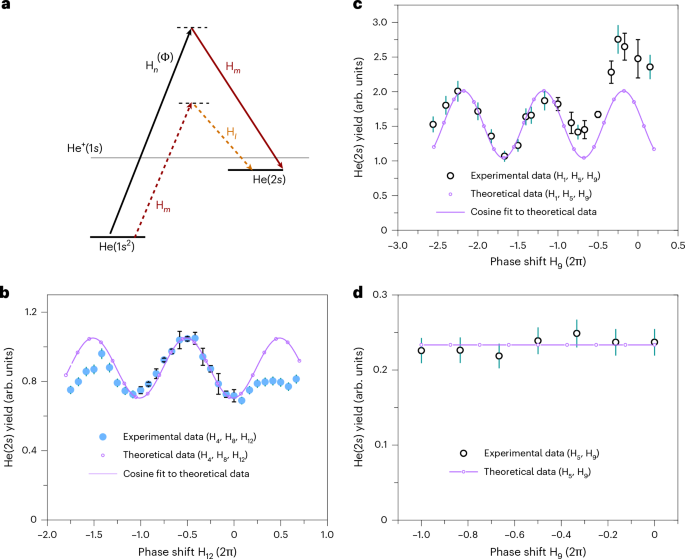
a, Scheme for generating two interfering pathways. Hm and Hn (n − m = 4) are the amplified harmonics (black and dark-red lines). Hl (l = m − 4) is the unamplified harmonic or seed laser (orange dashed line). b, Interference of the pathways (H8, H12) and (H4, H8), where the measured He(2s) yield as a function of the phase shift of harmonic H12 is shown as the blue circles. The data points with black error bars, which indicate the standard deviation of the mean, are the mean values of repeated individual measurements (either two or three). All other data points stem from single measurements. The average values of the relative mean errors were taken to assign an estimated error to these data points (green error bars without caps). The results of a TDSE calculation using field strengths (0.1, 100 and 770 TW cm−2) for the three harmonics (H4, H8 and H12), respectively, are shown as open violet circles. The cosine fit to the theoretical data is shown via the violet line. c, Interference of the pathways (H5, H9) and (H1, H5). The measured He(2s) yield as a function of the phase shift of harmonic H9 is shown as open black circles. The error bars are as defined in b. The results of a TDSE calculation using field strengths (0.72, 4.68 and 35.9 TW cm−2) for the three harmonics (H1, H5 and H9), respectively, as shown as open violet circles. The cosine fit to the theoretical data is shown as the violet line. d, Single pathway (H5, H9). The measured He(2s) yield as a function of the phase shift of harmonic H9 is shown as open black circles. The data points stem from single individual measurements. The average values of the relative mean errors in c were taken to assign an estimated error to these data points (green error bars without caps). The results of a TDSE calculation using field strengths (4.68 and 35.9 TW cm−2) for the two harmonics (H5 and H9), respectively, are shown as the open violet circles. The solid violet line acts as a guide to the eye.
First, we experimentally demonstrated the interference of the (H8, H12) and (H4, H8) Raman pathways. In addition to the amplified harmonics (H8, H12) providing the first Raman pathway we used the unamplified harmonic H4, which is typically present in the XUV spectrum at a 0.1% level of the total pulse energy, to form the second pathway (H4, H8). To observe the two-path Raman interference we used the phase shifter between the two undulator sets to vary the phase of H12 with respect to H4 and H8 (Fig. 1a). By scanning the phase, we found that the He(2s) yield varies periodically, as displayed in Fig. 3b, demonstrating the high degree of coherence deep in the XUV regime. We also show a theoretical TDSE calculation which confirms the experimental observation. The pulse parameters for the harmonics H8 and H12 were taken from the experiment. The pulse energy of the spurious H4 was taken to be 1/40 of 0.1% of the total pulse energy to match the visibility of the fringes. Calculating the He(2s) yields for the two pathways with these pulse parameters separately, we find the yield for the (H4, H8) transition to be 1.8% of the (H8, H12) yield. Phase fluctuations, which possibly reduce the fringe visibility, are not considered. We note that we do not observe interference for the pair (H7, H11), indicating that in this configuration the amount of unamplified signal at the third harmonic is substantially suppressed and no second pathway (H3, H7) is established. To clearly demonstrate experimentally that interference indeed vanishes when one of the two pathways is blocked, we used another two pairs of harmonics, for which it was technically feasible to block one of the laser frequencies involved.
In this alternate approach, we take advantage of the fact that the seed laser radiation, H1, is also present in the interaction region. Although the pulse energy is very low (on the order of 100 nJ) it can be used very efficiently together with harmonic H5 to provide the second Raman pathway. As the photon energy of harmonic H5 reaches only barely into the continuum above the first ionization threshold, the nonlinear Raman transition using the fundamental frequency as the Stokes photon shows by far the highest cross-section, as depicted in Extended Data Fig. 1. Moreover, it is technically easily feasible to block the fundamental radiation H1 from reaching the interaction region by simply inserting an aluminium filter into the path of the FEL beam.
Together with the amplified harmonics (H5, H9) we now realized the two interfering pathways. Again, using the phase shifter between the two undulator sets, we varied the phase of harmonic H9 with respect to harmonic H5 and to the fundamental H1. As the seed laser was sufficiently phase-stable, this, in turn, led to a controlled phase shift between the two interfering Raman pathways. This resulted in a similar periodic modulation as in the case investigated before (Fig. 3c), but with a higher fringe visibility of about 50%. When we inserted the aluminium filter, which also slightly reduced the intensities of harmonics H5 and H9, we no longer observed the modulation in the yield (Fig. 3d).
To analyse the data quantitatively, we calculated the interference with the experimental field strengths of the three pulses (H1, H5 and H9). The result, which shows very good agreement with the experiment, is plotted in Fig. 3c. We note that we had to shift the theoretical results by a few degrees to match the experimental data due to the unknown absolute phase of the interference signal. The calculations revealed that, in this combination, the (H1, H5) contribution dominates, which is in accord with the fact that the cross-section for this combination is much larger than for the combination (H5, H9).
In conclusion, the successful demonstration of a coherent stimulated Raman excitation using two controllable XUV pulses and control of interfering Raman pathways opens a new and exciting avenue for applying phase-sensitive methods for coherent control measurements in the ionization continuum for atomic and molecular processes. Moreover, the outlook of steady FEL development aimed at two independently tunable coherent laser pulses will finally enable investigations into strong-field phase modulations in stimulated Raman excitation. This is particularly the case in the vicinity of autoionizing resonances, where dramatic Stark shifts along with strong lineshape alterations are theoretically expected (Supplementary Information, Section 5 and Supplementary Fig. 3), which could be perfectly studied using our experimental approach.