
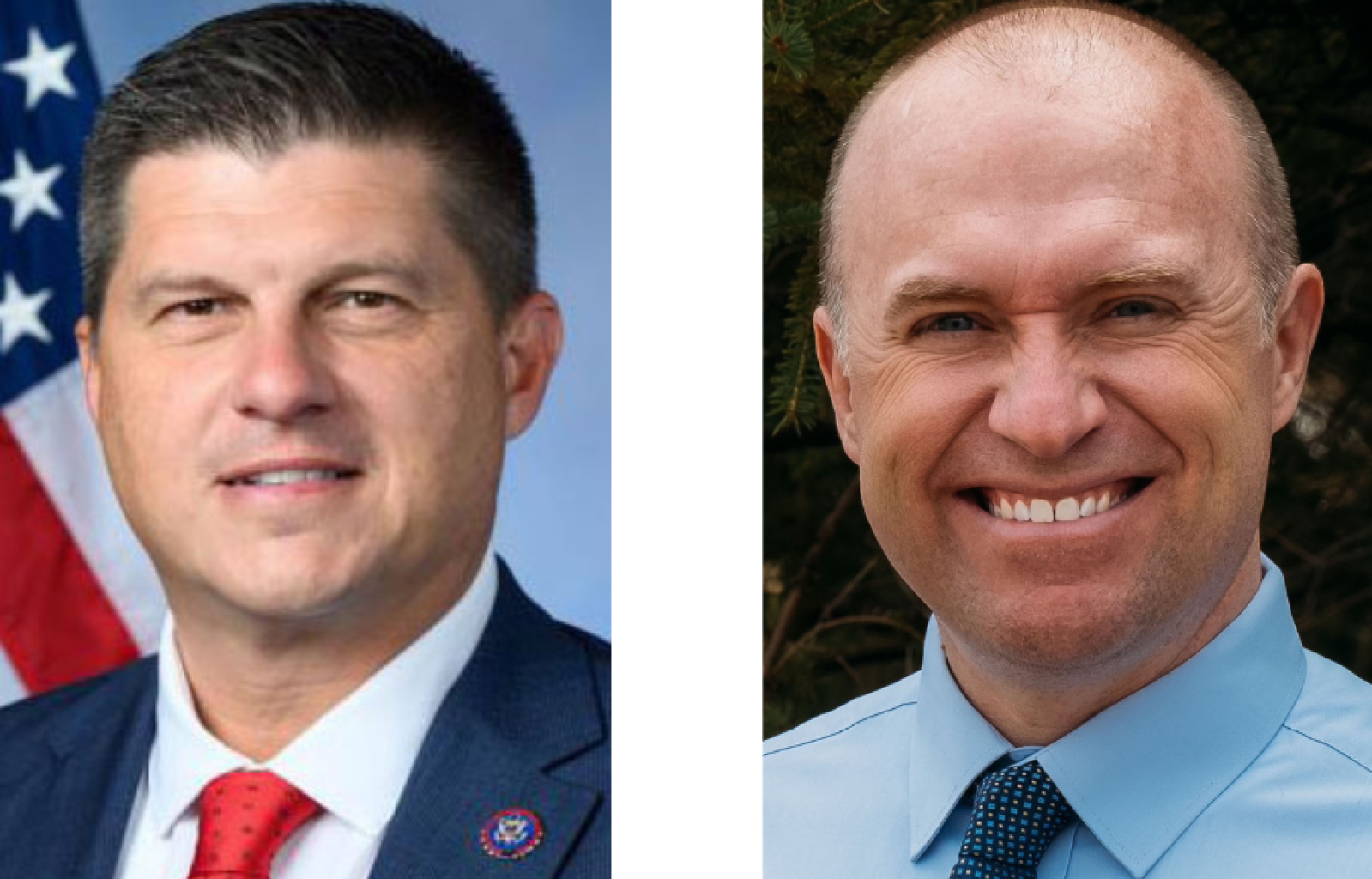
MANKATO — Republican Rep. Brad Finstad and Democratic challenger Jake Johnson faced off in a debate in Mankato less than a month before the November midterms, touting different ideas and visions for invigorating the American dream.
The candidates are vying for Minnesota’s 1st Congressional District seat in the Nov. 3 election.
The hourlong, issues-focused debate was televised Thursday on KTTC-TV, which co-hosted the event with KEYC News Now.
Johnson, a Mayo High School teacher, cited rising costs due to the Iran War and tariffs as well as cuts to Medicaid and SNAP, the food-assistance program for low-income households, for his decision to run for Congress. The American dream was falling further out of reach due to cuts to programs that benefited his family when he was growing up, he said.
“I was watching things get more and more expensive,” Johnson said. “I was watching things for my family and for my students get further and further out of reach. And to see a government in D.C. be so actively and openly hostile to the dream that I got to live.”
Finstad, a New Ulm farmer, small business owner and two-term incumbent, touted a secure border and tax reductions for the average family and farmers under the Big Beautiful Bill Act as accomplishments of the current Republican Congress, including eliminating taxes on tips or overtime. Finstad highlighted his work in shaping the Farm Bill, including 17 bills that he introduced as part of the package. The bill has passed in bipartisan fashion out of the House, but remains stuck in the Senate.
“Two years ago, the people of Southern Minnesota sent me to Washington to defend and advance our way of life, to work on securing the border and to let them keep more of their hard-earned money,” Finstad said. “The tax bill that we passed, putting real dollars in real people’s pockets, makes a difference. I am a believer that the government doesn’t know best what to do with your money.”
The candidates, who are locked in a dead heat according to polls, were asked about affordability concerns that polls show as among the public’s top concerns.
Finstad said “affordability is a real important issue” and “we didn’t get here by accident.” He blamed Democratic policies at the national level for making things unaffordable, listing Green New Deal policies for shutting down refineries and pipelines.
“We are living in a hangover of bad Democratic policies,” Finstad said. “We have went down the road of a liberal mindset that says the government knows best. ‘We tax you, we will regulate you and we will make your life unaffordable.’”
Johnson said that if elected to Congress, he would work to end the President Trump-imposed tariffs and the Iran War. He noted that Finstad has voted “multiple times” to continue the president’s tariff policy and the war.
“We see it here at home. When we talk about the cost of energy, we see it every time we go to the gas station,” Johnson said. “We’re paying $4 and something for unleaded. We’re paying $6 for diesel at a crucial time for our farmers harvesting out in our fields. It’s completely unacceptable and completely (avoidable).”
When they were asked about Trump’s Big Beautiful Bill, Johnson criticized it for transferring wealth to billionaires and corporations while adding $4.7 trillion to the national debt. He said he supported preserving tax cuts for working families, but opposed the law overall because of the cuts to SNAP and Medicaid.
“There’s a way to do both things: Tax cuts for working people without handing it over to billionaires and huge corporations,” Johnson said. “And those cuts are only going to get worse if we don’t have a new Congress with a new set of priorities in 2027.”
Finstad said the law benefited working families by extending the tax rates that were passed in 2017 with the addition of no tax on tips, overtime and Social Security. Finstad said that if Johnson is elected to Congress as part of a Democratic takeover of the House, the first vote the party will take is to repeal the HR1 law and raise taxes on families. He described the changes to SNAP and Medicaid as common-sense solutions that Bill Clinton embraced when he was president.
“If you’re an able-bodied adult without dependents, we’re asking you to have work requirements up until age 64,” Finstad said. “That was a Bill Clinton-era idea that we reintroduced, and I think it’s common sense.”
Asked about what should be done to make healthcare more affordable, Finstad blamed the Affordable Care Act, also known as Obamacare, for ensuring that insurance and pharmaceutical companies got rich. Proponents boasted that Obamacare would “fix all our healthcare problems,” but instead people weren’t able to keep their doctors and access to quality healthcare was diminished.
“It is high time that we, as a country, have a conversation and acknowledge the fact that we don’t have healthcare in our country. We have sick care. And the Obamacare model broke healthcare,” Finstad said.
Johnson described the current healthcare system as a “house on fire.” In town hall meetings he has hosted, he’s heard small business owners complain that they can no longer afford healthcare because of the slashing of ACA subsidies. Farmers have told him they don’t have healthcare unless they have a job in town. Johnson said he was in favor of restoring the subsidies and introducing more competition into the marketplace by offering a public healthcare option to people.
“The reality is, unless you are a multimillionaire, healthcare is very, very unaffordable right now,” Johnson said. “I advocate for a robust public option to sit alongside private insurers right now, who are raking in billions in profits at the expense of sick people, charging more and more.”
Finstad, in rebuttal, said what Johnson was advocating for was socialized medicine, which he argued has been proven globally not to work.
“You’re a math teacher, correct? So explain to me the math with the public option that will cost our country $30 trillion,” Finstad said. “Do we raise taxes for that? Do we cut certain programs? When we talk in platitudes, that doesn’t solve the problem.”
On immigration, Johnson said he supported the Trump administration’s efforts to secure the Mexican border, but disagreed with tactics used during Operation Metro Surge in Minnesota. The pendulum, he said, had swung too far in the other direction from former President Biden’s looser policies.
“We saw a well-funded, poorly trained militia wreaking havoc in our streets,” Johnson said about immigration operations in the state earlier this year. “It’s clearly a symptom of a broken system. Once we’ve done that, the third piece is making sure that we fix pathways for immigrants to come here, build their lives and enrich our communities.”
Finstad said immigration is one area where he and Johnson are on common ground. The system is broken, he said, adding that in conversations with law enforcement, county attorneys and families, frustration in the inability to deport violent criminals is a common theme. And the alphabet soup of visa pathways or routes to become a citizen are virtually inexplicable.
“(Immigration) needs to meet the needs of our current workforce,” Finstad said. “And there has to be buy-in. That you are coming here to buy into the American way of life, to the American dream, the land of opportunities. This is a good thing that we should be proud of, and our immigration system should reflect that.”