
EASTERN NORTH CAROLINA — From a German U-boat resting beneath the Atlantic to the wild horses of the Rachel Carson Reserve, Eastern North Carolina’s waterfront holds generations of history both above and below the water.
This week’s edition of Beyond the Headlines explores that history, including the role North Carolina’s coast played during World War II, the discovery of the German submarine U-352 and the wildlife and habitats protected at the Rachel Carson Reserve.
World War II reaches North Carolina’s coast
World War II came close to home along the North Carolina coast as German U-boats targeted Allied shipping.
Ethan Simmons, dive safety officer at the North Carolina Aquarium at Pine Knoll Shores, said many people do not realize how close the submarines operated to shore.
“A lot of folks don’t realize exactly how close to our shores the German U-boats were,” Simmons said. “I mean, they were literally right here off the beach.”
Simmons said the submarines targeted Allied ships carrying supplies to Europe.
Coastal communities eventually began blacking out lights at night to prevent ships from being silhouetted against the shoreline and becoming easier targets.
One of the German submarines operating off North Carolina was U-352. The U.S. Coast Guard cutter Icarus sank the submarine in 1942.
The wreck would remain undiscovered for decades.
Finding U-352
Robert Purifoy, owner and operator of Olympus Dive Center in Morehead City, said his father was part of the search for U-352.
Purifoy said his father’s mentor, Claude Hall, traveled to the National Archives in Washington and found naval records containing coordinates from the sinking.
The problem was the technology available when those coordinates were recorded.
“When the U-boat sank in 1942, it was sunk by the Coast Guard,” Purifoy said. “It’s just the GPS didn’t exist then.”
The search lasted about 10 years. Purifoy said advances in navigation technology eventually allowed the searchers to translate the old coordinates more accurately.
“They went the same place they’d always looked and looked and looked and looked,” Purifoy said. “And that day they put a buoy out and made one pass and turned around and came back and ran over a wreck, and it was the 352.”
The wreck was discovered in 1975.
Today, divers can visit U-352 off the North Carolina coast, but people do not have to venture into the Atlantic to get a glimpse of the submarine.
Bringing a shipwreck inside the aquarium
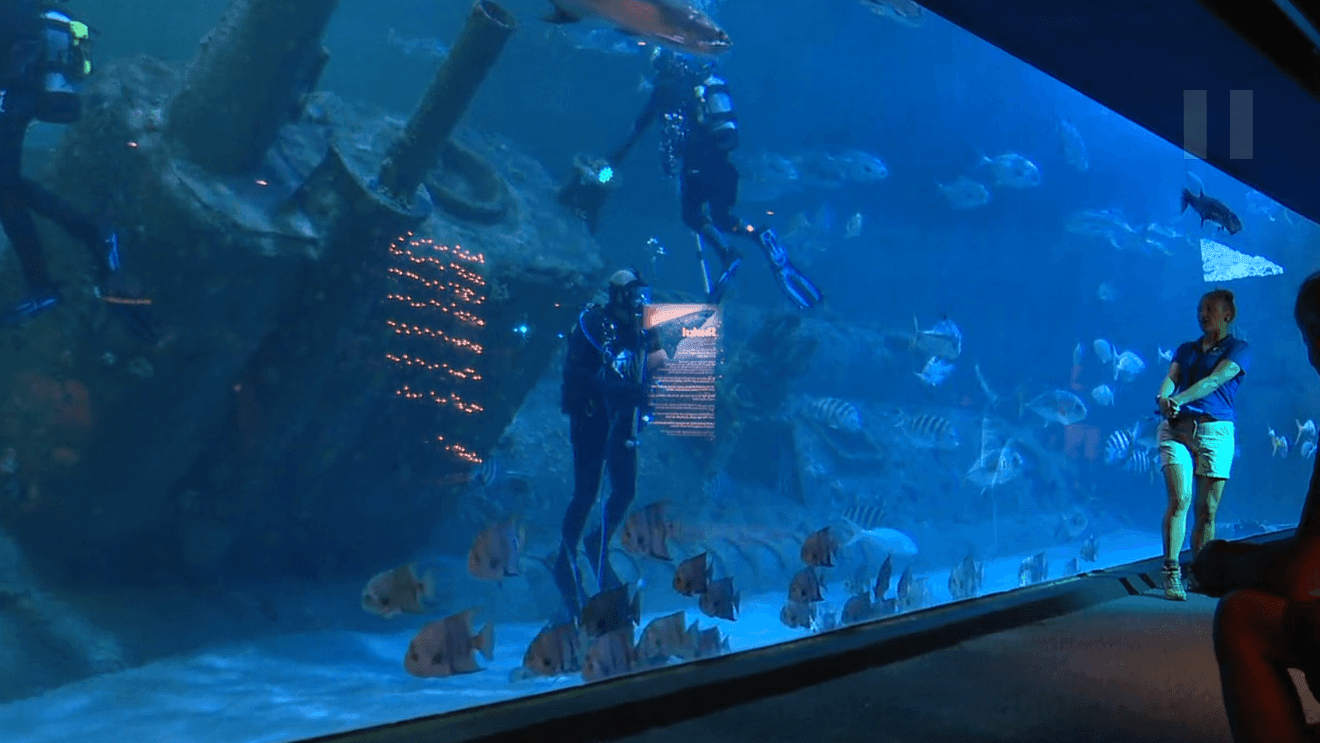
A three-quarter-scale replica of U-352 sits inside the North Carolina Aquarium at Pine Knoll Shores’ 306,000-gallon Living Shipwreck habitat.
Simmons said shipwrecks were chosen as a central theme because of their importance to marine life.
“We focused on shipwrecks because shipwrecks make great habitat for marine life,” Simmons said. “In fact, we refer to them as an artificial reef.”
Natural seawater pumped from Bogue Sound is filtered and used in the Living Shipwreck habitat.
The exhibit features marine life found off North Carolina, including sand tiger, sandbar and nurse sharks, along with spadefish, barracuda and other species.
Aquarium divers also enter the exhibit several times during an average day. Some dives include public presentations using full-face masks equipped with an underwater communication system, allowing divers to speak with educators and visitors outside the tank.
For Simmons, diving has been a longtime passion.
“My favorite thing about scuba diving is just the peace and tranquility that you get underwater,” he said.
Purifoy also grew up around diving. His family has operated dive charters from its Morehead City location since around 1980.
“I started working when I was 10 years old here, and I mowed the grass here before the building was built,” Purifoy said. “It’s what I’ve always done.”
Exploring the Rachel Carson Reserve
North Carolina’s waterfront history is not limited to what lies beneath the ocean.
Across the water from Beaufort, the Rachel Carson Reserve encompasses 3,215 acres between the mouths of the Newport and North rivers.
The reserve supports more than 200 species of birds and a variety of other wildlife, including its well-known wild horse herd.
Paula Gilligan, the reserve’s wild horse manager, said the herd was established in the late 1940s by Dr. Luther Fulcher, who brought horses from Core Banks.
“The Rachel Carson Reserve horses are related to the other horses along the North Carolina coast, specifically the Shackleford Banks herd,” Gilligan said.
The herd is monitored, but Gilligan said management is designed to remain as hands-off as possible.
The reserve also provides important coastal habitat supporting commercially harvested seafood, including blue crabs, shrimp and finfish.
The reserve is open to the public for activities including kayaking, hiking and enjoying the beach while its habitats remain protected.
The goal, according to reserve staff, is for visitors to understand the importance of North Carolina’s coastal environment and help protect it for the future.