
At the top of a long, steep staircase in The Historic New Orleans Collection research center in the French Quarter hang a pair of precious, newly acquired, 19th-century portraits. They are artifacts of a peculiar part of Louisiana’s 19th-century social system.
Both portraits were painted in 1835, when the enslavement of Black people was ubiquitous in Louisiana. Though the little boy with the moth and the elderly gentleman with the gold earring were both of African ancestry, they weren’t slaves.
The portrait sitters were so-called free people of color, who were permitted to earn money, to own property, and in ways conduct life like their European counterparts. Historic New Orleans Collection Deputy Director Erin Greenwald pointed out that in 1830, free people of color made up 24% of New Orleans’ population.
Chances are, either the subjects of the portraits or their loved ones paid for the artworks. As Greenwald explained, “plenty of free people of color were people of means.”

Julien Hudson’s 1835 painting ‘Creole boy with a moth’
Staff photo by Doug MacCash
New Orleans’ first native-born portraitist
The Historic New Orleans Collection’s new paintings are especially resonant artifacts of the city’s unusual racial stratification, because the artist, Julien Hudson, was also a free man of color.
He was the first professional portraitist born in New Orleans — previous artists had immigrated from elsewhere. Art historians consider him to be the nation’s second African American portraitist — after Baltimore’s Joshua Johnson.
There are only six signed paintings by Hudson known to exist, according to Greenwald. Which makes the two paintings recently donated to the French Quarter museum almost as scarce as ivory-billed woodpeckers. Because of the social and economic inequities of the 19th century, paintings of antebellum people of African descent are extremely rare.
Greenwald declined to reveal the estimated value of the portraits.
“They’re priceless,” she said, “not just because they depict people of color from the prewar period, but also because they are painted by a person of color.”
Meet Julien Hudson
Hudson was born in 1811, four years before the Battle of New Orleans. His mother was a native of La Nouvelle-Orléans who descended from French and African ancestors. His father was a White man from London.
Hudson grew up on Bienville Street, just around the corner from the museum where his portraits now hang. Young Julien first set out to be a tailor, before setting aside his needle and thread and devoting himself to painting. He studied with two well-known European artists in New Orleans and traveled to Paris to hone his artistic skills.
At a mere 20 years old, he took out a newspaper ad detailing his ability to paint miniature, keepsake portraits.
In 1839, Hudson painted a charming, miniature portrait of a svelte young gentleman, with muttonchop sideburns, brilliantly red lips and a nose as sharp as an axe. For years, the painting was considered a self-portrait, though one expert has recently called that into question.
Possible self-portrait of Julien Hudson
Provided by The Historic New Orleans Collection
The small artwork is in the collection of the Louisiana State Museum, just three blocks away at the Cabildo on Jackson Square, in the “Bienvenue Lafayette” exhibit.
Hudson died in 1844 in the prime of life, at just 33 years of age. Maybe he contracted yellow fever or any of the myriad infections that could claim a life in New Orleans back then, Greenwald said. There’s no telling. His early death, of course, contributed to the scarcity of his artworks.
Who are these people?
The two paintings at the top of the stairs at the HNOC are very yin and yang. The child on the left is cherubic, his eyes bright with promise. A beautiful insect — maybe a luna moth — has alighted on his hand. The boy seems to have been a scion of the Metoyer family, the mixed-race owners of Melrose plantation in Natchitoches Parish. The title given the painting is “Creole Boy with a Moth.”
Sadly, Hudson probably included the moth as a symbol of transition, which means the portrait could well have been done after the child’s death. Despite that, the painting has the promising glow of dawn.
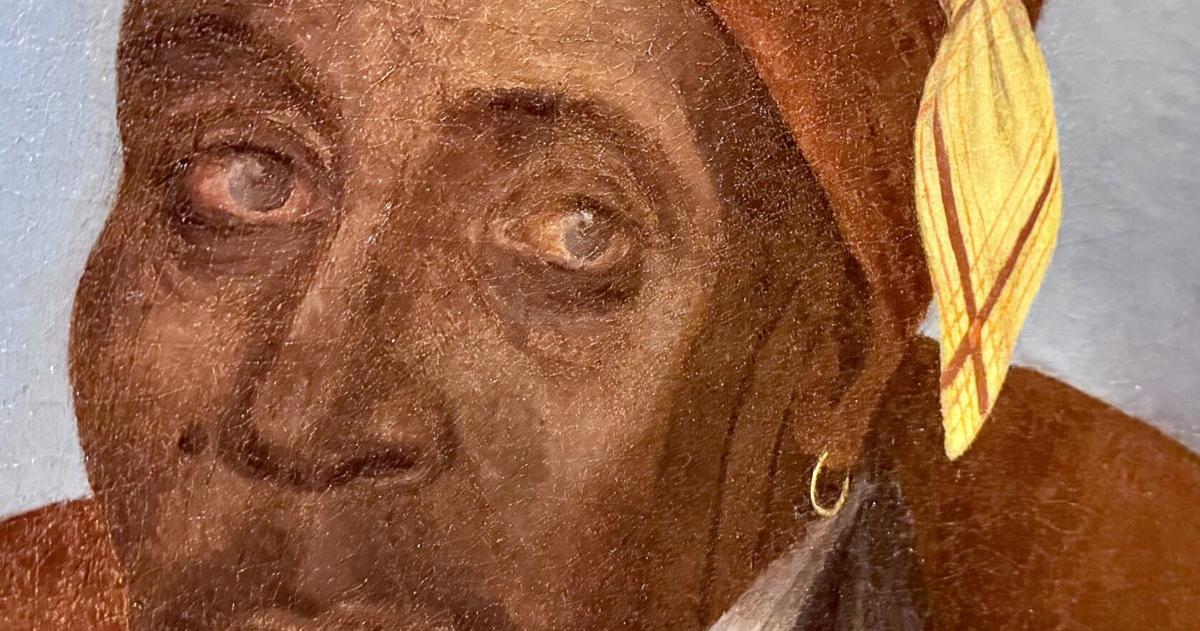
The other portrait, titled “Free Black Man Wearing a Turban,” is considerably more mysterious. The aging Black man reclines in a leather chair. His graying goatee almost reaches his elegant silk cravat that hangs between the lapels of his formal jacket. Atop his head, he wears a red headpiece, almost like a fez, which is draped with a madras scarf. His golden earring indicates wealth.
If you look closely, the man’s left cheek is marked with three vertical stripes of what seems to be ritual scarification. Such marks may well be West African. But what can the role of a formally dressed African have been in the midst of a city known as the largest slave marketplace on the continent? Nobody knows.
“Maybe he’s a ship’s captain or a merchant,” Greenwald speculated. “It’s a port city. We had people from all over the world in New Orleans. “If you’re narrowing down professions that may have brought someone like this to New Orleans, that’s a possibility.”
‘Free Black man wearing a turban,’ an 1835 portrait by Julien Hudson, New Orleans’ first native-born portraitist
Photo by Melissa Carrier | Provided by The Historic New Orleans Collection
Every picture tells a story
While the “Creole Boy” portrait has a certain buoyance, the “Free Black Man” is a bit dour. His eyes are clouded with age, yet compelling.
Baton Rouge art collector Jeremy K. Simien said every detail in the paintings signal something about the sitter.
“I wouldn’t be shocked,” he said, if the older man’s hat and scarf “perhaps had a religious meaning.”
Simien said that, coincidentally, he may have a tangent connection with Hudson. He — like the child in the portrait — is a descendant of the Metoyer family, Simien said.
Simian said there are other paintings in collections here and there that are suspected to have been painted by Hudson — maybe a dozen in all.
“It’s incredible that they survive,” he said. “It’s unfortunate that people of color don’t have more such heirlooms.”
The colorful moth in Julien Hudson’s 1835 painting “Creole boy with a moth” may have been a symbol of transition, implying that the portrait was made after the child’s death.
Photo by Melissa Carrier | Provided by The Historic New Orleans Collection
How to see the paintings
The two Hudson paintings at the HNOC were once owned by the late Robert and Martha Bolton, who were both philosophy professors at Rutgers University and art collectors. Martha Bolton attended Tulane University.
Fifteen years ago, the Boltons lent the portraits to the French Quarter museum for the first comprehensive Julien Hudson exhibit. They saw to it that, upon their deaths, the Hudson portraits would return to the city where they were painted.
The “Creole Boy” and “Free Black Man,” can be found at 410 Chartres St., which is free to the public from 9:30 a.m. to 4:30 p.m. Tuesday-Saturday.
Back in 1837, Bélizaire was the Black or mixed-race domestic servant of the Freys, a wealthy, White, French Quarter family. The enslaved 15-ye…
Louisiana artists Andrew Lamar Hopkins and the late Clementine Hunter never met. Hopkins was just 10 years old when Hunter died in 1988. Yet r…
The Neal Auction Company showroom on Magazine Street sizzled with anticipation Friday afternoon as bidding began on a circa 1840 painting of …