
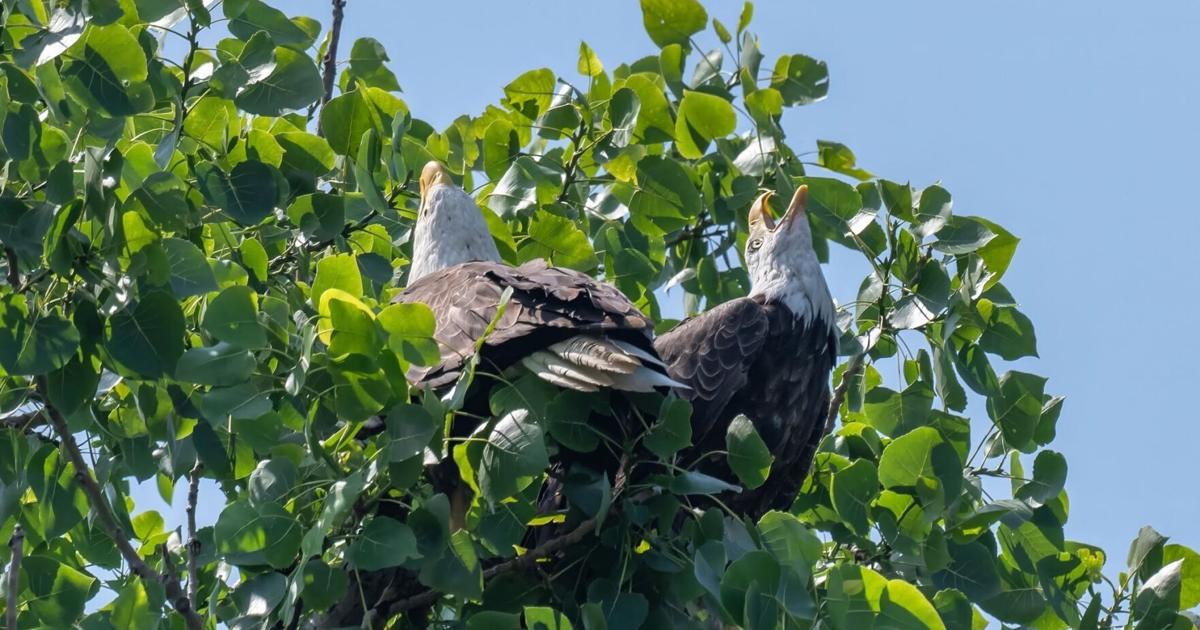

Bald eagles Scout and Willa, who parented Carillon Historical Park’s latest eaglets, America and Independence.
ROGER GARBER / CONTRIBUTED
Above the Wright Brothers National Museum at Carillon Historical Park in Dayton sits an empty eagle nest.
Home to bald eagle couple Scout and Willa — who earlier this year welcomed two eaglets, America and Independence — the nest represents nine nesting seasons for bald eagles at Carillon.
In that time, 20 eaglets have hatched here, eventually flying the coop to establish nests of their own.
In the Wright Brothers National Museum below sits the 1905 Wright Flyer III, the aircraft Orville and Wilbur Wright flew at Huffman Prairie and the first practical airplane capable of repeated takeoffs and landings. Two symbols of flight — the airplane and the bald eagle — coexist in the park.
“I always say it’s poetic to have wild eagles come in and build a nest directly above that aircraft,” said Jim Weller, Carillon Park’s designated eagle expert since 2018. “People ask me sometimes if we put the nest there because it is just an unbelievably appropriate location for an eagle’s nest. But they did it all on their own.”
After ‘America’s Got Talent,’ Carlisle native Luke Michael and Butter & Grit look ahead
The eggs were laid just after Valentine’s Day. Thirty-five days later, the eggs hatched. Seventy days later, America and Independence — named to honor the United States’ 250th anniversary — were nearly full-grown.
Weller says it takes about two weeks of exercise before bald eagles start flying. Then it takes another month or so to learn how to hunt and fish on their own. The cycle repeats each year. Around the end of July, the eaglets-turned-eagles typically wander off to start their own lives.
Since America and Independence left, Weller says there have been sightings of juvenile, first-year bald eagles along the Great Miami River corridor.
“We have no real way of telling whether they’re our two eaglets or not,” he said. “We do see adults interact differently with young eagles now and then, so we assume they might be one of their own.”
Willa and Scout are adding new sticks to their nest. Weller says the activity is encouraging because it suggests the pair may use the nest again next year, adding to the 20 eaglets that have hatched there over the last nine years.
How one gardener is helping native plants take root in local landscapes
Since he was 5 years old, Weller has found eagles to be “majestic” birds. He’s followed their history, their brushes with extinction and their fight for survival, for 65 years.
The bald eagle has served as a national symbol since June 20, 1782, when Congress adopted it as the nation’s emblem. It wasn’t formally designated the national bird until 2024, when President Biden signed the National Bird of the United States Act.
In 2025, Gov. Mike DeWine signed Senate Bill 24 into law to officially designate the 1905 Wright Flyer III as Ohio’s state airplane.
“Flight is one of those things that, throughout history, has always captured man’s attention,” Weller said. “To have eagles come in and begin nesting, especially above that aircraft, it’s almost like a pat on the back, almost a natural recognition of the fact that man-powered flight was conquered here in the Dayton area.”