
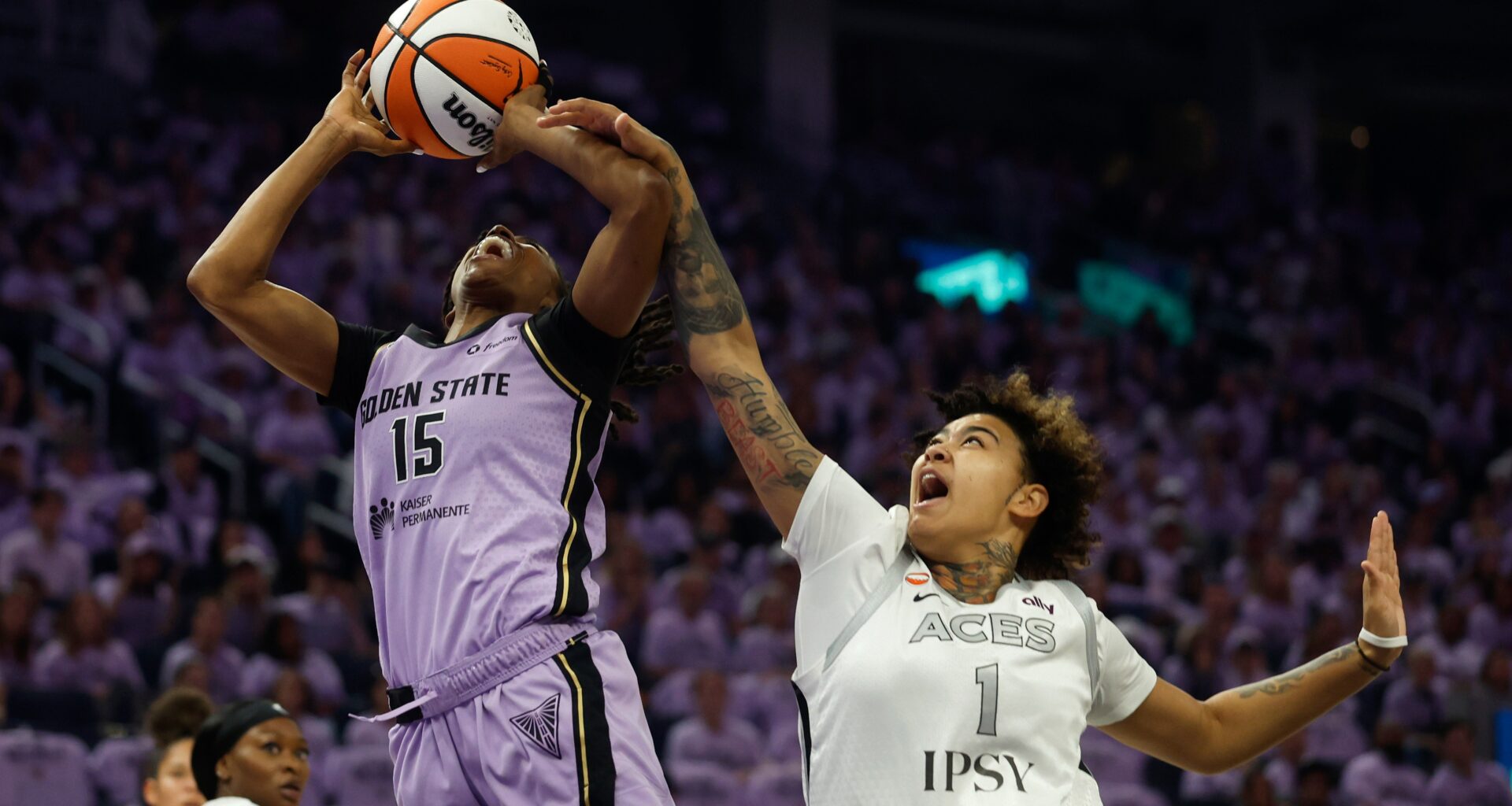
I woke up from a dream in which I was playing for the Golden State Valkyries.
Never mind that I’m a 65-year-old man.
In the dream, I took a pass from Veronica Burton, head-faked a drive, stepped back and drained a three-pointer.
For a few glorious seconds, my subconscious had decided that age, gender, athletic ability and several other inconvenient facts were merely eligibility suggestions.
But the strangest part of the dream wasn’t that I was playing professional basketball. It was that I was playing for the Valkyries.
I grew up a sports fan in the 1960s. Back then, the universe of sports was overwhelmingly male – Willie Mays, Bill Russell, Wilt Chamberlain, Johnny Unitas and Muhammad Ali. They occupied my bedroom walls, card collection and imagination.
But what I remember most about the sports landscape of my childhood wasn’t celebrity. It was intimacy.
Sports felt close.
I listened to games on the radio, read the box scores in the morning newspaper and waited all week to see my team on television. Players stayed with teams long enough that I felt like I knew them. Stadiums weren’t luxury shopping malls with playing fields attached. Nobody interrupted the seventh inning to encourage us to place a parlay bet on the next pitch.
I was a fan because I loved the game.
That world is largely gone from men’s professional sports.
I still love the Giants, Warriors and 49ers. But being a fan today can feel more like being a customer. Tickets can cost hundreds of dollars. Television networks determine when games are played. Players make staggering amounts of money, owners make even more and practically every available surface is available for sponsorship.
And then there is the betting. Gambling has become so deeply embedded in sports that sometimes the game itself seems like the backdrop for the betting operation. Point spreads, prop bets and parlays arrive alongside the scores. Fans are no longer simply being asked to root. We’re being asked to wager.
Somewhere along the way, something innocent was lost.
And then, unexpectedly, I found some of it again. At “Ballhalla.”
When I started following the Golden State Valkyries, I discovered something strangely familiar. The players are extraordinary athletes, but they don’t yet seem impossibly distant. Fans are more than demographic units. There is a palpable sense of community around the team – people discovering something together.
It reminds me of why I was a sports fan in the first place.
And it goes far beyond one basketball team.
Women’s basketball is exploding. Women’s soccer draws enormous crowds. Volleyball is booming. Women who once would have performed in relative anonymity are becoming household names.
Yet women’s sports retains something men’s sports has largely lost: a sense that the game is bigger than the business.
This era won’t last forever. Nor should we romanticize it. Women athletes deserve the money, television exposure, endorsements, facilities and financial security that male athletes have enjoyed for generations. If Caitlin Clark or A’ja Wilson can command a massive salary, good for them. If a women’s franchise becomes worth billions, terrific.
Equality shouldn’t require women to remain underpaid so the rest of us can enjoy affordable nostalgia.
But I hope women’s sports can grow without losing the qualities that make this moment so special.
Because what I’m rediscovering isn’t really women’s sports.
It’s sports.
It’s caring about players rather than contracts and watching a team develop its personality. It’s seeing kids in the stands wearing the jerseys of their heroes, believing that something surprising might happen tonight and desperately wanting to be there when it does.
For most of my life, that particular form of imagination had a gender line running through it. Boys dreamed about becoming Willie Mays. Girls were largely expected to watch.
Then something changed.
Or maybe I changed. Because six decades later, my subconscious didn’t put me in a Warriors uniform. It put me on the Valkyries.
And when Burton passed me the ball, apparently it never occurred to “dream me” that I didn’t belong there.
That’s funny.
It’s also kind of wonderful.
Sports fandom is usually described as loyalty to teams. But if you stick around long enough, you discover that it’s also a record of how the world changes.
The heroes change. The uniforms change. The stadiums change. The rules change.
And something that once seemed unimaginable becomes so ordinary that a 65-year-old man can dream he’s playing professional basketball alongside women – and the remarkable thing isn’t that they’re women.
It’s that I hit the three.
Kevin J. Morrison is a Novato-based writer.