
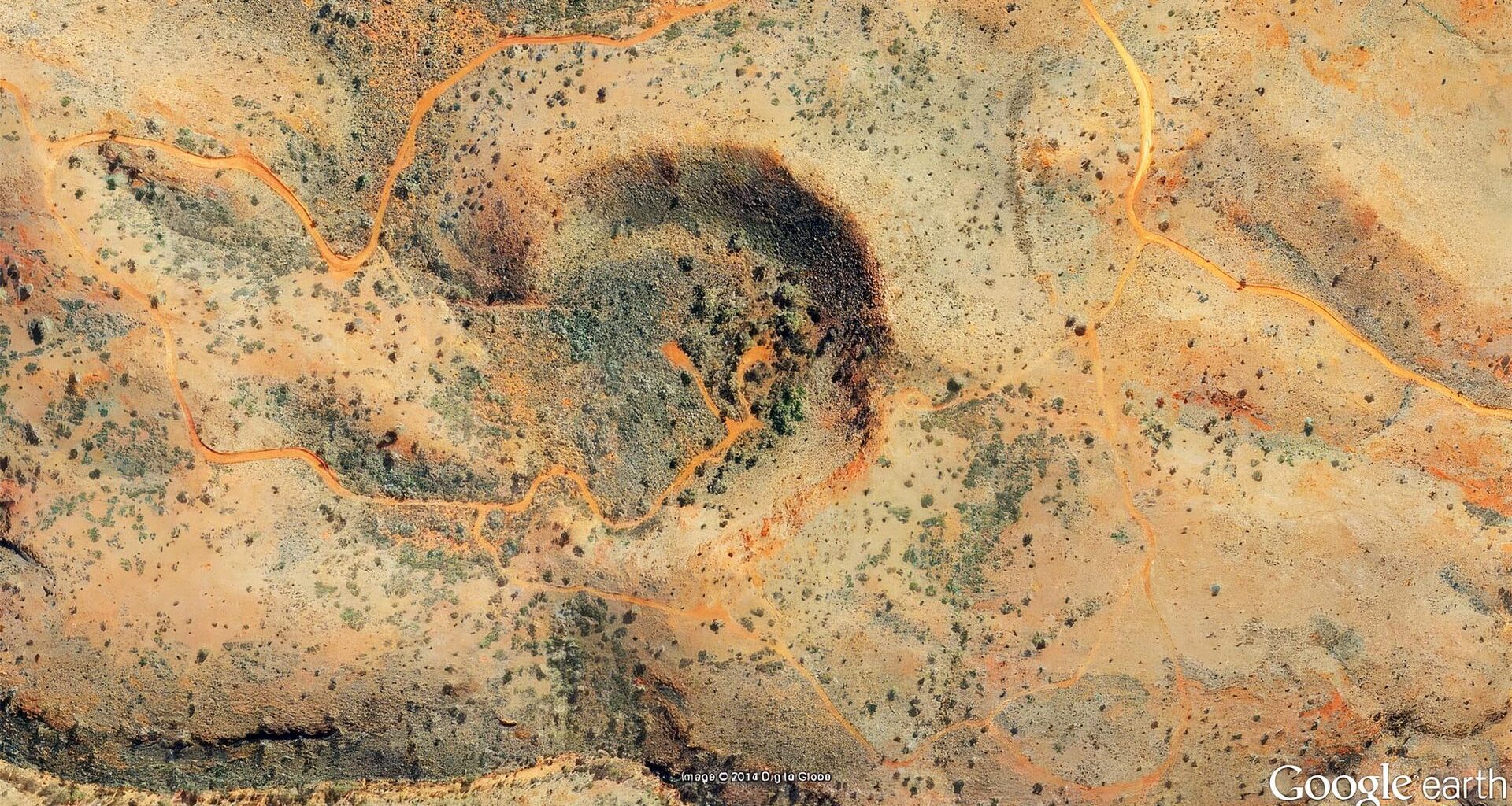
A geologist found an undiscovered meteorite crater in Western Australia on Google Earth in 2007. Later drilling confirmed its iron meteorite origin.
In July 2007, geologist Arthur Hickman was scanning satellite images of Western Australia on Google Earth, looking for iron ore. Instead, he spotted a near-perfect circle in the rugged hills of the Pilbara region.
The feature turned out to be a meteorite impact crater about 850 feet (260 meters) wide. Despite decades of mining activity nearby, no one had recognized it before.
Today it is known as Hickman crater. It took years of fieldwork, drilling and lab analysis to prove that a falling iron meteorite carved it out.
A “flaw” on the screen
Hickman worked for the Geological Survey of Western Australia (GSWA). At the time, he was searching the imagery for channel iron deposits, a type of iron ore found in ancient riverbeds.
“I was looking from high up at about 20,000ft [6000m] and I saw this bubble-like shape, like a flaw on the image,” he told Australian Geographic.
The circle sits in the Ophthalmia Range, about 22 miles (36 kilometers) north-northwest of the mining town of Newman. Iron ore exploration and mining have been intense in the surrounding Hamersley Range since the 1960s.
GSWA had also mapped the area roughly two decades before Hickman’s discovery, without noticing the crater, according to a 2008 report in Universe Today.
Hickman sent screenshots and coordinates to colleagues at the Australian National University (ANU). Researcher Andrew Glikson named the crater after him, in recognition of the discovery and his 35 years of work on the geology of the Pilbara.
Studying the surface
The crater has a partly eroded rim that rises up to 98 feet (30 meters) above a flat, circular floor. Its shape matched that of other small impact craters.
In 2008, Glikson, Hickman and a colleague described the site in detail. They found shattered rock in the crater rim, cut by veins of the iron mineral goethite, and these features appeared only within the crater zone.
The team estimated that the original crater was about 260 feet (80 meters) deep. They suggested it was excavated by an object roughly 33 feet (10 meters) across, which threw debris up to about 980 feet (300 meters) north of the rim.
The crater looked young, likely dating to the Late Pleistocene, between 10,000 and 100,000 years ago.
But one key piece of evidence was missing. Surface samples showed no chemical traces of meteorite material, so the case for an impact still rested mostly on the crater’s shape and fractured rock.
Drilling into the crater floor
In late 2012, GSWA teamed up with the mining company Atlas Iron to drill a vertical hole in the center of the crater floor. The core reached a depth of 212 feet (64.7 meters).
According to GSWA geologist Peter Haines, it was the first scientific drilling of a simple impact crater of this size in Australia, as described in a Curtin University seminar.
The drill passed through nearly 165 feet (50 meters) of sediment that had filled the crater. Below that lay about 20 feet (6 meters) of impact breccia, a layer of crushed and partly melted rock, before the bit reached the original bedrock.
That breccia held the missing evidence. Nickel levels reached up to 2,381 parts per million, compared with less than 3 parts per million in the surrounding rock.
The layer was also enriched in iridium and other platinum group elements. These metals are scarce in typical Earth rocks but much more abundant in many meteorites.
Fingerprints of an iron meteorite
The chemistry pointed to an iron meteorite. Because the crater lacks some of the shock features seen at larger impact sites, researchers suggested the relatively small object was slowed significantly by the atmosphere before it hit.
In 2018, the first fresh metallic meteorite associated with the crater was reported. It was classified as an iron meteorite of the IAB group and named Hickman.
In 2025, researchers from Curtin University and GSWA presented new results at the annual meeting of the Meteoritical Society. They studied glass formed by the impact, which they described as extremely bubbly and similar to pumice.
Inside the glass, the team found tiny iron-nickel spherules and elevated levels of iron, nickel, cobalt and platinum group elements. One spherule, just 20 micrometers across, contained 33 percent nickel.
The researchers concluded that this material, together with the earlier drilling results, provides “unambiguous diagnostic evidence of a meteorite impact origin for Hickman crater.”
Craters still hiding in plain sight
Hickman crater shows how easily small impact sites can blend into the landscape. Erosion, vegetation and rough terrain can hide them even in well-explored regions.
Satellite images continue to reveal new candidates. In 2026, scientists reported a much larger crater in Quebec that was first spotted by an amateur astronomer on online satellite maps.
The Pilbara itself holds far older scars. Researchers have identified what is now considered Earth’s oldest known crater in the same region, and some scientists think such impacts may have created environments for early life.
Iron meteorites like the one that formed Hickman crater are also valuable to scientists because they preserve clues about how the solar system formed. Their metal content can reveal where their parent bodies took shape.
For Hickman, the find began with a routine search for iron ore. It ended with a crater named after him.
The original study was published in the Australian Journal of Earth Sciences.
—–
Like what you read? Subscribe to our newsletter for engaging articles, exclusive content, and the latest updates.
Check us out on EarthSnap, a free app brought to you by Eric Ralls and Earth.com.
—–