

According
to the August 2026 Speedtest Global Index figures released by network
intelligence firm Ookla, Vietnam’s median mobile broadband download speed
reached 219.93 Mbps, representing a 45 percent increase compared to the same
period last year. With this performance, the country moved up one notch to secure
ninth place globally.
Screenshot from the Ookla Speedtest Global Index report.
At
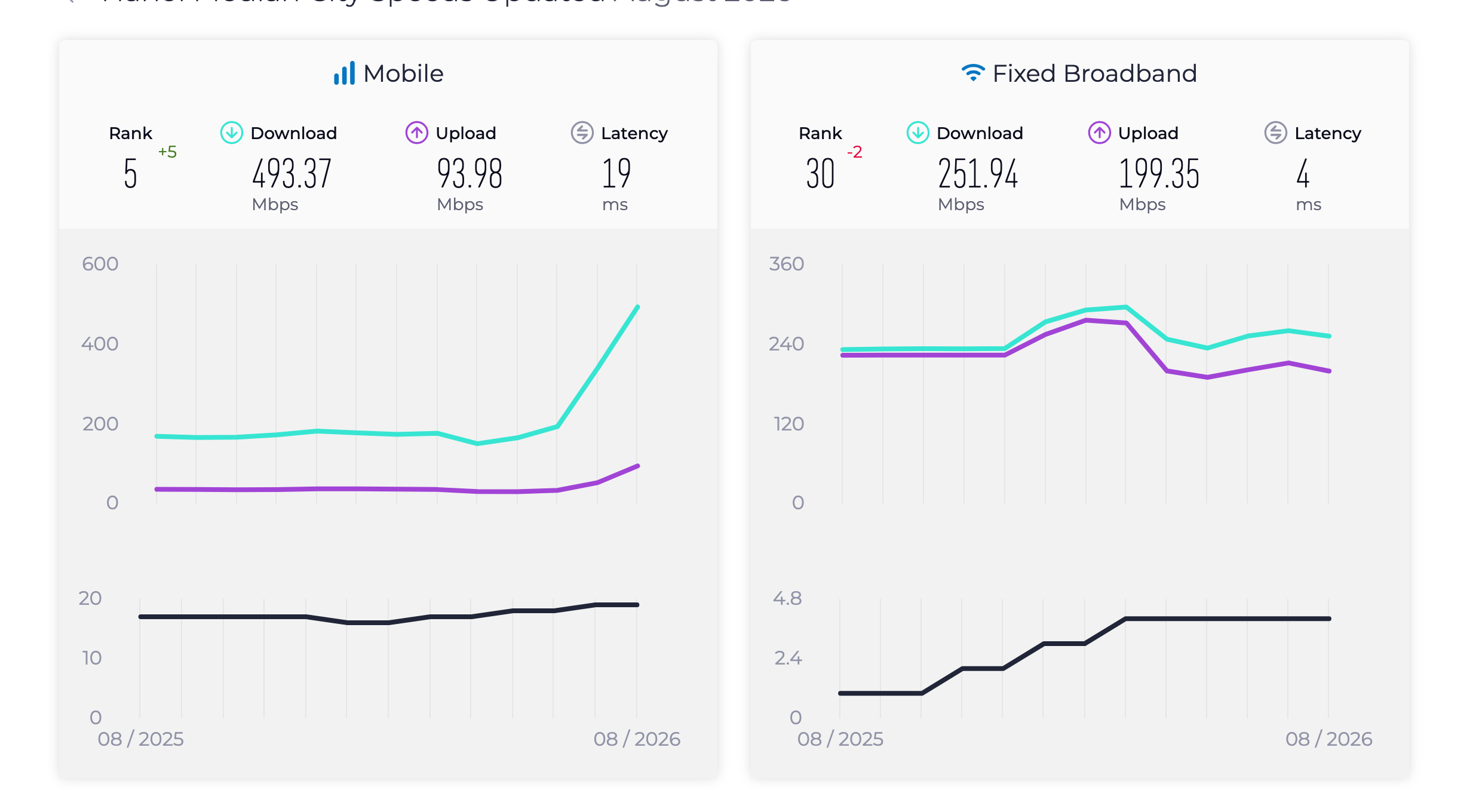
the city level, with its speed at 493.37 Mbps, Hanoi’s
mobile network quality recorded significant progress, ranking fifth among 149 ranking cities globally, up five places from the previous evaluation period, for mobile internet download speed. Vietnam’s capital city ranks just behind Abu
Dhabi, Al-Rayyan, Doha, and Dubai, while surpassing major metropolitan areas
including Stockholm, Kuwait City, and Rio de Janeiro.
Meanwhile,
Ho Chi Minh City achieved a mobile internet download speed of 175.91 Mbps,
climbing four places to rank 54th among the 149 ranking cities.
In
the fixed broadband sector, Vietnam recorded a median download speed of 301.48
Mbps, ranking eighth globally and dropping one spot from the previous period.
Despite the slight drop in ranking, Vietnam’s fixed internet speed
remains approximately 2.3 times higher than the global median of 129.68 Mbps.
Singapore leads the global ranking with a median download speed of 462.50 Mbps.
Vietnam
ranks directly behind the United States, which recorded 307.16 Mbps, and ahead
of Thailand at 298.92 Mbps.
By
city performance, Ho Chi Minh City ranks 14th, and Hanoi 30th, among 194 ranking cities globally, for fixed broadband
speed. The download speed in Ho Chi Minh City reached
298.38 Mbps, which is 46.44 Mbps or 18.4 percent higher than Hanoi’s speed of
251.94 Mbps.
According
to Ookla, the rankings reflect global user testing data collected between June
and August 2026. The firm noted that test results can be influenced by multiple
variables, including end-user devices, subscription packages, and testing
environments.
According
to Vietnam’s
Ministry of Science and Technology, the fixed broadband speed of 301.48
Mbps demonstrates the efficiency of ongoing investments in fiber optics,
transmission infrastructure, and access network upgrades. Meanwhile, the rapid
increase in mobile speeds reflects the positive impact of 5G commercialization.
Since
September 16, mobile telecommunications operators in Vietnam have officially
terminated 2G mobile network services, excluding specialized geographic areas
such as Truong Sa, Hoang Sa, and DK1 platforms, to reallocate radio spectrum
(900MHz and 1800MHz) for 4G and 5G deployment.
This
transition extends beyond retiring legacy technology, representing a strategic
reallocation of infrastructure resources from low-efficiency networks to modern
technologies, particularly 4G and 5G. As mobile subscribers transition to
broadband-capable devices, the addressable market for digital service expansion
expands accordingly.