
The Taiwan Machine Tool & Accessory Builders’ Association (TMBA) held its 7th second member representatives’ meeting on the 13th, officially launching the “TMBA AI CENTER.” Through a computing power partnership with Leadtek Research (2465.TW), the association has established an on-premises AI computing environment to help members overcome adoption barriers in computing power, data security, and system integration. Chairman Chen Shen-teng noted that while complete machine tool exports fell 1.9% year-over-year in the first nine months, key component exports rose 13.1%, reflecting a “two-speed” industry where the domestic demand pull from semiconductors and ICT has not yet been reflected in export data.
This year’s member meeting was themed “Unity, Upgrade, Create Value,” bringing together representatives from government, industry, and cross-sector associations. Distinguished guests included Presidential Office Senior Advisor Shen Jong-chin, Legislative Yuan Vice President Johnny Chiang, Industrial Development Administration Director-General Chiu Chiu-hui, and Taichung City Economic Development Bureau Director-General Chang Feng-yuan. Representatives from the Chinese National Federation of Industries, the Taiwan Electrical and Electronic Manufacturers’ Association, SEMI, and the Taiwan Automation Intelligence and Robotics Association also attended.
On-Premises Computing Power Removes Adoption Barriers
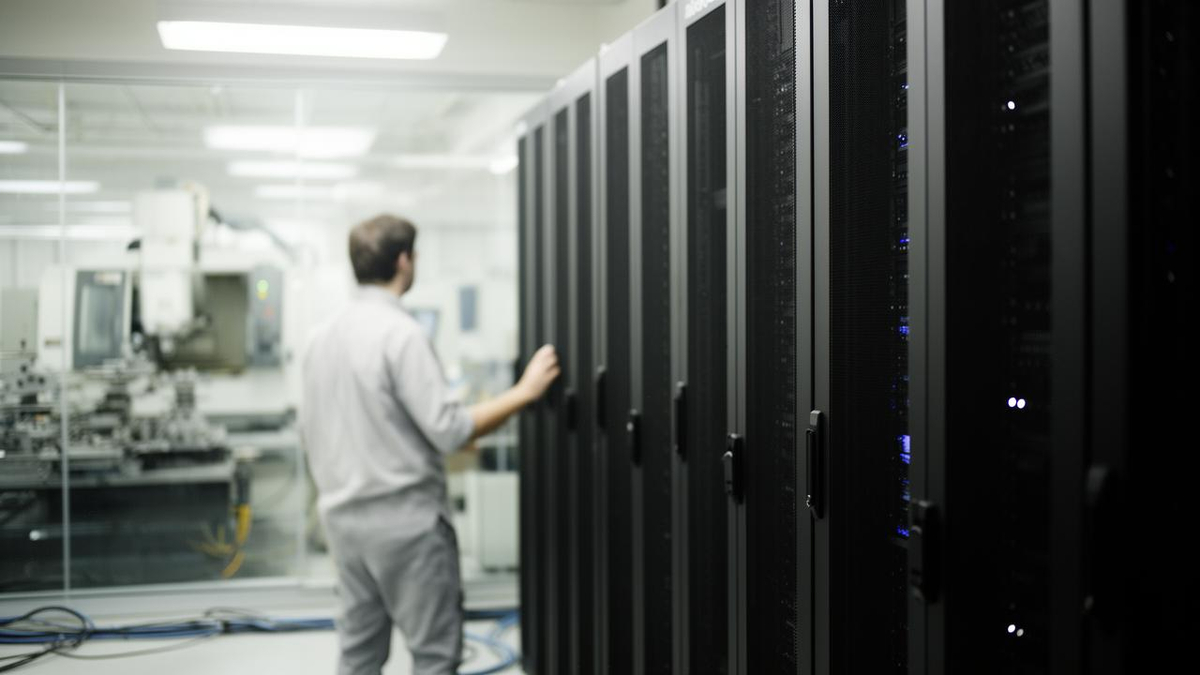
Facing rapid AI development, machine tool and component manufacturers commonly encounter practical hurdles in computing infrastructure setup, model deployment, data security, system integration, and specialized talent. TMBA has partnered with Leadtek Research on AI computing power, deploying Leadtek’s WinFast GS3852T AI server equipped with NVIDIA RTX PRO 6000 Blackwell server-grade GPUs as the core computing equipment for the AI CENTER, completing on-premises environment setup and small-scale validation testing.
The on-site demonstration showcased AI workstations, a no-code AI platform, and industry AI modules provided by DSI and the Precision Machinery Research & Development Center (PMC), presenting the complete workflow of AI models from computing power and deployment to real-world industrial application. Through on-premises deployment, enterprises can leverage high-performance GPU computing for AI applications without uploading sensitive data to external clouds, balancing computational performance with data security.
The association stated that following the member meeting, it will continue to expand AI models and application modules specific to the machine tool industry, extending AI applications from individual equipment to manufacturing floors and operational management.
Strengthening Domestic Demand and Structural Industry Shift
In his industry analysis at the meeting, Chen Shen-teng pointed out that complete machine tool exports fell 1.9% year-over-year in the first nine months, while key component exports rose 13.1% — superficially appearing as “one industry, two speeds.” However, he emphasized that complete machine tool builders have actually benefited from domestic demand driven by the semiconductor and ICT industries, though this has not been reflected in export data.
Looking at the overall market structure, the share and contribution of the Taiwan market is growing. Previously, the Taiwan market typically accounted for about 20% of complete machine builders’ revenue; now some builders report that Taiwan market revenue share has reached over 30%, and even as high as 50%. He believes machine tool transformation should consider how to support the industries Taiwan wants to develop, converting domestic demand growth into momentum for industrial upgrading.
Dual-Track Approach: Energy-Saving and AI Labels
In addition to building the AI computing environment, TMBA has also adopted a labeling system to encourage members to invest in energy-saving technologies and innovative AI applications. The meeting held the award ceremony for the 4th Machine Tool Industry Energy-Saving Label and the 2nd Machine Tool Industry AI Empowerment Label, with Industrial Development Administration Director-General Chiu Chiu-hui presenting the awards.
For the Energy-Saving Label, 13 products passed evaluation this year, with 5 receiving Gold labels and 8 receiving Silver labels. For the AI Empowerment Label, 4 companies received Gold labels and 2 received Silver labels in the enterprise category; in the product category, 6 products received Gold labels and 4 received Silver labels.
Label CategoryGoldSilverTotalEnergy-Saving Label (Products)5813AI Empowerment Label (Enterprise)426AI Empowerment Label (Products)6410
From energy-saving equipment to AI applications, the label evaluations reflect the machine tool industry’s transformation direction, extending from traditional equipment efficiency improvements to smart and low-carbon initiatives. The association hopes to establish practical reference cases through the labeling system, promote technical experience exchange, and help members align with international carbon reduction requirements and smart manufacturing trends.
Charitable Contributions Exceed NT$39.7 Million
Beyond industrial upgrading, TMBA continues to promote corporate social responsibility. The member meeting also held the Corporate Volunteer Alliance award ceremony, recognizing member companies actively engaged in public welfare and social care. This year, the association continued to promote beach cleanups, mountain cleanups, senior sports events, and Mid-Autumn Festival charity gift box purchases. With collective member participation, cumulative charitable donations exceeded NT$39.7 million (approximately $1.2 million), demonstrating that the machine tool industry actively practices corporate social responsibility alongside its pursuit of technological innovation and business growth.
A Clearer Transformation Path
From the messages delivered at this member meeting, the transformation path for Taiwan’s machine tool industry has become increasingly clear: externally, on-premises AI computing power lowers the digital transformation barrier for small and medium-sized enterprises; internally, the labeling system guides members toward energy conservation, carbon reduction, and smart upgrades; simultaneously, domestic demand growth driven by the semiconductor and ICT industries provides new market opportunities for complete machine builders.
Facing smart manufacturing, AI, net-zero carbon reduction, and global market changes, TMBA will continue to connect government, research institutions, associations, and member companies — from institutional establishment and technology validation to cross-sector collaboration — helping enterprises lower transformation barriers and jointly advancing Taiwan’s machine tool and accessory industry toward smart, efficient, low-carbon, and sustainable development.