
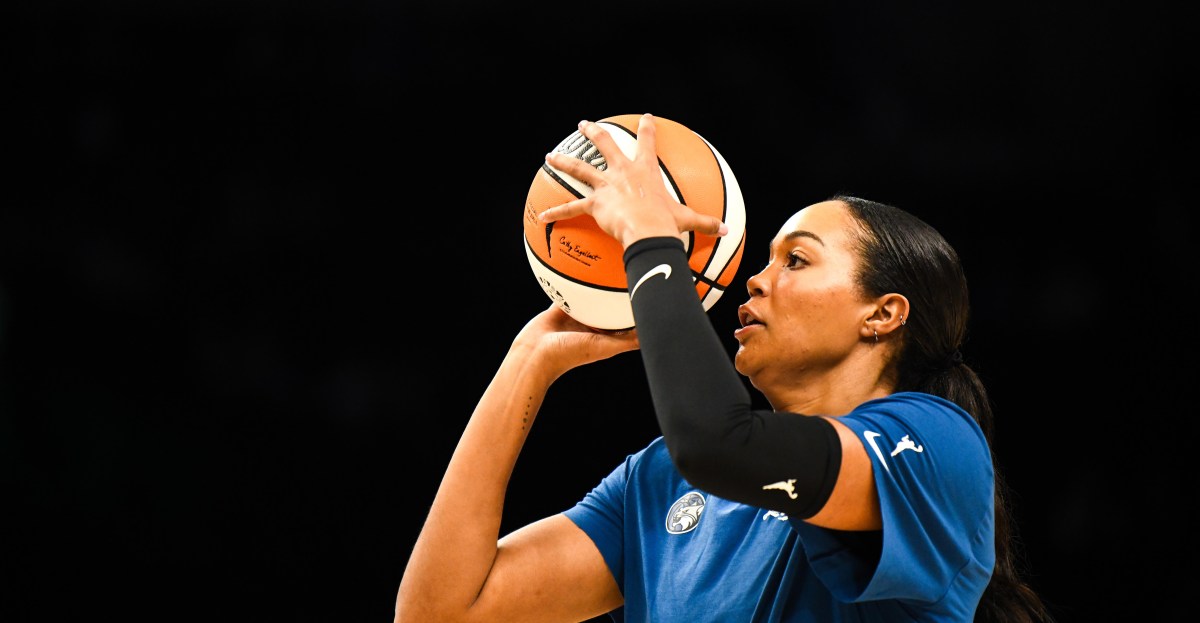
Retrospectively, Napheesa Collier’s absence, presence and future defined the 2026 WNBA season for the Minnesota Lynx.
Maybe, had the Lynx not experienced another early and underwhelming playoff exit and instead, as many expected, were preparing to play in the WNBA Finals, this wouldn’t be the case.
But when looking back on how the segments of the season unfolded for Minnesota, it’s hard not to see everything Lynx-related through the lens of Phee.
The Lynx were Miles ahead without Phee
An extended recovery from double-ankle surgery over the 2026 offseason delayed Collier’s season debut until July 22 and would limit her 16 regular-season games.
In Collier’s stead, Olivia Miles, the No. 2 pick in the 2026 WNBA Draft, emerged as an instant sensation, a splashy and spectacular precocious point guard who, compiling a number of records as she cruised to Rookie of the Year honors, helped Minnesota defy expectations and claim the best record in the league.
Head coach Cheryl Reeve also worked her magic for the Phee-less Lynx, not only guiding Miles ascendance but also maximizing the contributions of a veteran core as she would secure her record-extending fifth Coach of the Year award, in addition to becoming the WNBA’s all-time winningest coach. She also was named the 2026 WNBA Basketball Executive of the Year, earning the honor for a record-tying third time in large part for the decision to select Miles at No. 2 overall.
The rest of the roster that Reeve built also ensured that it was,“No Phee, no problem” in Minnesota for the first half of the season. While Alanna Smith and Jessica Shepard departed in free agency, Reeve retained Kayla McBride and Courtney Williams, while bringing back a better-than-ever Natasha Howard and tapping Nia Coffey Brodie as a perfect Phee fill-in.
Things were going so well that concerns about the effect Collier’s return would have on the league-best Lynx—the epitome of a first-world problem—were somewhat legitimate.
The success of the Phee-less Lynx also prompted some premature burblings about Collier’s future in Minnesota, although such speculation mostly seemed like the inventions of opposing fanbases or others interested in transactional drama.
Nevertheless, Collier’s decision to sign a one-year deal last offseason, in addition to comments that could be interpreted as her signaling the possibility of a future outside of Minnesota, invited those imaginings.
Phee and the Lynx look like a Finals lock
But then, Collier returned, looking fantastic.
Of course, the two-time WNBA MVP runner up was only additive for the league-leading Lynx.
Collier’s instant reintegration and usual production seemed to cement Minnesota as title favorites as she and Miles began to establish a partnership that looked to be the foundation of the next Lynx dynasty. Our Zack Ward saw the vision, envisioning the potential shared stardom of Phee and Liv as comparable to what Maya Moore and Sylvia Fowles developed in the late 2010s.
After Phee returned to the court, the Lynx won 11 of 12 games, appearing even more on course to, finally, win the franchise’s fifth WNBA championship.
Phee and the Lynx flame out, again
But then, two losses before the FIBA World Cup break were followed by a third-straight loss when play resumed. And from that point forward, the Lynx, especially Collier and Miles, were never right.
A first-round loss in sweeping fashion as the No. 1 seed—a first-ever in WNBA history—suddenly made it more than conceivable that Collier, in fact, might have played her last game in a Lynx uniform. Phee, like almost every Lynx, was uncharacterisitically off in the series.
A more than 20-point scorer who converted more than half of her shot attempts and compiled a least two stocks per game over the Lynx’s playoff runs in 2023, 2024 and 2025, Collier averaged 13 points on below 43 percent shooting in the two games against the New York Liberty, failing to make 3-pointer while also recording just one steal and no blocks. In Game 1, the Lynx were outscored by a team-worst 23 points in Phee’s minutes.
Miles’ playoff debut might have been even more discouraging. After scoring almost 20 points per game on just under 50 percent shooting in the regular season, in addition to averaging of six assists, Miles scratched for just eight points and a single assist per game in her two-game introduction to playoff basketball. She shot 20 percent from the field, including only 16.7 percent on 2-pointers.
When talk of dynasty again ends in disappointment, it becomes more conceivable that Collier could believe that she’s more likely to achieve her championship aspirations outside of Minnesota. The matter-of-fact comments during exit interviews from Collier and Reeve about her future did little to deter the developing consensus that Collier, at minimum, seems certain to strongly consider alternatives.
Phee’s free agency will decide the future for the Lynx
Phee’s choice, in turn, will determine how Minnesota chooses to chart their future.
If Collier elects to remain in Minnesota, then the Lynx will look to build around the Liv-Phee duo, deciding whether to maintain the veteran core that thrived for the majority of the season, or to make trades in order to surround Miles and Collier with players who offer more physicality than finesse, preparing the team to better combat what has been their postseason kryptonite.
If Collier departs, Minnesota could still essentially run it back, believing that the pre-Phee verision of the Lynx had found something special and sustainable that could be successfully revived for 2027.
Or, if Phee decides to find a new WNBA home, would Minnesota likewise choose to move on from their vets who are almost a decade older than Miles in order to totally re-envision and reconstitute the team around their rising WNBA sophomore star?
This wouldn’t have to be a rebuild; Miles proved, at least in the regular season, that she is ready to lead a successful team right now. Rather, it would involve building a team around Miles that can sustain contention beyond as season or two, importing players who are closer in age to Miles and better equipped to compete in what appears to be becoming a WNBA where depth, athleticism, defense and winning on the margins are pre-requisites to postseason success.
How Minnesota evaluates Miles’ postseason will be critical to how the organization chooses to construct a team in a world without Phee.
Was Miles, in fact, dealing with an injury during the playoffs, with the calf tweak that sidelined her at the end of the regular season sapping her explosiveness and, in turn, confidence? Did she, finally, hit the rookie wall, exhausted and overwhelmed after playing near-constant basketball since last November? Or, were real issues exposed, ones that require time and experience to address, even for a talent who seems as ahead-of-schedule as Miles did for much of her rookie year?
Compared to the 2026 version, the 2027 Lynx might end up looking quite similar, very different or something in between.
Whatever Minnesota team materializes in 2027, however, will be the product of a long offseason process full of pivotal decisions. The first one belongs to Phee.