
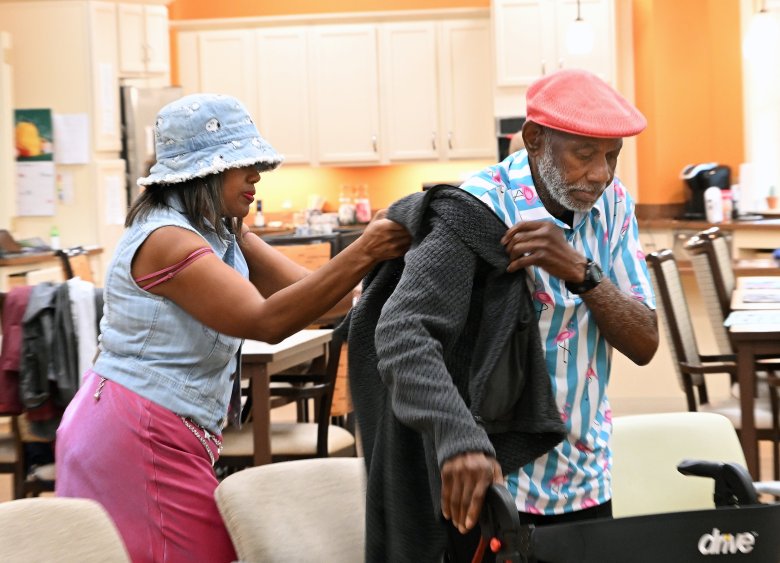
Marvella Heard has faced more challenges than most in caring for her aging father.
She spent over a year back in her hometown in New York, after she discovered her father was living in squalor, his health was deteriorating, his meager finances were in jeopardy and his house was in foreclosure, she said.
A Navy veteran and retired federal prison employee, she stepped in and wrangled repeatedly with family members, government officials and social service agencies — even after she became her father’s legal guardian, she said.
“He was living in filth when I got there,” said Heard, 56, of Biddeford. “He had no food, no clean clothes. He didn’t recognize me at first.”

As Maine’s population ages, taking care of its older residents is becoming an increasingly urgent issue. From the stress of rural isolation to a shortage of workers to complicated federal Medicare guidelines, this guide helps Mainers learn about the services, technology and resources available to caregivers and the parents, spouses, neighbors and friends they’re caring for.
Now 79, Samuel Heard has since been diagnosed with Alzheimer’s and heart disease, and the retired hospital worker has mobility issues that require him to use a walker, his daughter said.
Despite many setbacks, Heard said she managed to navigate unfamiliar caregiver territory by being resourceful, searching the internet for solutions and being tenacious when she ran into roadblocks. She still struggles to reconcile how hard it was to help her father.
“I was treated awfully — the system didn’t support me at all,” Heard said. “We had confrontations again and again, and I just wanted to take care of my dad.”
Finally, last December, Heard was able to move her father to her home in Biddeford, where they’ve settled into a routine of medical appointments, grocery shopping, barber shop visits and adult daycare programs.
 Samuel Heard and his daughter, Marvella Heard, at the Samuel L. Cohen Center in Biddeford. (Shawn Patrick Ouellette/Staff Photographer)
THE ROLE TAKES A TOLL
While Heard’s experience was severe, a growing number of Mainers are facing challenges as caregivers for aging and disabled loved ones. They’re providing assistance with all aspects of daily living, including meals, medications, bathing, dressing, toileting, transportation and advocacy at medical appointments and in long-term care.
Most of that help goes unpaid and can take a significant toll on other areas of their lives, consuming free time and affecting job performance. The role reversal of caring for once-vital adults can be emotionally devastating, and managing their complicated medical needs and finances can be overwhelming. Some caregivers also support their loved ones financially — Heard figures she has spent about $3,000 on her father’s behalf.
She and others in the thick of it have learned the benefits of planning ahead, becoming expert problem solvers and seeking support from other caregivers. They don’t have to look far.
In 2025, an estimated 310,000 Mainers provided the full-time equivalent of 220 million hours of unpaid care for aging or disabled adult family members valued at $5.5 billion, according to AARP and the National Alliance for Caregiving. That value of that care more than doubled in the past decade, up from $2.2 billion provided by 178,000 Mainers in 2015.
The same is true nationwide, where the value of adult family caregiving also has more than doubled, from $470 billion to $1 trillion in the same period, and the number of caregivers increased 22.5%, from 40 million to 59 million, according to Caregiving in the US 2025, the latest report from AARP and NAC.
The exponential increase has solidified family caregivers as an invaluable contingent in the wider landscape of long-term care, AARP Maine State Director Noël Bonam said. It doesn’t matter if the help is provided to loved ones at home, in assisted living or at a skilled nursing facility.
“The long-term care system would crumble without those family caregivers,” Bonam said. “Whether what they do is big or small, without caregivers spending hours and personal resources while juggling other responsibilities, the system would collapse.”
CAREGIVING IN THE OLDEST STATE
As the oldest state, Maine is on the leading edge of this trend — nearly one-quarter of 1.4 million residents are age 65 and up. At the same time, it has a shortage of 2,300 workers to care for older Mainers as they age, according to the progressive Maine Center for Economic Policy.
Yet the important role that family caregivers play in filling the gap is critically undervalued, advocates say, especially when at least 60% of caregivers are juggling jobs outside the home and nearly 30% are part of the so-called sandwich generation, caring for both an adult and children.
“The federal and state funding and services available right now don’t cover the tip of the iceberg,” Bonam said.
Some MaineCare recipients may receive funding to pay a family member to provide care, but it comes with significant restrictions. The State Respite Care Program provides funding so family caregivers of dementia patients can hire occasional help, but there’s often a waiting list.
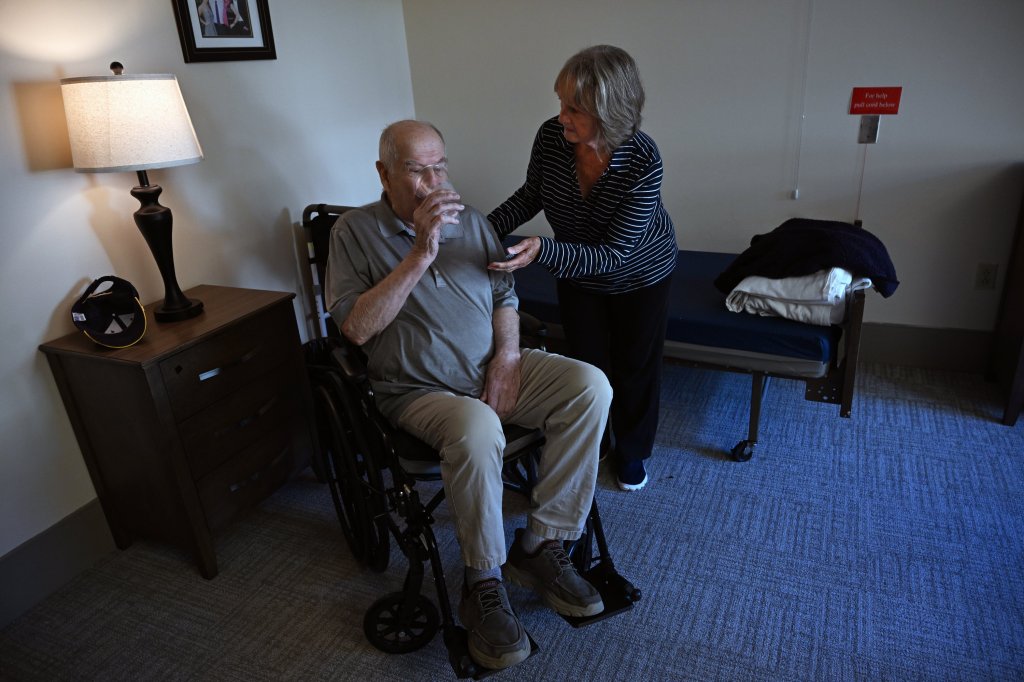 Clare Herrmann helps her husband, Jim Vollmar, at Fallbrook Woods Memory Care in Portland. (Shawn Patrick Ouellette/Staff Photographer)
The new Maine Paid Family and Medical Leave program may be providing some relief — 11.6% of 4,720 claims approved in the first three months, April through June, were to care for family members with serious health conditions, according to the Maine Department of Labor.
Some advocates are pushing for a non-refundable federal tax credit up to $5,000 for eligible working family caregivers to cover 30% of qualified expenses. However, this proposal also comes with restrictions and would cover only a small portion of care provided. In Maine, that care is valued at $25 per hour or about $52,000 annually based on a 40-hour work week, according to AARP.
Although family caregiver funding is widely recognized as lacking, advocates say it’s not showing up as a legislative priority despite dire predictions that the need will only intensify.
“There’s been a tremendous increase over the past 10 years and that’s just going to continue,” said Amanda Rector, state economist. “We have more people not only over 65, but also over 75. That’s a larger older population that will need more care from a smaller younger population that’s still working.”
The issue may draw more attention as more families and employers experience the impact of caregiving on daily living, especially in a labor market with a worker shortage, Rector said.
“If (a caregiver is) a really valuable worker, they may not be working at their best,” she said. “You may want to provide support to relieve their mental and financial stress so they don’t leave.”
REACHING OUT FOR HELP
Jim Vollmar started showing signs of vascular dementia nearly a decade ago, when the former build contractor and his wife, Clare Herrmann, were living in Georgia.
“He started not remembering things he should have remembered, like my birthday or what we did last week,” said Herrmann, who, like her husband, is now 78.
Initially, Herrmann cared for him on her own, reluctant to even ask friends for help. But the difficulty mounted as his disease progressed, so she decided to accept her daughter’s invitation to come live with her family in Portland.
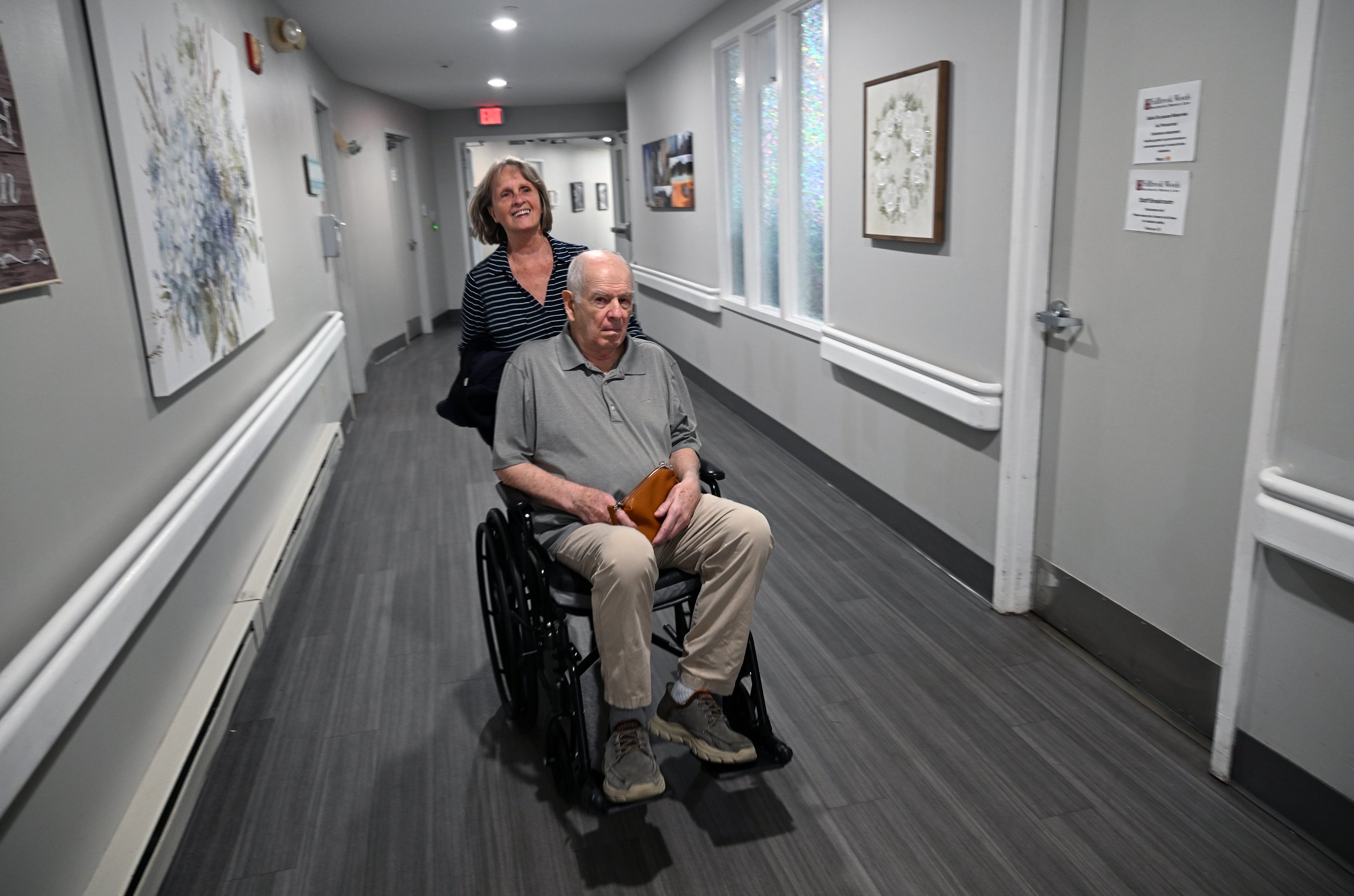 Clare Herrmann and her husband, Jim Vollmar, in a hallway at Fallbrook Woods Memory Care in Portland. (Shawn Patrick Ouellette/Staff Photographer)
As Herrmann prepared to move north, the retired office manager reached out to the Southern Maine Agency on Aging for guidance on what services and programs would be available to them, including peer support groups she still attends.
After the couple moved to Portland in 2024 — into an accessory dwelling unit they had built at her daughter’s house — Herrmann was relieved to have backup assistance from her daughter, son-in-law and grandchild. Still, she was overwhelmed by round-the-clock responsibilities.
Again, she reached out to SMAA, who helped her secure respite care for her husband so she could have a few hours off each week. One of the first things she did was take a meditation course.
“I wanted to learn how to chill,” Herrmann said. “I was so hyperaware of everything, I never really slept because I didn’t want him to fall and I didn’t want him to leave the house. He never did, but I worried about it.”
Herrmann reached out to SMAA again last spring, after her husband broke his left femur in a fall and it became clear he needed to be in a memory care facility. The agency helped her find Fallbrook Woods in Portland, where he lives now.
“They have been so supportive,” Herrmann said of SMAA. “Whenever I call, they always know who to refer me to. I can’t even enumerate all they ways they have helped me.”
REBRANDING WITH CAREGIVERS IN MIND
SMAA this month changed its name to AgeMaine and launched a new website, support network and membership program to better serve family caregivers.
“We want to create one place where family caregivers can find trusted information and training, connect with other caregivers, and get help figuring out what resources and services are available,” CEO Megan Walton said.
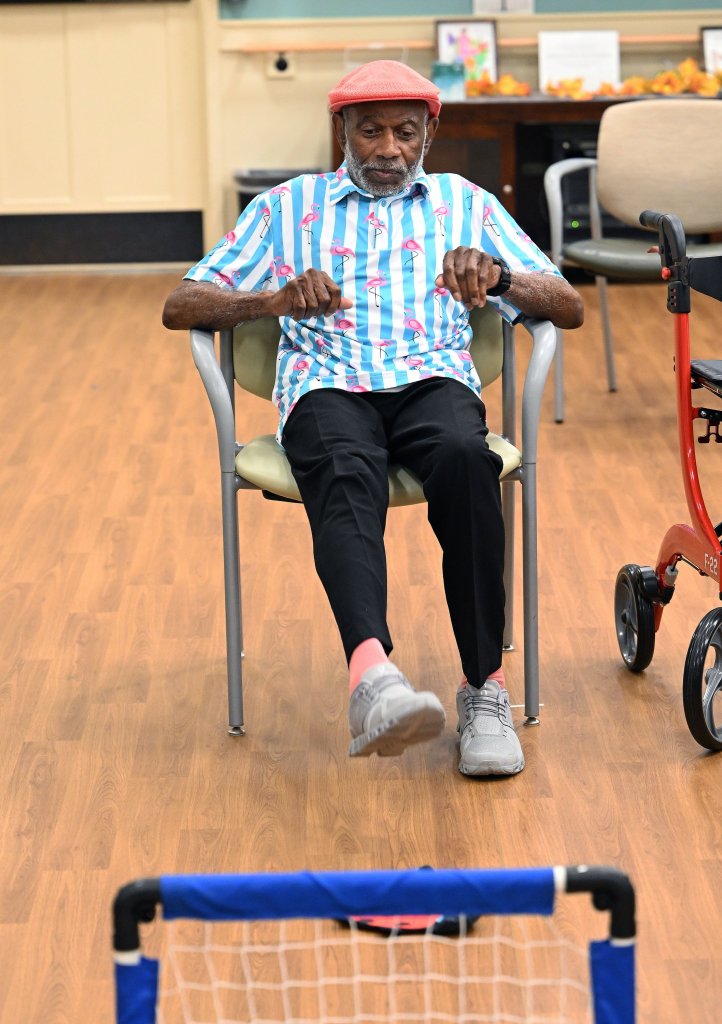 Samuel Heard plays a seated soccer game during an adult daycare program at the Samuel L. Cohen Center in Biddeford. (Shawn Patrick Ouellette/Staff Photographer)
AgeMaine.org/Caregiver, a caregiver-focused page that goes live Oct. 16, will start as an online resource hub for information and support, then expand to provide individualized guidance for family caregivers and help employers support workers who are caring for an aging adult. The agency will eventually offer a paid membership option, but the cost and structure have yet to be established, Walton said.
“We want more caregivers sharing their experiences and letting legislators know what they’re going through,” Walton said. “Peer support especially is so important. It can be so valuable to hear that other people are going through the same thing.”
The goal is to help caregivers like Marvella Heard find the support they need. While her father, Samuel, regularly attends adult daycare programs at the Samuel L. Cohen Center in Biddeford, which is an AgeMaine facility, she said she has yet to participate in caregiver support groups and other programs.
She admits that she should.
“I’m burned out because nobody is taking care of me,” Heard said. “Everybody needs a break sometimes, and I need a break, like, yesterday.”