
The state Office of Elections is proposing to formalize a procedure for breaking Hawaii election ties, and it’s pretty much the same way it determined the winners of two primary election contests in August.
The proposal to establish administrative rules for breaking ties between candidates seeking state or county office, using some kind of random process required under state law, is being done to comply with a recent Hawaii Supreme Court order stemming from a legal challenge filed by a candidate in the Aug. 8 primary.
As part of rule-making, the public has an opportunity to submit written testimony on the proposed rule or testify in person or by videoconference during a public hearing scheduled for Oct. 26.
Final approval of a new rule is up to Gov. Josh Green, though crafting the rule is in the hands of Scott Nago, the state’s chief elections officer, who carried out the two recent tie-breaking events in similar fashion to what is proposed to become the prescribed procedure to resolve future election ties.
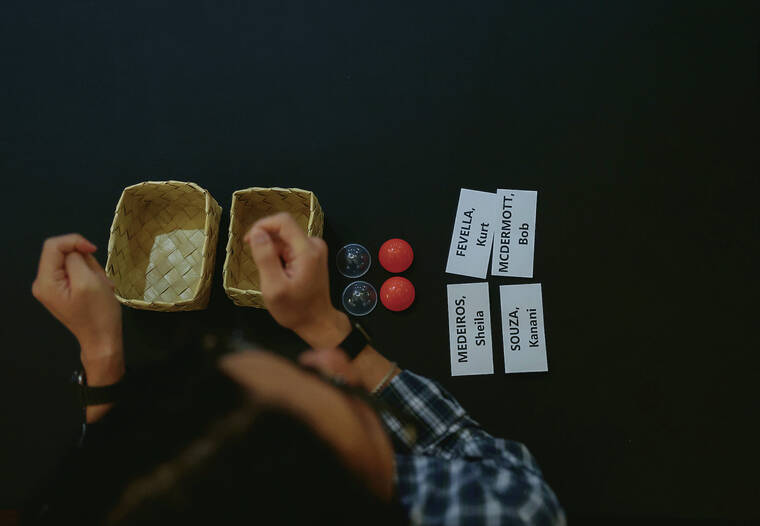
To break the recent primary election ties, which involved a pair of contests between Republicans vying for two seats in the state Legislature, names were pulled from a container in front of a public audience in a state Capitol auditorium.
In both cases, the competing candidates’ names were printed on separate pieces of paper that were held up to public view by a state elections specialist, who then folded each paper in half three times and placed them in separate plastic toy capsules not too different from Easter eggs.
The two capsules were then placed in a lauhala basket that was then covered, shaken and opened for Nago to pick one capsule with eyes averted.
The new proposed rule allows for the folded pieces of paper to be drawn from a container if capsules aren’t readily available.
Nago said the process is fair and complies with state law requiring that election ties be broken “by lot,” which means a random process.
“A drawing is the most random thing we could think of,” he said.
Nago explained that he wanted to mimic something used by other state entities, such as the Judiciary, which draws names to randomly select prospective court jurors.
The procedure used to break the two primarily election ties also mirrors how the Office of Elections has determined, every two years since 1998 without complaint, which political party’s group of contests on Hawaii primary election ballots get listed first, according to Nago.
“I don’t know why this Easter egg thing is such a big deal,” he said.
State Rep. Kanani Souza (R, Kapolei- Makakilo), who lost her tie-breaker drawing against Sheila Medeiros, filed a legal challenge with the Hawaii Supreme Court contesting the primary election vote count and the procedure used to break the declared tie.
Souza, an attorney, claimed in part that the capsules for her drawing weren’t adequately mixed up in the lauhala box.
“The ball that purportedly contained (my) name was placed in the basket towards the back of the basket … . Medeiros’ name ball appeared to have been placed toward the front of the basket,” Souza said in her complaint. “It appeared that the ball … placed in the front portion of the basket facing the audience which was the selected ball and winner of the lottery, remained in place while the shaking took place.”
In court, Nago acknowledged that the method was not tested to determine whether it favored certain outcomes, but he contended that the process was fair and impartial.
Souza also claimed that the tie-breaking procedure was invalid because it hadn’t been established as an administrative rule by the Office of Elections.
“Plaintiff contends that the drawing method was a ‘rule’ that should have been promulgated through the rule-making process,” Souza said in her complaint. “It was not promulgated, and therefore, the rule must be deemed invalid and the winner cannot stand.”
Hawaii’s high court decided that the tie-breaking method was “tantamount” to a rule under the Hawaii Administrative Procedure Act, and that the Office of Elections erred by using it without complying with the law’s rule-making requirements that include holding a public hearing.
So the court ordered Nago to expeditiously promulgate rules to implement the statute calling for election ties to be determined by lot.
The court also invalidated the primary election results for Souza and Medeiros and ordered a new election held in conjunction with the Nov. 3 general election, based on Souza contending that voting data showed two voters from another district were mistakenly given ballots for House District 43 at the Kapolei Hale Voter Service Center run by county elections officials, potentially skewing the number of valid votes cast enough to make Souza or Medeiros the winner.
The race for House District 43 had no candidate from another political party, so rerunning the primary election on the general election ballot isn’t conflicted.
Sen. Kurt Fevella, who lost a tie-breaker drawing to former state Rep. Bob McDermott in Senate District 20 affected by the same ballot distribution mistake, petitioned the high court to apply its ruling to his race. But the court ruled that Fevella (R, Ewa Beach-Ocean Pointe-Iroquois Point) missed a deadline to contest election results.
McDermott now faces Democrat Markus Owens, a former local sports television broadcaster who played baseball for the University of Hawaii, in the general election.
The Office of Elections aims to have rules for breaking future election ties in place for the Nov. 3 general election, though it’s possible for implementation to take longer.
Under the rule-making process, someone may file a written protest or other comments on the proposed rule within two days of the hearing as long as the person informs Nago of their intent to do so during the hearing. And the period for filing written protests or comments may be extended by Nago “for good cause.”
Written testimony can be emailed to elections@hawaii.gov, faxed to 808-453-6006, or mailed or hand-delivered to the Office of Elections at 802 Lehua Ave., Pearl City, HI 96782. Ten copies are required for testimony submitted on the day of the hearing.
For more information about the hearing and proposed rule, visit elections.hawaii.gov.