
By Wendy Sawyer and Brian Nam-Sonenstein
October 14, 2026
Press release
With growing public attention to the problem of mass incarceration, people want to know about women’s experiences with incarceration. How many women are held in prisons, jails, and other correctional facilities in the United States? Why are they there? How are their experiences different from men’s? These are important questions, but finding the answers requires not only disentangling the country’s decentralized and overlapping criminal legal systems,1 but also unearthing the frustratingly limited data that’s broken down by gender.2
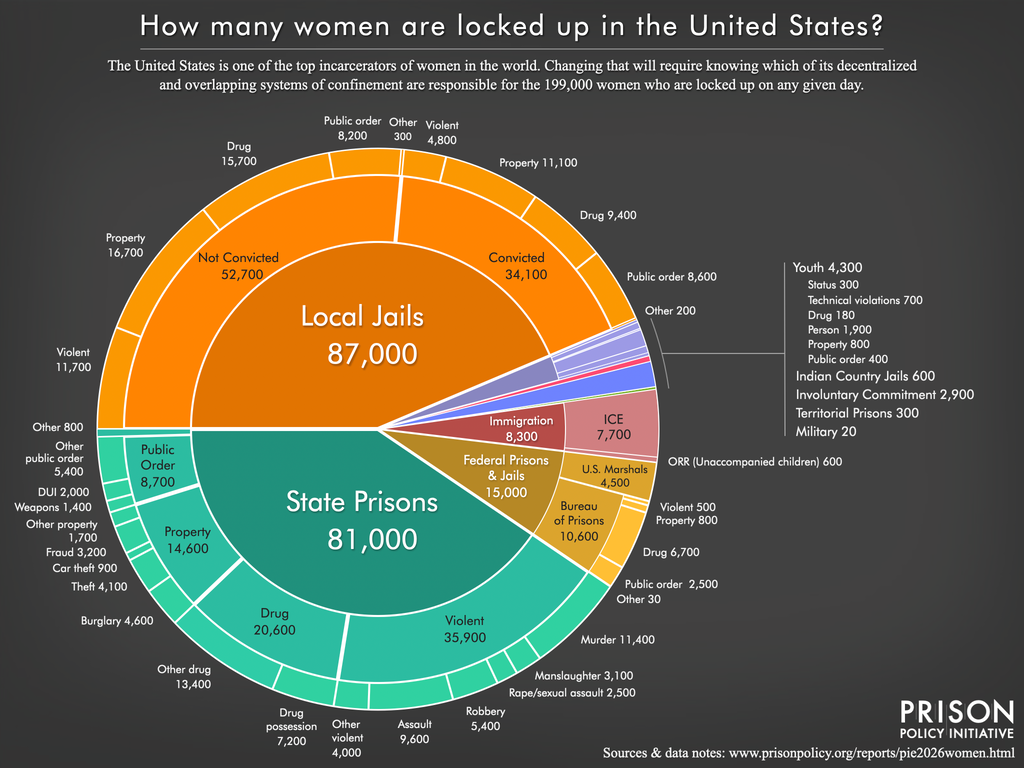
This report provides a detailed view of the 198,800 women and girls incarcerated in the United States and how they fit into the even broader picture of correctional control. We pull together data from a number of government agencies and break down the number of women and girls held by each correctional system, by specific offense, in 446 state prisons, 27 federal prisons, 2,765 local jails, 1,277 juvenile correctional facilities, 65 Indian country jails, and 148 immigration detention facilities, as well as in military prisons, civil commitment centers, state psychiatric hospitals, and prisons in the U.S. territories.3 We also go beyond the numbers, including rare self-reported data from a national survey of people in prison4 to offer new insights about incarcerated women’s backgrounds, families, health, and experiences in prison. This report answers the questions of why and where women are locked up — and much more:
Women’s incarceration has risen by almost 60% globally since 2000. For several decades in the U.S., it grew at twice the pace of men’s incarceration, yet it still receives relatively little attention, obscured by the much larger scale of men’s incarceration. Making up just 1 in 10 people behind bars, women continue to experience confinement in systems designed for men — that is, systems that ignore important gender differences, even in the data they collect and report. Frustratingly, even as this report is updated using many of the same data sources from year to year, it is not a direct tool for tracking changes in women’s incarceration over time; we are forced to rely on the limited sources available, which are neither updated regularly nor always compatible across years. Still, particularly in light of the scarcity of gender-specific data, the disaggregated numbers presented here are an important step to ensuring that women are not left behind in the effort to end mass incarceration.5
The policing and incarceration of so many women is at least partially explained by the United States’ bipartisan commitment to so-called “tough on crime” policies. Rather than cracking down on the “worst of the worst” as politicians often promise, this approach has instead made local, state, and federal governments reliant on the criminal legal system as the primary (if not only) tool for addressing a wide array of societal issues like drug use, poverty, and homelessness. As a result, governments have ensnared hundreds of thousands of vulnerable people — including nearly 200,000 women and girls — in a system that fails to resolve those issues but nonetheless returns people behind bars over and over again, destroying their lives, families, and communities in the process. The rapid expansion of a surveillant, punishing system of community supervision; the aggressive policing of “quality of life” issues stemming from disinvestment in healthcare and housing; and the commitment to long mandatory sentences under the war on drugs are just some examples of policy choices that have forced so many women behind bars.
It’s particularly notable that — in stark contrast to the total incarcerated population, where state and federal prison systems hold twice as many people as jails — more incarcerated women are held in jails than in prisons. As we explain, the outsized role of jails has serious consequences for incarcerated women and their families.
Get our latest data & analysis in your inbox!
Jails loom large in women’s incarceration
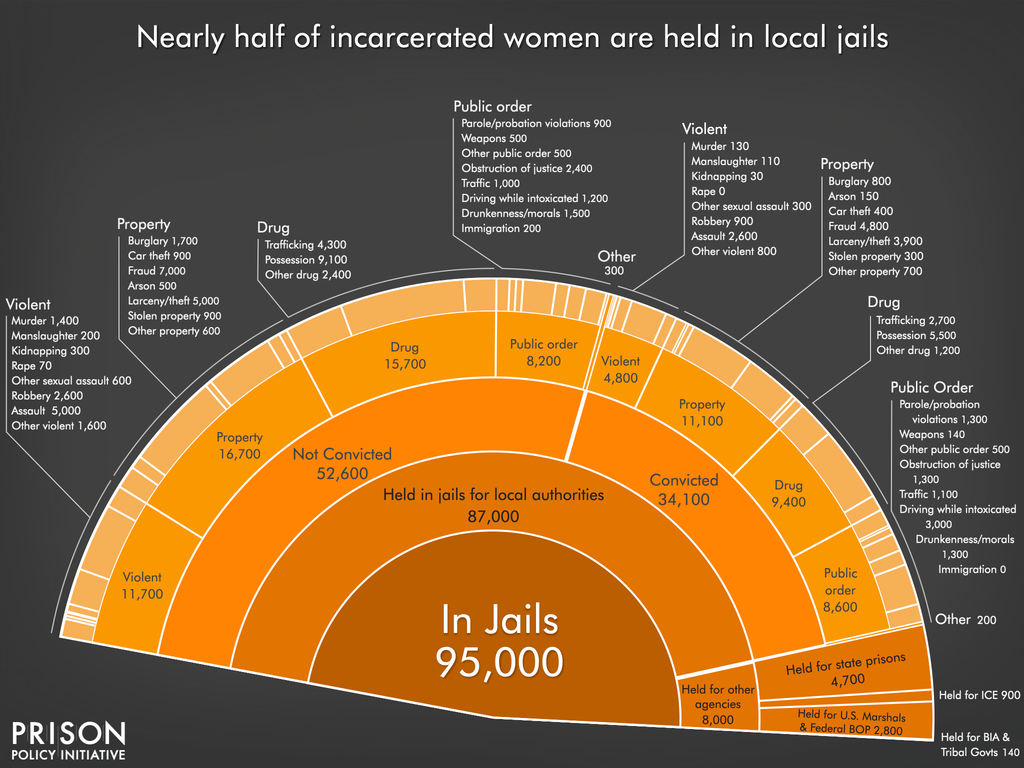
Women make up about 25% of all individuals booked into jail each year. Compared to men or the total jail population, a greater share of women in jails are serving sentences, but even so, most women being held for local authorities (61%) have not been convicted of a crime and are trapped there awaiting trial.
Aside from women under local authority (or jurisdiction), state and federal agencies also pay local jails to house nearly 7,600 additional women. For example, ICE and the U.S. Marshals Service, which have fewer dedicated facilities for the people they detain, contract with local jails to hold roughly 2,900 women on a typical day. That means the number of women physically held in jails is even higher:
Women disproportionately stuck in jails: Causes and effects
Avoiding pretrial detention is particularly challenging for women. The number of unconvicted women stuck in jail is surely not because courts are considering women to be a flight risk,8 particularly when they are generally the primary caregivers of children. The far more likely answer is that incarcerated women, who have lower incomes than incarcerated men, have an even harder time affording money bail. When the typical bail amounts to a full year’s income for women,9 it’s no wonder that women are stuck in jail awaiting trial.
After conviction, the system continues to funnel women into local jails: About one-quarter (26%) of convicted incarcerated women are held in jails, compared to about 8% of all people incarcerated with a conviction.10 This reflects the different distribution of offense types and criminal histories between convicted men and women. Women are proportionally more likely to be serving a sentence of incarceration for a property or drug offense and less likely to be incarcerated for a violent offense as compared to men. These differences mean that women are more likely to be sentenced to a term in jail, where people typically serve shorter sentences of up to one year.11
So, what does it mean that large numbers of women are held in jail — for them, and for their families? First, while stays in jail are generally shorter than stays in prison,12 jails can be especially deadly for women.13 Women have a higher mortality rate than men in jails,14 dying of drug and alcohol intoxication at twice the rate of men. And the number of deaths by suicide among women in jails increased by almost 65% between the periods of 2000-2004 and 2015-2019. Women are more likely than men to enter jail with a medical problem or a serious mental illness, and while incarcerated, they are more likely to suffer from mental health problems and experience serious psychological distress.15 Being locked up doesn’t help: research shows that incarceration can cause lasting damage to mental health.
Compounding the problem is the fact that jails are particularly poorly positioned to provide proper health care. In fact, local jails tend to offer fewer services and programs overall than prisons do, and because most programs are designed for the larger male population, women may not even have access to programming that’s available to men in the same jail. (However, this is certainly not to say that prisons are always better at meeting women’s needs, as we will discuss further.)
Jails also make it even harder to stay in touch with family than prisons do. Jail phone calls are often at least three times as expensive as calls from prison, and other forms of communication are more restricted — some jails don’t even allow real letters, limiting mail to postcards. Increasingly, both prisons and jails are doing away with real mail altogether and contracting with private companies that scan and then destroy postal mail, delivering shoddy scanned copies to the recipients. These barriers to authentic communication are especially troubling given that 80% of women in jails are mothers, and most of them are primary caretakers of their children. Children are therefore particularly susceptible to the domino effect of burdens placed on incarcerated women.16
Ending mass incarceration requires looking at all offenses — and all women
Too often, the conversation about criminal legal reform begins and ends with the question of “non-violent” drug and property offenses. While drug and property offenses make up more than half of the offenses for which women are incarcerated, the pie chart reveals that all offenses — including the violent offenses that account for nearly one-third17 of all incarcerated women — must be considered in the effort to reduce the number of incarcerated women in this country. This fact underscores the need for policy discussions to focus not just on the easier choices but on the changes that will have the most impact. Particularly in light of the fact that many survivors of domestic and sexual abuse have been incarcerated for violent crimes that occurred in response to gendered violence and abuse, excluding entire offense categories from consideration for reform makes even less sense.
Furthermore, even among women, incarceration is not indiscriminate and reforms should address the disparities related to gender identity, sexual orientation, race, and ethnicity as well. A 2017 study revealed that one-third of incarcerated women identify as lesbian or bisexual,18 compared to less than 10% of men who identify as gay or bisexual. The same study found that lesbian and bisexual women are likely to receive longer sentences than their heterosexual peers, and more likely to be put into solitary confinement.
And although the data do not exist to break down the “whole pie” by race or ethnicity, we know that Black and American Indian or Alaska Native women are consistently overrepresented in state and federal prisons: Women in prison are 47% white, 18% Black, 19% Hispanic, 3% American Indian or Alaska Native, 0.7% Asian, and 13% “other.”19 While we are a long way from having data on the intersectional impacts of sexuality and race or ethnicity on women’s likelihood of incarceration, it is clear that Black and lesbian or bisexual women and girls are disproportionately subject to incarceration.20
Prison is no answer for marginalized, traumatized women
About half of confined women and girls are held in state and federal prisons.21 In general, women in prison are serving longer sentences than those in jails, and they are often located far from their families and friends. In many geographically large states there is just one facility for women,22 making visits difficult for children and other loved ones located hundreds of miles away.23 To make matters worse, a lot of facilities that hold women are overcrowded, which can lead to heightened levels of violence, worse health outcomes, and longer terms of incarceration. In Wisconsin, for example, women’s prisons are 78% over capacity, compared to 30% over capacity for men’s facilities. But these are just a few of the many challenges facing women in prison, as we found in our 2022 analysis of a rich dataset published by the Bureau of Justice Statistics, the 2016 Survey of Prison Inmates.24
The data from the survey offer a rare in-depth look at the backgrounds and experiences of people in prison, relying on responses from incarcerated people themselves, rather than the administrative data that’s easier to collect from prison systems. In our analysis, we focused on people held in state prisons, who make up a much larger piece of the “whole pie” than those in federal prisons. Among our findings and those of the Bureau of Justice Statistics, we see that in state prisons nationwide:25
Women report childhood disadvantages at alarming rates: 12% report homelessness before they turned 18, 19% were in foster care at some point, and 43% came from families that received welfare or other public assistance. Almost half (45%) had been arrested by age 18.
Women are more likely than men to enter prison having already received a high school diploma or equivalent credential, but still over half (53%) did not finish high school.
More than 1 in 6 women (16%) experienced homelessness in the year before the arrest that led to their incarceration — a higher rate than among men (10%).
Women are more likely to be jobless (53%) than to be employed in the month before their arrest.
Women are more likely to be written up for a prison rule violation in the past year (58%), particularly for “minor” rule violations (70%).26
Women report disabilities (50%) and physical and mental health problems at higher rates than men. Over half (58%) of women met the criteria for a substance use disorder the year before they went to prison, and over three-quarters (76%) had some indication of a past or current mental health problem — both significantly higher rates than among men. Yet just 47% had received treatment for a substance use disorder and just 43% had received professional mental health care since they went to prison.
Women are more likely to be parents of minor children (58%), more likely to be single parents, and more likely to have been living with their children prior to their imprisonment — making it more likely that incarceration would uproot their children and lead to termination of parental rights, permanently breaking up their families.
About 4% of women (over 3,000) were pregnant when they went to prison, and more than two-thirds (68%) of these women had no health insurance at the time. Yet only half had received any kind of prenatal care in prison apart from an obstetric exam.2728 Only 10 states and the federal government run prison nursery programs, which are residential programs where people can live with their newborns.
These statistics confirm much of what we know about incarcerated women from previous research: By almost any measure, women in prison are worse off than men, both leading up to and during their incarceration. Furthermore, the underlying causes of women’s criminal behavior are distinct from men’s and show that they would be better served in treatment programs in their communities than by criminal legal system punishments far from home.29
Mass incarceration targets girls, too
Over 5,000 young women and girls are caught up in various systems of confinement, very often for minor and even non-criminal offenses. Most (85%) are held by the juvenile justice system, but about 600 are unaccompanied migrant children held in facilities operated by the Office of Refugee Resettlement (ORR). While children held by ORR are not held for any criminal or delinquent offense, most are held in shelters or even juvenile placement facilities under detention-like conditions.30 And a not-insignificant number of confined girls are actually held in adult prisons and jails. Like their adult counterparts, confined girls often report identities that are marginalized in the U.S. along lines of race, gender, and sexual orientation.
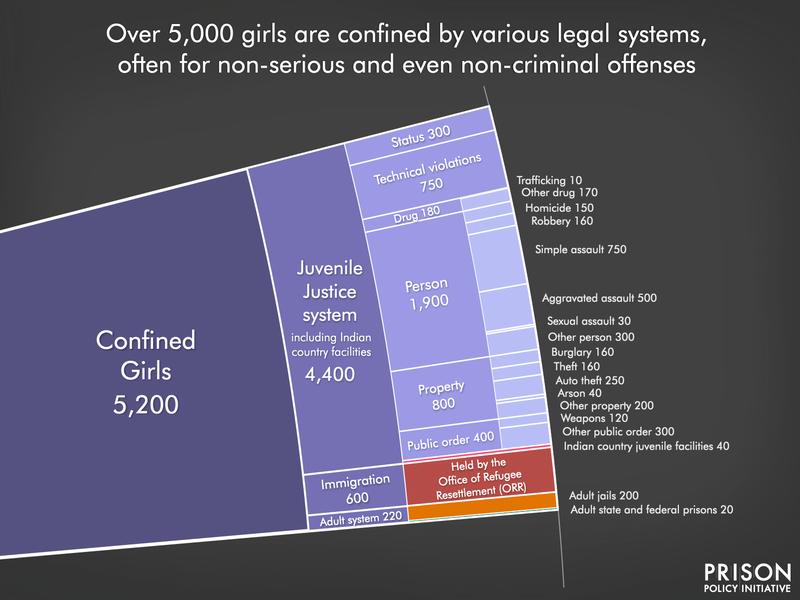
Many girls are locked up for reasons that have nothing to do with public safety. For nearly 1 in 4 girls (24%) confined by the juvenile justice system, the most serious charge levelled against them is a non-criminal “technical” violation of probation (17%) or a status offense (7%), such as “running away, truancy, and incorrigibility.” These are behaviors that would not warrant confinement except for these girls’ status as probationers or as minors. By comparison, boys are held for these technical violations and status offenses at half the rate of girls. The use of confinement in response to status offenses is particularly troubling because those behaviors tend to be simply responses to abuse.
Girls of color and those who identify as LBTQ+ are disproportionately confined by the juvenile justice system. Black girls account for 37% of all girls in juvenile facilities, despite making up just 16% of girls under 18 nationwide; similarly, 3% of girls in juvenile facilities are American Indian or Alaska Natives, compared to less than 2% of girls nationwide.31 And while LBTQ+ women are overrepresented in the adult correctional systems, a staggering 40% of girls in the juvenile justice system are lesbian, bisexual, or questioning and gender non-conforming. The comparable statistic for boys is just under 14%.
While society and the criminal legal systems subject all girls to stricter codes of conduct than is expected of their male peers, Black girls in particular shoulder an added burden of adultification — being perceived as older, more culpable, and more responsible than their peers — which leads to greater contact with and harsher consequences within the juvenile justice system. In fact, about 220 girls aged 17 or younger are locked up in adult prisons and jails,32 the result of laws that allow the transfer of youth from juvenile to adult criminal courts. In 2023, 292 girls were “waived” to criminal courts from the juvenile system — nearly 8% of all cases “waived.” More than one-third (37%) of those girls were Black.
A look at some of the smaller “slices”: immigration and involuntary commitment
Turning to those who are locked up criminally and civilly for immigration-related reasons, we find that over 1,200 women are held for criminal charges or convictions of immigration offenses by the federal Bureau of Prisons and U.S. Marshals Service. The vast majority of people incarcerated for criminal immigration offenses are accused of illegal entry or illegal reentry — in other words, for no more serious offense than crossing the border without permission.
Under the current Trump administration’s mass deportation regime, U.S. Immigration and Customs Enforcement (ICE) now civilly detains about 7,700 women and girls, not for any crime, but simply because they are facing deportation. People detained by ICE are physically confined in federally-, privately-, or state-run immigration detention facilities, and in local jails under contract with ICE or the U.S. Marshals. Many of the federally-run facilities in particular have long track records of abusive treatment and inhumane conditions.33 The roughly 600 unaccompanied migrant girls held in the custody of the Office of Refugee Resettlement (ORR) are awaiting placement with parents, family members, or friends, rather than deportation, but we include them in our count because, again, most are held in detention-like conditions.
Adding to the universe of people who are confined because of criminal legal system involvement, we estimate that about 2,900 women are involuntarily committed in a growing number of state psychiatric hospitals and civil commitment centers for underlying criminal charges. Many of these people are not even convicted, and some are held indefinitely. So-called “forensic patients” include people being evaluated or treated for incompetency to stand trial, as well as those found not guilty by reason of insanity or guilty but mentally ill, who may remain forcibly hospitalized for decades or for life. A small number of women convicted of sex-related crimes are involuntarily committed or detained after their prison sentences are complete. Meanwhile, at least 38 states allow involuntary commitment for substance use disorder treatment, and in many cases, people are sent to actual prisons and jails, which are inappropriate places for treatment.
The tentacles of mass incarceration have a long reach
Even the “whole pie” of incarceration in the chart above represents just one small portion (18%) of the women under any form of correctional control, which includes 819,400 women on probation or parole.34 Again, this is in stark contrast to the total correctional population (mostly men), where one-third (35%) are in prisons and jails.
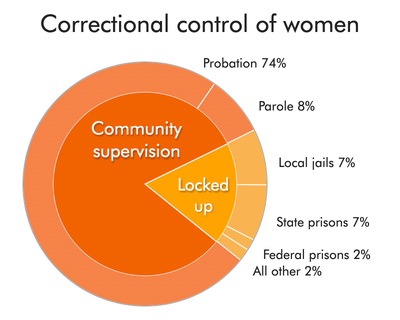
To avoid double-counting, any woman with more than one status was included in the most restrictive category, with probation counted as the least restrictive and imprisonment as the most restrictive. Percentages may not total 100% due to rounding.
Nearly three-quarters of women (74%) under the control of any U.S. correctional system are on probation. Probation is often billed as an alternative to incarceration, but instead it is frequently set with unrealistic conditions that undermine its goal of keeping people from being locked up.3536 For example, probation often comes with steep fees which, like bail, women are in the worst position to afford.37 Failing to pay these probation fees is often a non-criminal “technical” violation of probation. Childcare duties further complicate the common probation requirement to meet regularly with probation officers, especially for women with no extra money to spend on childcare or reliable transportation across town. And probation violations — even for these innocuous and understandable reasons — can land women in jail or prison who were never sentenced to incarceration in the first place. In fact, our analysis of the 2016 Survey of Prison Inmates found that one-third (33%) of women in state prisons were on probation at the time of their arrest, which underscores how this “alternative to incarceration” often simply delays incarceration.
In the wake of the 2022 Supreme Court decision to overturn Roe v. Wade, restrictive pretrial, probation, and parole conditions can also create barriers to accessing reproductive health care. Restrictions on travel are “standard conditions” of supervision in many places, requiring approval from a probation or parole officer to make specific trips. With many states now restricting access to and criminalizing abortion, seeking an abortion or other reproductive care may be difficult or impossible for many of the hundreds of thousands of women on probation or parole in those states. We estimate that 4 out of 5 women (82%) on probation or parole nationwide are impacted by state abortion restrictions. More specifically, (excluding federal probation and post-release supervision) 82% of women on probation and 85% of women on parole live in states that (1) either completely ban abortion or restrict it based on gestational age and (2) list travel restrictions as a standard condition of supervision.
Reentry is another critical point at which women are too often left behind. Almost 2.5 million women and girls are released from prisons and jails every year,38 but fewer post-release programs are available to them — partly because so many women are confined to jails, which are not meant to be used for long-term incarceration. Additionally, many women with criminal records face barriers to employment in female-dominated occupations, such as nursing and elder care.39 It is little surprise, therefore, that formerly incarcerated women — especially women of color — are also more likely to be unemployed and/or homeless than formerly incarcerated men, making reentry and compliance with probation or parole even more difficult. All of these issues make women particularly vulnerable to being incarcerated not because they commit crimes, but because they run afoul of one of the burdensome obligations of their community supervision.
Like probation before it, electronic monitoring is touted as an “alternative” to incarceration, but it is being used to expand the scope of correctional control rather than reduce the number of people behind bars. The rapid expansion of electronic monitoring in the pretrial context has created “an entirely new path to incarceration via ‘technical violations.’” And ICE’s “Alternatives to Detention” and “Intensive Supervision Appearance Program,” which both rely almost entirely on electronic monitoring, now subject hundreds of thousands more people to constant surveillance and the threat of detention or deportation than just a few years ago. Unlike probation, electronic monitoring is so constrictive that it amounts to a form of “e-carceration.” Unfortunately, the available data are not broken down by sex or gender identity, but with nearly half a million people on electronic monitoring across the criminal legal and immigration systems in 2022, it’s safe to assume that many, many women are confined by this form of mass incarceration as well.
The need for more data
The picture of women’s incarceration is far from complete, and many questions remain about mass incarceration’s unique impact on women. This report offers the critical estimate that a quarter of all incarcerated women are unconvicted. But since the federal government hasn’t collected the key underlying data in 20 years, is that number growing? And how do the harms of that unnecessary incarceration intersect with women’s disproportionate caregiving to impact families? Beyond these big picture questions, there are a plethora of detailed data points that are not reported for women by any government agencies. In addition to the many data gaps and limitations mentioned throughout this report, we’re missing other basic data, such as the simple number of women incarcerated in U.S. territories or who are being held in federal pretrial detention by the U.S. Marshals.
As public awareness has grown about the differences between gender identity and sex assigned at birth, there has been a growing interest in the question of how transgender and nonbinary individuals experience incarceration. Unfortunately, government surveys that break down data between “male” and “female” categories often include trans men among “females” and trans women among “males,” relying on housing assignments as a proxy for gender. In recent years, the Bureau of Justice Statistics had begun collecting data on transgender and nonbinary individuals — for example, it reported data on a small sample of transgender individuals in state prisons in its 2016 Survey of Prison Inmates, which we analyzed — but removed questions about gender identity from its surveys in early 2025 when Trump took office. This further muddies the picture of women’s incarceration.
While more data are needed, the data in this report lend focus and perspective to the policy reforms needed to end mass incarceration without leaving women behind.
Get our latest data & analysis in your inbox!
About the data
This briefing uses the most recent data available on the number of people in various types of facilities and the most significant charge or conviction. Because not all types of data are collected each year, we sometimes had to combine differing data sets; for example, we applied the percentage distribution of offense types from the previous year to the current year’s total count data, since prison offense data lags by one year. To smooth out these differing levels of vintage and precision among the sources, we choose to round all figures in the graphic. This process may, however, result in various parts not adding up precisely to the total.
Jails: Calculated based on the Bureau of Justice Statistics report Jail Inmates in 2024, Table 3 (as of June 30, 2024). The Bureau of Justice Statistics stopped collecting data on the conviction status of women in jails in 2005, so we calculated the breakdown based on the 2009 estimate (the most recent available) published in the Jail Inmates at Midyear 2013 — Statistical Tables. Our analysis of offense types is based on the Survey of Inmates in Local Jails, 2002. See Who is in jail? Deep dive for why we used our own analysis rather than the otherwise excellent Bureau of Justice Statistics analysis of the same dataset, Profiles of Jail Inmates, 2002. While this methodology section illustrates the pervasive dearth of women’s criminal justice data, this 2002 data continues to be the most recent data available of its kind even without regard to gender breakdown. (The Bureau of Justice Statistics finally administered another Survey of Inmates in Local Jails in 2024 and 2025, but the data have not yet been published.)
Immigration detention: The number of women in immigration detention and the facilities they are held in comes from ICE’s Detention Statistics for FY 2026 (reporting populations as of July 20, 2026, which includes the first ten months of the fiscal year). We calculated the total average daily population from the reported numbers of “Female Crim” and “Female Non-Crim” in the “Facilities FY26” spreadsheet, and categorized them by facility type as follows: 10 women held in non-ICE federal facilities (BOP or USMS CDF), 860 in local jails (ISGA or USMS IGA), and 6,808 held in facilities that typically hold only ICE detainees (DIGSA, CDF, SPC, Staging, and Family facilities). The 860 women held in local jails were then removed from the total jail population to avoid double-counting them. Because the federal BOP publishes population data by jurisdiction (as opposed to custody), the women held for ICE in the BOP facilities were already excluded from the federal prison population data.
Federal: The population under federal jurisdiction includes those held for the Bureau of Prisons (BOP) and the U.S. Marshals Service (USMS). The Bureau of Justice Statistics provides data on the BOP population in its report Prisoners in 2023; Table 20 reports the percentage breakdown of offense types for the sentenced population as of Sept. 30, 2023, and the total population of women reported in Table 2 for December 31, 2023. We applied the offense type percentages to the more recent total female BOP population. The USMS does not publish data by sex or gender, but we obtained population data by sex and offense type for fiscal year 2025 through our FOIA request 2026-USMS-000875. We removed those held in jails for USMS from the local jails slice, and included them in the federal slice, as explained in the “data definitions and clarifications” section below. We also obtained offense types by sex and status (sentenced versus unsentenced) for fiscal year 2024 in an earlier records request, but this breakdown is not shown on the pie chart. The U.S. Marshals Services does not publish any data by sex on its website.
State prisons: Prisoners in 2023, Table 2 provides the sex breakdown for the total population as of December 31st, 2023, and Table 16 provides data (as of December 31, 2022) that we used to calculate the ratio of different offense types, which we then applied to the total state prison population as of year-end 2023.
Military: For the first time, we obtained the Annual Correctional Reports from all branches of the U.S. military for reporting year 2024 through our FOIA request 25-F-3993. The Bureau of Justice Statistics does not publish data on confinement in military facilities by sex or gender identity.
Territorial prisons (correctional facilities in the U.S. Territories of American Samoa, Guam, and the U.S. Virgin Islands, and U.S. Commonwealths of Northern Mariana Islands and Puerto Rico): Estimates for the female populations were calculated based on the percentages of women reported in World Prison Brief data, which we then applied to the total populations reported in Prisoners in 2023, Table 25. The reference dates for the World Prison Brief data range from year-end 2007 (for the Northern Mariana Islands) to November 14, 2022 (for Guam).
Youth: For youth held for the juvenile justice system, we used the Office of Juvenile Justice and Delinquency Prevention’s Easy Access to the Census of Juveniles in Residential Placement tool, reporting data for 2023. The number of unaccompanied migrant girls held in the custody of the Office of Refugee Resettlement (ORR) comes from the “sex” table on ORR’s Unaccompanied Alien Children Data page, accessed September 2, 2026. The number of youth held in facilities in Indian country comes from the Bureau of Justice Statistics report Jails in Indian Country 2024, Table 7.
Criminal legal system-related involuntary commitment (includes “civil commitment” for sex-related crimes and “forensic psychiatric” commitments arising from underlying criminal charges or convictions):
Civil commitment for sex-related crimes (At least 20 states and the federal government operate facilities for the purposes of detaining people convicted of sex-related crimes after their sentences are complete. These facilities and the confinement there are technically civil, but in reality are very similar to prisons. People under civil commitment are held in custody continuously from the time they start serving their sentence at a correctional facility through their confinement in the civil facility.): We obtained data directly from 11 states through a combination of public records requests, emails from relevant state agencies, and annual reports published by those agencies. Our estimate of 8 women in civil commitment facilities is a conservative one because we are missing gender data from the other nine states and the federal Bureau of Prisons, and also because California provided a range (“fewer than eleven”), which we counted as 1. The only other states reporting women in civil commitment were New Jersey (5), Texas (1), and Virginia (1). Arizona, Florida, Iowa, Kansas, Minnesota, Missouri, and Washington all confirmed holding no women with this status. We believe this is a reasonable estimate because of our past communications with the Sex Offender Civil Commitment Programs Network (SOCCPN), which has conducted an annual survey of these populations from its members for years; the last time the survey data were broken down by sex, there were 7 women committed.
Forensic psychiatric commitments (People committed to state psychiatric hospitals by courts after being found “not guilty by reason of insanity” (NGRI) or, in some states, “guilty but mentally ill” (GBMI) and others held for pretrial evaluation or for treatment as “incompetent to stand trial” (IST)): We created an estimate for the number of women held under these statuses based on a national total (18,948 men and women) from the Treatment Advocacy Center’s 2024 report Prevention over Punishment, and the percentage of people held under these statuses who were women in a handful of states where we were able to obtain gender-specific counts. Through a combination of public records requests and state agency data publications, we found that women made up about 15% of the forensic populations from which we obtained data: 17% in Arizona and California, 13% in Minnesota, 12-36% in Pennsylvania (range based on data including several “less than 11” counts), and 20% in Washington. Massachusetts did not report any women committed at the facility holding these patients (0%). Our estimate is the result of multiplying that 15% by the Treatment Advocacy Center’s total. It should be used with caution given the low number of states providing gender-specific data.
Indian country jails (correctional facilities operated by tribal authorities or the U.S. Department of the Interior’s Bureau of Indian Affairs): Bureau of Justice Statistics’ Jails in Indian Country, 2024, Table 7, reporting data for June 30, 2024.
Probation and parole: Our counts of women under community supervision are calculated from the Bureau of Justice Statistics report Correctional Populations in the United States, 2023, Table 4 (showing the total number of women on probation and the total on parole) and Table 10 (showing the estimated number of women who were on both probation and parole when the data were collected). To avoid double-counting those women who had dual probation and parole status, we reduced the total number of women on probation by 1,400 — counting them just once, within the total parole population. This is consistent with our past methodologies, in which we categorize those with dual status by their most restrictive status — counting parole as more restrictive, as people on parole are finishing carceral sentences in the community. For readers interested in knowing the total number of women on parole and probation, ignoring any double-counting with other forms of correctional control, there were 80,400 women on parole and 740,400 women on probation at the end of 2023.
Several data definitions and clarifications may be helpful to researchers reusing this data in new ways:
To avoid double-counting women held in local jails on behalf of the Bureau of Prisons, ICE, U.S. Marshals Service, state, and other prison authorities, we removed the 8,466 women from the jail custody population reported by the BJS, as well as from the numbers we used to calculate the number of convicted women in local jails. Our calculation for the number of women held under such arrangements was based on data reported for the total number of people held in jails for federal and state authorities in Table 14 of Jail Inmates in 2024 and our own analysis of the 2002 Survey of Inmates in Local Jails, which showed that about 8.5% of those held in such arrangements were women. Because the total numbers of people held in jails for each agency are not broken down by gender, we applied that ratio (8.5%) to the totals reported as held in jails for each agency except for ICE to create estimates by gender. To estimate the most recent number available of women held in jails for ICE, we used ICE’s Detention Statistics for FY 2026 (reporting average daily populations as of July 20, 2026, which includes the first ten months of the fiscal year). We calculated the total average daily population held in jails (860) from the reported numbers of “Female Crim” and “Female Non-Crim” in the “Facilities FY26” spreadsheet that were held in facilities designated as ISGA or USMS IGA.
Because we removed people held by ICE and people under the jurisdiction of federal and state authorities from the jail population, we had to recalculate the offense distribution reported in Survey of Inmates in Local Jails, 2002 by people who were “convicted” or “not convicted” without the people who reported that they were being held on behalf of state authorities, the Federal Bureau of Prisons, or U.S. Immigration and Naturalization Service (now known as ICE). Our definition of “convicted” in that Survey included those who reported that they were held “To serve a sentence in this jail,” “To await sentencing for an offense,” or “To await transfer to serve a sentence somewhere else.” Our definition of “not convicted” included those who reported being held “To stand trial for an offense,” “To await arraignment,” or “To await a hearing for revocation of probation/parole or community release.”
Lastly, the youth slice in the main graphic does not include the estimated 220 girls held in adult jails and prisons; these girls were counted in the jail and prison populations of which they are a part. As of 2024, there were 200 girls under the age of 18 held in local jails, and we estimate another roughly 20 girls held in state or federal prisons. To calculate the latter estimate, we multiplied the percentage of youth in adult prisons that were girls, as of 2021 (the most recent year for which data are available on this point), by the reported number of youth 17 or younger in prisons in 2023 from Table 15 of Prisoners in 2023.
Acknowledgements
All Prison Policy Initiative reports are collaborative endeavors, but this report builds on the successful collaborations of the many versions of this report we have produced since 2017. For this year’s report, the authors would like to thank Aleks Kajstura for her foundational work on previous iterations of this report.
Finally, we’d like to thank each of our individual donors — your commitment to ending mass incarceration makes our work possible.
About the authors
Wendy Sawyer is the Research Director at the Prison Policy Initiative. Along with directing the organization’s research priorities, Wendy is the author (or co-author) of several major reports, including Mass Incarceration: The Whole Pie, Youth Confinement: The Whole Pie, Beyond the Count: A deep dive into state prison populations, All Profit, No Risk: How the bail industry exploits the justice system and Arrest, Release, Repeat: How police and jails are misused to respond to social problems. Wendy also publishes briefings on recent data releases, academic research, women’s incarceration, pretrial detention, probation, and more.
Brian Nam-Sonenstein is a Senior Editor and Researcher at the Prison Policy Initiative. He is the author of several major reports, including Mass Incarceration: The Whole Pie 2026, Youth Confinement: The Whole Pie 2025, Cut-rate care: The systemic problems shaping ‘healthcare’ behind bars, and Bad Behavior: How prison disciplinary policies manufacture misconduct. Brian also published briefings explaining why ending mass incarceration is an economic justice issue and how providing housing can help interrupt a major pathway to prison created by the criminalization of homelessness. In addition to his work as a researcher, Brian plays a pivotal role in supporting other members of the Research Department in shaping the framing and messaging of their publications in a way that maximizes their impact and reach.
About the Prison Policy Initiative
The non-profit, non-partisan Prison Policy Initiative was founded in 2001 to expose the broader harms of mass criminalization and spark advocacy campaigns to create a more just society. Through big-picture reports like Mass Incarceration: The Whole Pie, as well as in-depth reports on issues such as probation and parole, the organization shapes the public conversation on mass incarceration and helps the public more fully engage in criminal legal system reform.