
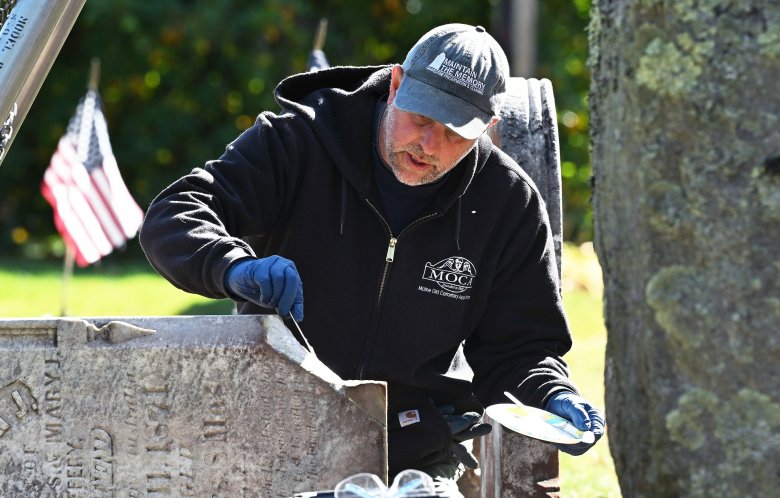
KENNEBUNKPORT — Judson Star chiseled a flaky gray substance from a piece of the broken headstone.
“It looks like someone tried to repair it with some type of goop,” he said. It crumbled in his fingers. A bathroom caulk, he guessed, not the preservation-grade epoxy that he brought in his white pick-up truck and mixed on a paper plate.
The fractured stone in Arundel Cemetery in Kennebunkport captured Star’s attention on a windy October morning. It was still upright when he started working a little after 10 a.m., but it wasn’t stable. The bottom right corner was fractured into three pieces, and wobbled under just a little pressure.
After he gently removed the layer of caulk, Star applied the epoxy with a popsicle stick. He slid the stones together like a puzzle, making sure the lines of the epitaph were flush. He clamped wood planks to the stone to hold it in place while it cured for 24 hours.
Star is a professional gravestone conservator who travels all over the state repairing headstones. He works in about 20 cemeteries a year, typically from May through November (the epoxies and mortars don’t cooperate once temperatures consistently drop below 45 degrees).
 Judson Star repairs an 1800s-era gravestone at Arundel Cemetery in Kennebunkport. (Shawn Patrick Ouellette/Staff Photographer)
In about half of the towns he works in, there are dedicated volunteers who work alongside him tackling simpler tasks like cleaning or righting a leaning stone. They ask him questions, and he is always happy to lend a tool. He likes it when they tell him about the histories of the people buried there.
“There’s a lot of things that you could know about preservation, and there are hundreds of stones that need to be worked on in each town,” he said. He teaches the enthusiastic some of his skills, so they can be a little more self-sufficient with ongoing cemetery maintenance.
NEED FOR REPAIR
There are more than 7,800 cemeteries in the state, including historic and modern burial grounds, family cemeteries and single graves, according to Walter Guptill, president of the Maine Old Cemetery Association.
“People buried their family members up on the hillside,” he said. Over time, roads changed, and some were reclaimed by woods. About 1,200 still haven’t been physically located, and that’s after MOCA volunteers found 500 cemeteries over the last two years.
Many of them are small, with 30 burials or fewer. Sometimes, it’s just a grave or two, or a base in the middle of a field, Guptill said.
The number of professional conservators pales in comparison to the preservation needs. Star is just one of about a dozen in the state, Guptill said.
So it’s often up to municipal employees, cemetery and conservation committees, descendants, historical societies and community volunteers to find and maintain these cemeteries.
“The gap is not a lack of interest or good intentions,” Guptill said. “It’s the shortage of trained people, reliable guidance, funding and organized local stewardship needed to care for thousands of cemeteries across Maine.”
LEARN TO DO NO HARM
MOCA hosts workshops and training to pass on the art of conservation to the people who are trying to keep local cemeteries alive.
Lesson one is to do no harm, Guptill said. Lesson two is to only work within the limits of your training.
There’s an adage among cemetery aficionados, Guptill said. “More damage is done in cemeteries by people with good intentions than by vandals.”
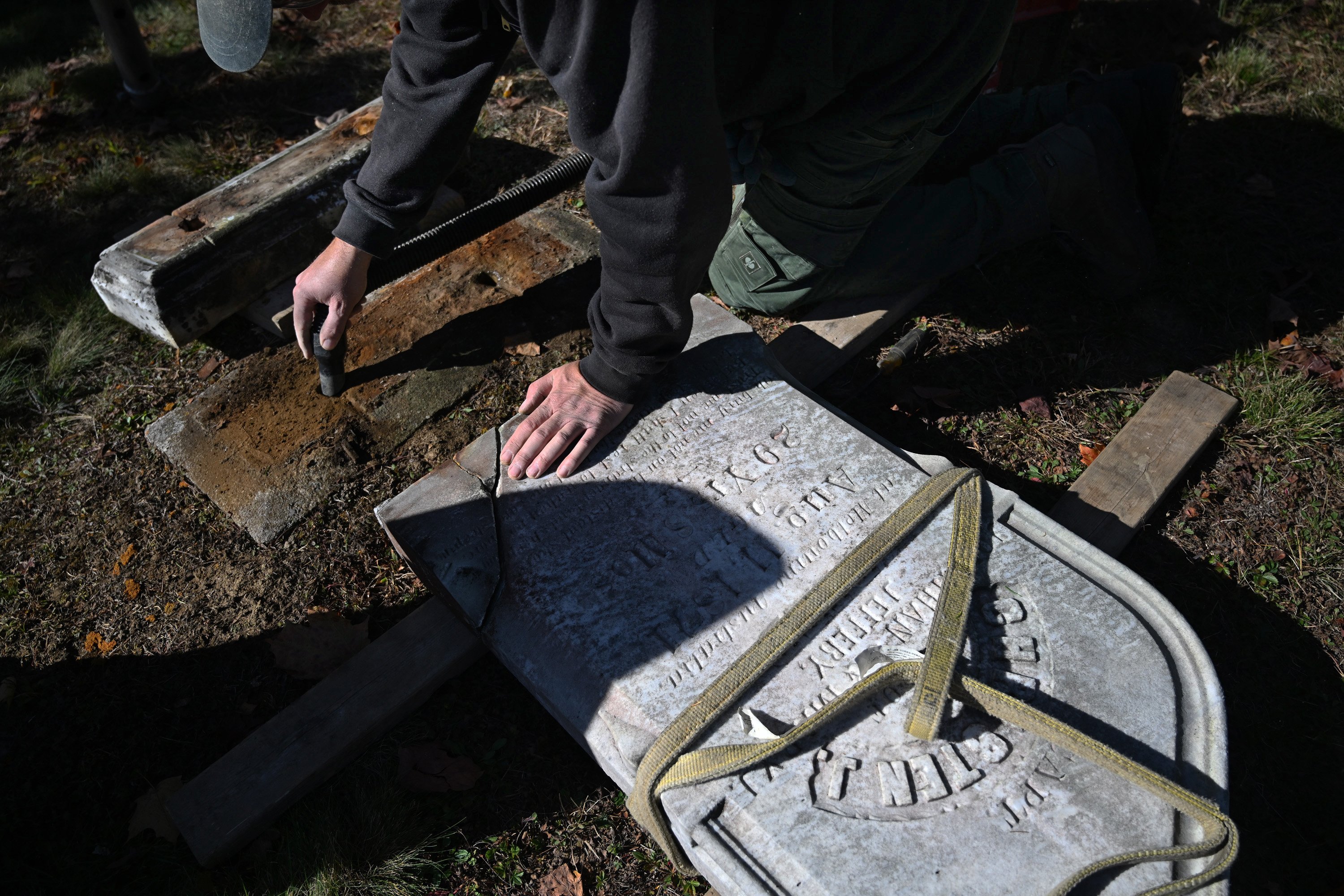 Judson Star is a professional gravestone preservationist, cleans the base of a damaged headstone at Arundel Cemetery in Kennebunkport Tuesday. (Shawn Patrick Ouellette/Staff Photographer)
Improper cleaning and repair techniques can cause permanent damage. Despite what one might think, bleach and other household cleaners shouldn’t be used on gravestones, Guptill said. Over time, the residue causes discoloration. And if you don’t use a soft bristle brush on marble, for example, you can take away parts of the surface, a phenomenon known as “sugaring.”
“People are out there trying to make it better, and we want to harness that energy with the right skillset, so that people are not only doing good but doing good in the right way,” he said. There’s a risk in overcleaning, if you can imagine, he said.
To grow the pool of experts in the state, MOCA hosts two types of workshops: a one-day gravestone cleaning class and an annual, four-day repair boot camp. The nonprofit provides the instructor and materials. Towns can volunteer their cemeteries as training grounds, so overdue repair work gets completed.
The group also has training videos and resources for people who have lingering questions.
There are three aspects of preservation work, according to Star: moving and lifting the stone, which he does with an aluminum tripod that can hoist up to a ton of weight; prepping the ground, often with gardening tools like shovels, tampers and loppers; and repairing the actual stone, which requires epoxies, mortar and lime.
 Star pieces together a broken gravestone dating to the 1800s. (Shawn Patrick Ouellette/Staff Photographer)
Star has spent about $10,000 on equipment over the past six years. He keeps a lot of it in the trunk of his truck. (He owns more than 20 orange Home Depot buckets, and keeps the components, like a plastic container of special sand, ready to mix mortar at a moment’s notice.)
He charges a per diem rate. “To fix a stone costs hundreds of dollars,” he said. “Not thousands.”
Star recognizes that municipalities might not have more than a few thousand dollars for cemetery maintenance in any given year, with most of that budget eaten up by mowing and tree care costs.
But proper cleaning techniques can be taught in a day, Guptill said, and you can see the results instantly.
“Have the courage to start,” Guptill said.
START WITH ENTHUSIASM
Star began as an enthusiastic volunteer. Or rather, he started out as someone who didn’t really think twice about cemeteries.
But that changed when his wife’s parents died in short succession, and both of them were buried in Arundel Cemetery.
“Now that we had family there, there was a lot more connection,” he said. “You’re no longer just driving by.”
He started helping out with fall and spring cleanups, picking up sticks and debris. He realized that cemeteries can be happy places, and that good people take care of them. He joined the board about 10 years ago, and in 2019, started his business, Maintain the Memory, cleaning gravestones locally. His town of Kennebunkport has 75 cemeteries, which kept him busy in the beginning.
 Star started his business, Maintain the Memory, in 2019, cleaning gravestones locally. (Shawn Patrick Ouellette/Staff Photographer)
On this particular October morning, he worked a stone’s throw away from the first grave he ever repaired, in the same cemetery where he discovered his love of preservation.
About a year after starting his business, he wanted to expand his skillset. He participated in the MOCA four-day workshop. He joined the MOCA board, and slowly acquired specialty equipment, like an aluminum tripod and different kinds of mortars. His business grew by word of mouth.
“There’s something deeper than just fixing a stone,” he said. “There’s an emotional aspect. I hope somebody’s doing this for my stone in a couple hundred years if it needs it.”
BREATHING NEW LIFE
Sometimes the preservation work can be dramatic, breathing new life into what was once dilapidated or unrecognizable.
Wescott Cemetery in South Portland didn’t look like a burial ground for decades. A vandal had knocked over all the stones sometime before the 1980s, and the pieces were stored in a shed until this summer, when the historical society received a $5,000 donation from Peter and Muffet Wright to aid their restoration.
Kathy DiPhilippo, the historical society’s executive director, had been tending to this small family cemetery tucked in a residential neighborhood of Thornton Heights for years. This summer, she went to MOCA’s four-day training with her husband, and connected with Star through the group.
Together with the help of a small group of experienced volunteers, they put nearly 20 stones back together, including one that had been fractured into 13 pieces. Viewed in sunlight weeks later, it glowed like a stained glass window.
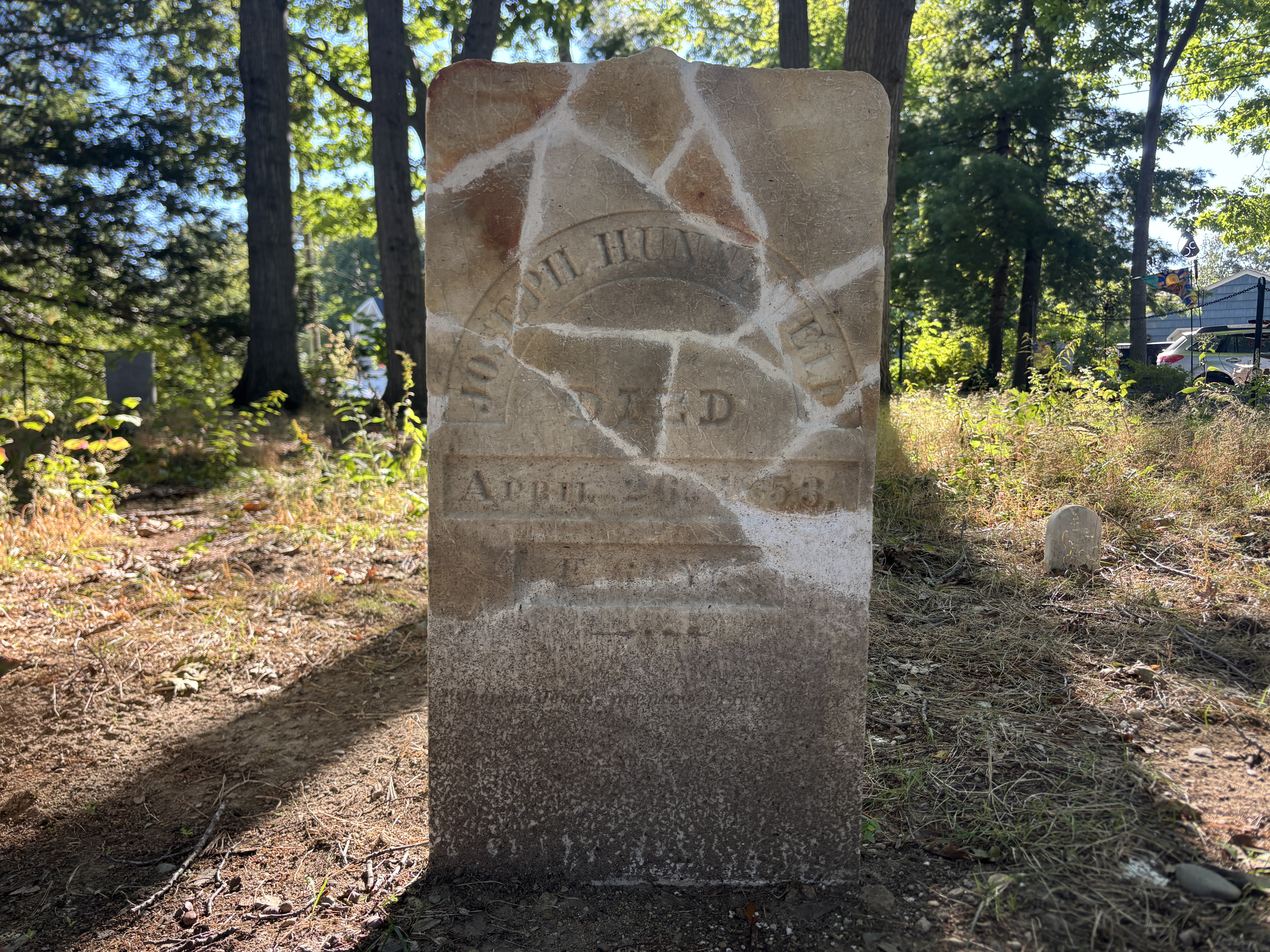 This shattered headstone in Wescott cemetery was restored with epoxy. (Dana Richie/ Staff Writer)
“It’s incredible,” DiPhilippo said.
Over the years, Star has worked with a lot of volunteers. He said restorations usually trace back to one or two people who care.
“It just takes someone saying we need to do something,” he said.