
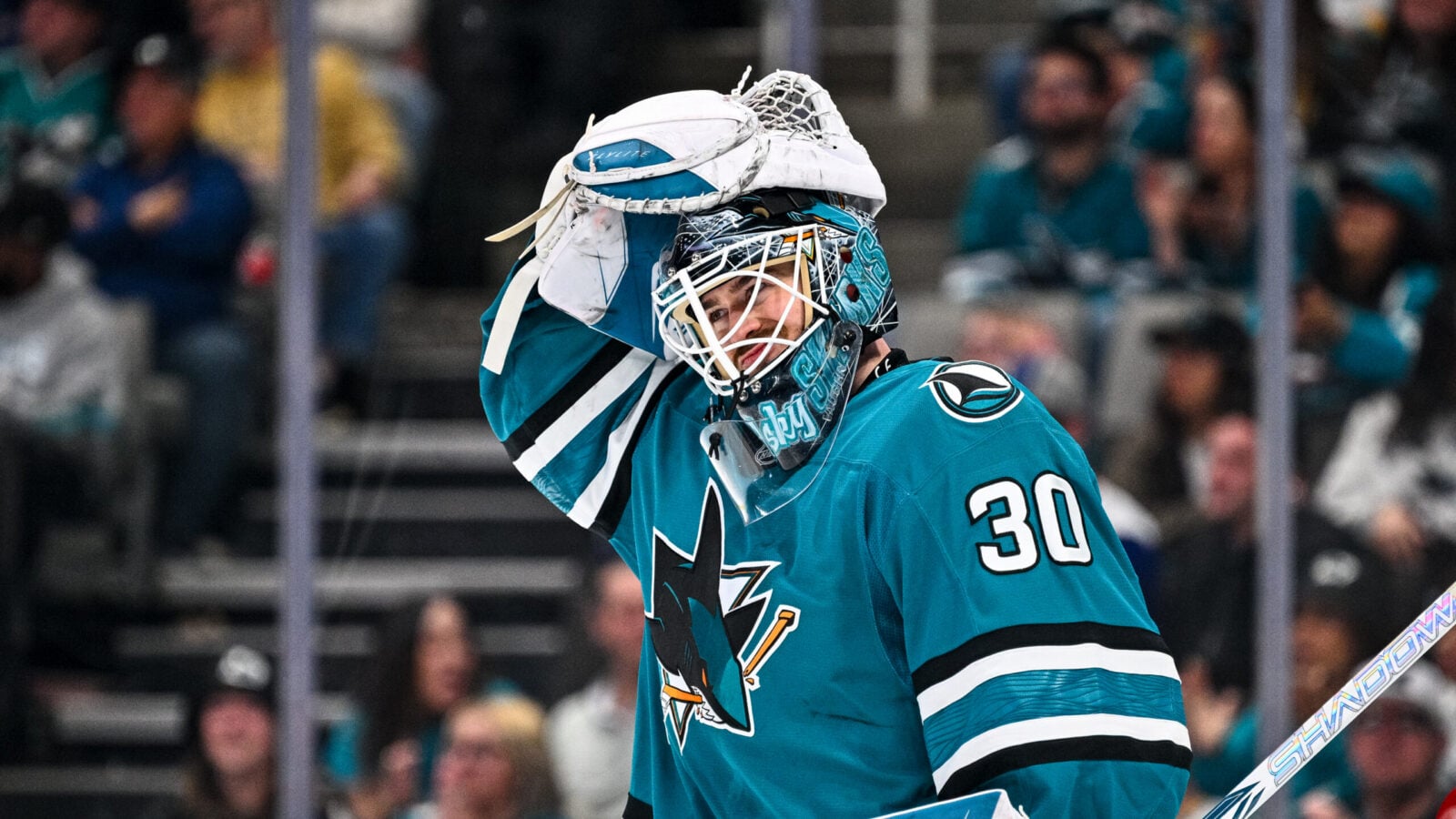
Goaltending is a touchy issue for many head coaches to discuss.
They defer their netminding decisions, often, to their goaltending coaches.
Which is why, in most cases, San Jose Sharks head coach Ryan Warsofsky gives non-answers about his goaltending, unless he’s speaking positively about it.
Sharks tools
“I thought he made some saves,” Warsofsky said, carefully, about Yaroslav Askarov’s performance in a 6-3 loss to the Boston Bruins on Tuesday night. “There’s not much that he can do on some of those.”
Warsofsky’s expertise is forwards and defensemen and special teams and systems. What happens after all that, when the puck gets to his goalie? That’s on Askarov or Alex Nedeljkovic, or above them, director of goaltending Evgeni Nabokov or goaltending coach Thomas Speer.
The media, however, rarely receives access to Nabokov or Speer. We’ve asked.
Typically, organizations want the GM or head coach or scouting directors to be the public voices of their specific aspects of organizations. But, you rarely see a goaltending coach speaking on behalf of the organization. Maybe we should see that more, because of how siloed the goaltending position is.
I’d love to chat with Speer at mid-season, to get what would be highly-educated if understandably filtered thoughts on his goalies and the environment around them.
Of course, organizations should also pay their goalie coaches more, if they’ve got to be media trained, too. But that’s another story.
In the end though, it would help demystify the sport’s most mysterious and siloed position.
That leaves, for this story, analytics to judge Askarov’s performance against the Boston Bruins.
The raw numbers don’t favor the young keeper: He stopped 20-of-25 shots, and for the season, has a 2-3-0 record and .848 Save %. That Save % is among the NHL’s worst. As of Oct. 13, league-average Save % is .885.
Personally, I don’t think the raw numbers this season, which puts lot of weight on Askarov, are necessarily fair.
Stathletes’ micro-stats give a little more nuance. I don’t think these stats are be-all, end-all, but they’re better than just plain Save %.
Let’s go backwards, through each of Askarov’s starts this season.
On Tuesday, Askarov was expected to give up 4.14 Goals. He gave up five, for a -0.86 Goals Saved Above Expected. On the other side, Jeremy Swayman was expected to give up 4.09 Goals, he gave up three, for a +1.09 Goals Saved Above Expected.
That feels right: The San Jose Sharks did not do Askarov any favors, but Swayman outdueled him. The Sharks probably should’ve got at least a point in a wide-open game.
On Oct. 10, in a 3-1 loss to the Edmonton Oilers, Askarov was expected to give up 2.16 Goals. He gave up three, for a -0.84 GSAE. The Sharks, however, made life too easy for Tristan Jarry. He was expected to give up 1.36 Goals, and he gave up one.
It would’ve been nice for Askarov to steal a point in his team’s best defensive performance of the season, but hard to blame him for a completely punchless offense.
Oct. 5, a 5-0 loss to the Dallas Stars, is actually Askarov’s worst analytical performance this season. He was expected to give up 3.0 Goals and gave up five. On the other side, Jake Oettinger was expected to give up 1.67 Goals but earned the shutout.
Askarov was bad, but the team was worse, especially in the early part of the game, when it mattered.
On Oct. 3, a 5-4 OT win over the Los Angeles Kings, Askarov was expected to give up 3.84 Goals. He gave up four, for a -0.16 GSAE. On the other side, Anton Forsberg was expected to give up 2.47 Goals. He gave up five for a -2.33 GSAE.
You can say Forsberg lost this game for the Kings. Askarov wasn’t outstanding, but he outplayed Forsberg by a significant margin, and most importantly, earned the win.
On opening night, a 4-3 OT win over the Florida Panthers, Askarov was expected to give up 3.25 Goals. He gave up three for a +0.25 GSAE, his best performance of the year. On the other side, Akira Schmid was expected to give up 3.77 Goals. He gave up four for a -0.23 GSAE.
Once again, Askarov outdueled the opposing goalie and earned the win.
In this case, I do think the analytics match the eye test.
There are many ways you can go with that.
On the bright side, Askarov has only really “blown” one game for the San Jose Sharks this season, it just happens to be the most recent one.
Also, Askarov hasn’t been as bad as his counting stats: The Sharks clearly haven’t provided a winning environment for him. In fact, they’ve lost the Expected Goals battle in four of his five starts, so his 2-3-0 record might actually be to his credit.
It’s also just six games into the season.
But on the flip side?
You need a goalie to steal a game for you at some point, and Askarov hasn’t done that this year, or for the most part, since last November, when he went 8-2-0 with a .947 Save %.
Also, San Jose is still a team with a thin margin for error. I believe they’re better than last season, but they’re not some offensive juggernaut a la the Colorado Avalanche that can overcome consistently average or below-average netminding.
The Sharks didn’t trade basically two first-round picks for Askarov three summers ago for the 2020 No. 11 pick to perform at the standard of the defense around him. There are more expectations for him, as there should be, than the run-of-the-mill keeper.
I can understand the impatience around him, but reminder, he’s just 24.
So has Askarov been “good enough” this season?
I think you can argue that he actually has been. But you can also say that he’s expected to be more than just good enough, and that the Sharks need him to be more than that, if they want to make the playoffs.