

A new form of global timekeeping is about to be introduced that could forever change how our clocks work.
A vote by the International Bureau of Weights and Measures on Thursday is expected to ditch so-called leap seconds that keep atomic time in line with astronomical time.
Leap seconds have been implemented 27 times since 1972 to keep our clocks in sync with Earth’s position to the Sun.
The practice first became problematic with the emergence of the World Wide Web and satellite communications, with Amazon, Google, Meta and other tech giants campaigning to have the “devastating” time quirk scrapped.
Scientists claim that replacing leap seconds with a leap hour would be less disruptive and would rarely need to be used.
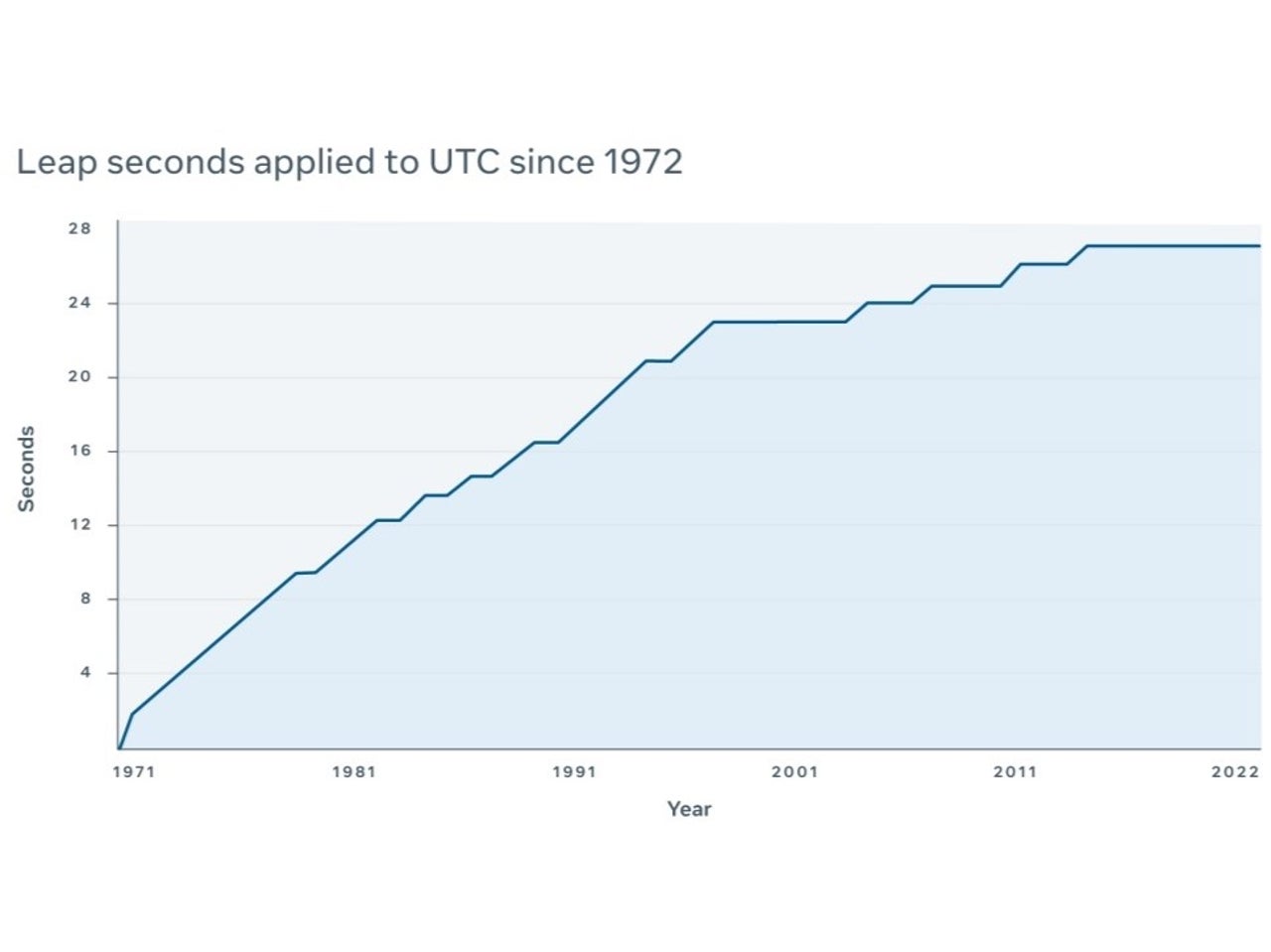
The leap second has been used 27 times since its introduction 50 years ago (Meta)
The world’s international time system, known as Coordinated Universal Time (UTC), is maintained by ultra-precise atomic clocks, such as those at the National Physical Laboratory in the UK.
Much of today’s infrastructure and technologies, such as smartphones and financial markets, rely on this dependable and consistent way of measuring time.
Applying leap seconds to this system is tricky to implement and can cause significant disruption to telecommunications, global navigation systems and grid synchronisation.
Rather than implementing a leap second every couple of years or so, scientists say that shifting to a leap hour would require an update once every thousand years.
“The decision taken today reduces the risk to systems that depend on precise and continuous time synchronisation, including national infrastructure that we rely on daily,” said Setnam Shemar, principal scientist at the National Physical Laboratory.
“Leap seconds can be difficult to implement reliably, and if not applied correctly they can cause differences in time across networks, potentially leading to the failure of systems such as mobile phone networks or electricity grids.”

Clocks of the art installation ‘Zeitfeld’ (time field) by German artist Klaus Rinke are seen in Duesseldorf, western Germany, on 28 March, 2024 (AFP/Getty)
In recent years, the unusual possibility of a negative leap second has arisen due to an acceleration in the Earth’s rotation.
It would be the first time a negative leap second has ever been implemented, which could further increase the risk of disruption.
The vote will mean that from 20 May 2027, a difference of up to 1 hour will be allowed between UTC and astronomical time (UT1) before intervention is needed.
“The relationship between UTC and UT1 is important for some applications, such as astronomy and celestial navigation,” Dr Shemar said.
“The decision would not sever that link: UT1 will continue to be monitored and its difference from UTC will continue to be disseminated through established international services.”