
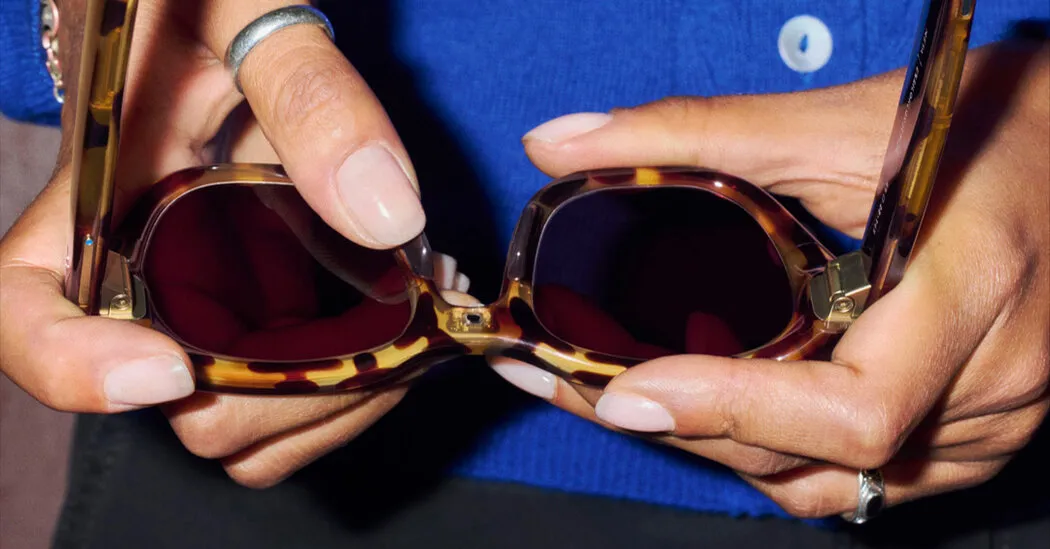
First came the fake influencers, the A.I. ad campaigns and the chatbots for shopping. Now, fashion is dealing with the relentless promotion of smart glasses, humanoid robots on the runway and polarizing scions of Silicon Valley sitting front row.
So it makes sense, in a way, that fashion influencers, writers and editors, attracted to money and power and always looking for ways to support themselves, have lately cozied up to Big Tech companies.
Many in recent months have accepted gifts, sponsored content deals and invitations to events where they are encouraged to try the latest A.I. wearables and wax eloquent about how to use the technology for planning their outfits.
The deals can be lucrative, the events luxe.
Vogue World’s recent extravaganza in Milan was sponsored by Meta Glasses with “additional support” from OpenAI as well as from nontech companies like eBay and Eli Lilly, and had robots appear alongside human models during a runway show dedicated to Italian craftsmanship.
Last month, fashion influencers and designers were flown out to the Meta campus for a day of panels that concluded in a keynote by Mark Zuckerberg, clad in trousers from the Row, and a party where at least some participants received free Meta Glasses.
Conscious of the wary feelings bubbling up around A.I., the influencers have tried to strike a tone that is at turns dutiful, curious and half-apologetic — as well as occasionally defensive when confronted by criticism in their comment sections.
“Hate to say it, but A.I. did a great job making outfits for me,” read the headline of a recent newsletter from the fashion influencer Leandra Medine Cohen.
The newsletter post was sponsored by Yahoo Scout, Yahoo’s A.I.-powered answer engine, and Cohen had used the tool to help her craft ensembles to transition her wardrobe from summer to fall.
“Layer a neutral knit over cream trousers to stay warm while maintaining an effortless, effortless vibe,” it advised her. Cohen embedded photos of herself trying this and other A.I.-generated looks.
“I know the popular opinion is to feel frustration/fear that A.I. is going to replace us, but I strongly believe that if we use it correctly, it’s more likely going to enhance us,” Cohen wrote.
Emily Holtzman, the founder of Sunday on Bowery, an art studio specializing in hand-painted playing cards, subscribed to the newsletter just so she could leave a comment: She called Cohen’s post “diabolical to any creative out there.”
“It was disheartening and disappointing to see a creator I admire promote A.I. for what should be a very human task,” Holtzman told The New York Times in an interview. “Creators are definitely being targeted as vessels for A.I. propaganda.”
Responding to Holtzman’s comment, Cohen wrote: “Testing a tool that is already out there (and most likely not going anywhere) and leveraging it to help you do something that will still necessarily require you to use your creative energy (actually make the outfit).”
Cohen declined to be interviewed for this article, and Yahoo did not respond to requests for comment.
Some in the industry have looked on at these experiments with ambivalence, as they continue to weigh whether A.I. is just another tool or something more sinister. Others have expressed more outright skepticism at the creep of the technology into fashion spaces.
“Some people would say, ‘I’m still kind of at the controls here — it’s just helping me create more powerfully,’” said Jonah Weiner, the co-writer of the fashion newsletter Blackbird Spyplane, where last year he wrote critically about J. Crew’s use of A.I. to make a series of vintage-feeling posts. (J. Crew added a caption on its Instagram calling the photos “digital art” after the Spyplane newsletter.)
“Whether or not that is true is an open question,” he continued. “There are others cases where it seems bogus.”
Recently, Meta has been leading the charge as it tries to build a towering presence in the fashion world. Meta Glasses was among the sponsors of the fifth edition of Vogue World, the mega-runway show and spectacle created and hosted by the fashion outlet.
Held at the Galleria Vittorio Emanuele II shopping center in Milan, the Vogue event was partly intended to pay “tribute to craftsmanship and the human touch,” Anna Cafolla, Vogue’s news editor, wrote in an article.
But some viewers at home balked when they saw that one of its five themes was “The Age of Intelligence,” and watched as humanoid robots by the Chinese company Unitree Robotics walked down the runway alongside the supermodels Alex Consani, Ruth Deng and Yumi Nu.
The replies on Vogue’s Instagram posts featuring the robots were filled with outrage and mockery. In one post, Vogue acknowledged that the robots had “divided the internet,” to which many users responded that they were seemingly united in their opposition.
In the days after the show, footage of Miuccia Prada and Alessandro Michele, the creative director at Valentino, the moment the robots appeared on the Vogue World spread widely across social media. Many speculated that the designers seemed skeptical about the participation of the robots.
In a statement to The New York Times, a Vogue spokesperson said: “Robots and artificial intelligence are very much here — they are already a part of many of our lives — but we’ve not yet seen them reach their full potential, for better or for worse. That was what we wanted to capture at Vogue World: incredibly powerful technology that is, in many ways, still finding its feet.”
Last month, a Meta spokesperson wrote in an email to The Times that the Vogue World event was meant to be a “direct through line” with Meta Connect, an annual tech conference Meta hosts to unveil its latest products to people in the tech industry who cover and review them that took place days after the Vogue runway show this year.
This time, a smattering of people in the fashion world also attended: Meta’s email included a list of 19 fashion writers, editors, designers and influencers who had been invited.
The representative noted that the company invited this group to earn “cultural endorsement” from the fashion industry’s top players.
“I think that it always has to be a symbiotic relationship,” Eva Chen, the director of fashion partnerships for Instagram, said later in an interview. “It needs to be a fit for both Meta and for the industry.” What does Meta get from it?
“For them to tell their stories on Instagram,” Chen said. “Them sharing their artistry through our platform. We are like the vessel.”
The designer Mike Amiri; the podcast host and columnist Chris Black; the stylist Wayman Bannerman; and Jalil Johnson, a fashion influencer who writes the popular Substack newsletter Consider Yourself Cultured, were among those who attended Meta Connect.
Most guests arrived in California on Sept. 22 and were treated to a dinner that night, Johnson said. The next day, there were several panels, followed by a party with an open bar, according to Johnson.
“It had that energy of a college party,” he said. “It wasn’t as rambunctious as that sounds, but it just had that energy.”
The event did not sell him on the Meta Glasses. (“I have no need for those glasses in my life right now,” Johnson said.)
But he has found a use for Muse, Meta’s new A.I. agent, he said. He has a newsletter coming out soon about how it helped him identify a coat he saw someone wearing in Paris while he was in town for fashion week.
Johnson said he understood the overall hesitance to embrace A.I. and other new tech, but he also saw the other side of the argument.
“Historically, whenever new technology is presented, there’s mass pushback and there’s basically fear mongering about this being the end of civilization,” Johnson said. “There is validity in apprehension and fear, but if you think about what the glasses are doing, which is taking photos, the camera, that’s your phone. What’s the difference between taking a random photo of someone with your phone?”
The social media influencer Blakely Thornton, known for his piercing commentary on the fashion world, saw it another way.
“Fashion and luxury fashion boils down from the creativity of the human spirit and the human hand,” he said. “These are people that take thousands of hours to do something creatively from a human vision, and I think that is the antithesis of what A.I. is.”
Some influencers have tried to occupy a gray zone around the technology, falling just short of a full-throated endorsement but keen enough to appear at sponsored events and try it for their large followings.
Last month, the fashion writer Laura Reilly dedicated an entire post to the Meta Connect event, what she called the “Meta Gala,” in her Substack newsletter, Magasin.
The “big through line,” Reilly wrote in the post, “was that Meta wants to be chic.”
In the newsletter, which has over 46,000 subscribers, according to the tag that appears beside her page, Reilly said she was not paid for the post discussing the Meta Glasses. (Reilly initially agreed to be interviewed but did not respond to follow-up requests.)
“So disappointing the uncritical endorsement of the Meta Glasses,” a reader commented on Reilly’s post.
“Not an endorsement,” Reilly replied.

Sandra E. Garcia
Reporter
I have seen AI and tech creep onto my algorithm through posts by designers, influencers and artists that I follow. How has Big Tech come across your feeds?
Vanessa Friedman contributed reporting.