

David Byrne is in the spare bedroom – also a music room – of his apartment in New York.
The 74-year-old writer, musician and onetime frontman of Talking Heads, almost fills my screen with his shock of white hair and a blue shirt, but behind him I can see cardboard boxes piled up on a metal shelf and the headstocks of an electric guitar and a bass.
He pauses frequently as he speaks, but on the page his words turn into perfectly coherent, thoughtful paragraphs. His speaking style reminds me a lot of his singing.
His new book, Sleeping Beauties: Why Good Ideas Go Dormant and How They Wake Up, is a fascinating look at the way concepts from the worlds of art and science and philosophy can be forgotten for decades, centuries, even millenniums before being rediscovered through pure luck or the vagaries of a changing zeitgeist. (At the start of each chapter Byrne estimates how long each idea was “asleep”.)
It’s meticulously written and researched, and Byrne’s passion for it is infectious. When I bring up artists or scientists from the book he responds with a delighted “Yes!”, as though I were introducing the subject randomly and not because he had introduced me to them in his writing. When I tell him my 13-year-old nephew loved his rain- and windswept Dublin gig in June he looks very amused.
The phrase “sleeping beauties” was first used by the researcher Anthony van Raan in 2004 to describe formerly ignored but consequential science papers.
“I loved the term,” Byrne says. “It seemed to really resonate, and I immediately thought, ‘Oh, this applies beyond science.’ So I started collecting. I’d read about something or hear about something. If I told people that I was working on this, they’d say, ‘Oh, do you know about..?’ I was kind of down the rabbit hole.”
Some artists hate the idea of analysing creative output, thinking it erodes the magic. Byrne, whose earthy grooves have always come with a side order of art-rock intellectualism, does not agree.
“I enjoy asking why something’s popular, why something is the way it is, why it ended up like this and not like something else,” he says. “Delving into that, I don’t think it takes away from the pleasure or the wonder or the awe of listening to a piece of music or reading something or a scientific discovery. I think it actually deepens it. Knowing how a car engine works doesn’t affect how you can drive.”
 David Byrne. Photograph: Shervin Lainez
Sometimes an idea can be discarded because it doesn’t fit the dominant ideology of the time, he says. In the book he writes about the way the biologist Lynn Margulis’s discovery that interorganism symbiosis was a key part of evolution was ignored for decades.
“I’m probably biased towards co-operation as opposed to competition as a valid engine for creativity and things being discovered,” he says. “But for many decades it’s been pushed aside, and in business, science and the arts the idea has been dominant that competition drives things.
“But some of these scientists and sociologists and evolutionary people discovered that sometimes animals or plants or cells co-operate, and sometimes they actually become a new entity by co-operation. They have this symbiotic union that happens, and their odds of survival increase that way.”
Margulis’s idea ran against the grain. “By that time the idea of survival of the fittest got in some ways perverted to survival of the strongest. She was showing us that it’s not the only way. Sometimes something new comes into being because of co-operation.
“Businesspeople like to think, I’m successful because I’m smarter than the others. Sometimes you were just meaner or lucky. They tend not to give luck much credit.”
Luck is another theme of the book. “Sometimes it’s just the wrong thing in the wrong place, and then [years later] someone stumbles on it.”
Another of the reasons innovations get ignored is prejudice, Byrne says. In the 1940s the abstract artist Janet Sobel “started doing work on these abstract paintings. It was just this texture of paint and splatters and all this kind of thing. She’d lay the canvas on the floor of her apartment.”
Her son “connected her with other well-known artists at the time, and she got some gallery shows and was to some extent well accepted. However, with the art world there was a sexism involved, and a sense that she was not part of the boys’ club.
“She was described as a ‘housewife in Brighton Beach’, which was a put-down, like she was not a serious artist.”
Sobel made a painting called Milky Way; shortly afterwards, Jackson Pollock made a very similar work, called Galaxy.
“It’s pretty clear that Jackson Pollock saw her work and within a year or so he was doing almost exactly the same thing,” Byrne says. “He’s held in very high regard. Not to take anything away from him, but it really seems obvious that he got anointed, probably because he was a macho guy. She was kind of pushed aside.”
Some work is sidelined because the creators themselves thought it too odd in the context of their time, such as the dark and fantasmagoric pieces of art that have become known as Goya’s “black paintings”, which he kept on the walls of his own house rather than intending them for public consumption.
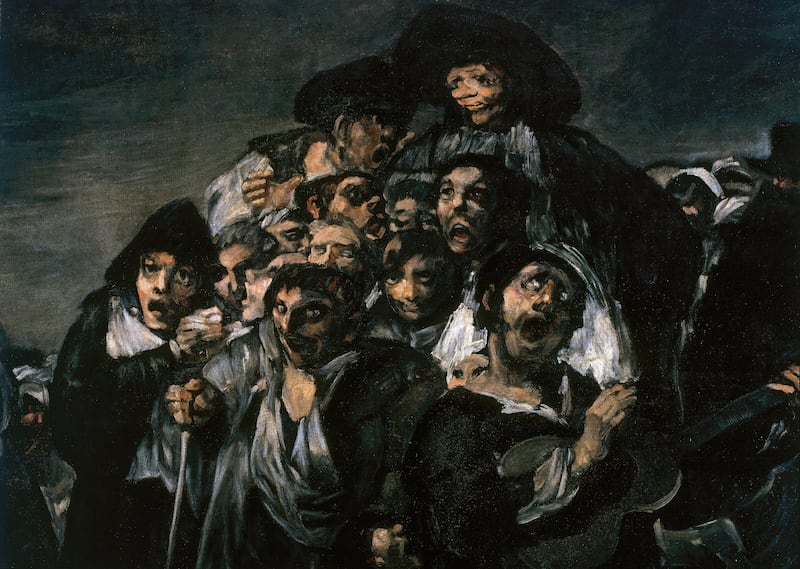 A Pilgrimage to San Isidro by Francisco de Goya. Photograph: Prisma/UIG via Getty Images
“He might have thought: I have to do this – I have to speak to the world as I see it – but I also understand that there might not be any interest from the public. What really mystifies me, sometimes, is where [an artist says]: I’m not going to show it to anyone; I’m going to keep it just for myself.”
Does that really surprise him?
“I’ve tended to take the evolutionary point of view that making art or writing or doing any of those kinds of things is a form of display, like a bird’s plumage or a peacock’s tail, and that you make those things and you put them out because it’s your way of connecting with other people and announcing who you are and what you’re about,” he says.
“You exist because they see what you’ve done. But then there’s people who decide: No, I’m never going to show this to anyone.”
He laughs.
“That defeats that whole evolutionary idea.”
Perhaps this approach to art is more a form of processing than display.
“I think so too,” he says. “I think it’s self-processing. I realised that this has its own rewards, and the reward doesn’t have to be public acceptance or putting it out there. It can be internal.
“You’re having a dialogue with yourself and exploring how you feel about things – what interests you, whether it’s literature or paintings or whatever else. And in that case you don’t crave public acceptance. It’s its own reward, which kind of tempts me to revise my thinking.”
Has this changed Byrne’s approach to making art? He chuckles. Not yet.
“A lot of the work that I do is kind of public facing. But, yes, I also realise now that I’m getting my own kind of personal enjoyment out of that creation, whether it’s the creation of a performance, a show, or this book, or drawings I’ve done. There’s an enjoyment in just putting it there.”
Byrne had some experience of this with drawings he made during the pandemic (although he did subsequently release them for public view). “I didn’t know what they were about when I was doing it, and then, afterwards, I realised [I was] talking to myself about what it felt like during the pandemic.”
[ David Byrne: ‘I couldn’t write songs during the depth of the pandemic’Opens in new window ]
Sleeping Beauties is a rejection of the notion that progress is always linear. There’s an idea, he says, that knowledge accumulates, “and once we’ve learned something, or discovered how to do something, that it adds to this vast storehouse, and these stories make it evident that that is sometimes the case. But just as often things get forgotten.
“Sometimes the thing that actually solves the problem or is really wonderful or beautiful or moving existed in the past and needs to be renovated and rediscovered.”
Byrne rejects modernist hubris. He notes that Roman concrete, for example, was longer-lasting and environmentally friendlier than the version revived by the modern world.
“Sometimes there was a better way in the past, and we have to swallow our pride a little bit and go: Maybe we can learn from that.”
The book includes lots of scientific examples. This feels relatively unusual coming from an artist.
“When I was younger I really debated whether I should go into the sciences or the arts,” Byrne says. “The arts seem to promise a more creative reward faster. With the science it seemed like you had to go through many years before you got to actually experiment and try things out and be creative.
“But, at the same time, the sciences are in many ways just as creative as the arts are, but the emphasis on proofs and predictions and quantitative measurements and all this kind of thing – the arts don’t have that, really.”
He laughs.
“People would like it if they did. People would like to maybe judge a painting by how it sells at Sotheby’s.”
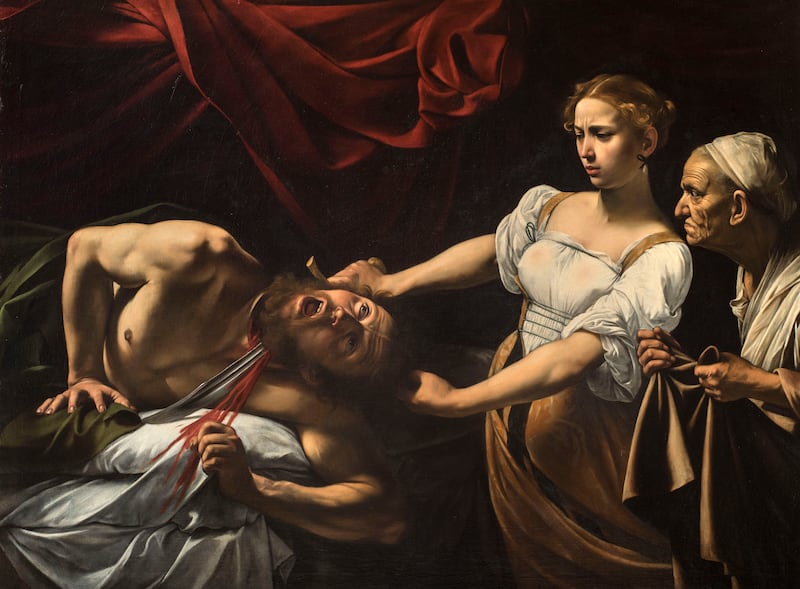 Caravaggio’s Judith Beheading Holofernes
But we can’t, Byrne says. In the 19th century, he points out, art dealers could barely give Caravaggio paintings away, but then, in 2019, his work Judith Beheading Holofernes was valued at up to €150 million or so. “And it’s the same painting. It hasn’t changed.”
Popularity or price or sales figures are never a true gauge of worth, Byrne says.
“Something that, on its own, has a very small audience or reaches a very small public can have a disproportionate influence on other people. We all know records that didn’t sell very well but had a huge influence on lots of other people.
“I used Tom Zé” – the Brazilian Tropicália musician whose albums Byrne was involved in reissuing in the 1990s – “as an example, but there were really obvious ones, like The Velvet Underground.” Byrne included their royalty statement in his book How Music Works. “It was pretty miserable, and yet they had a huge influence.”
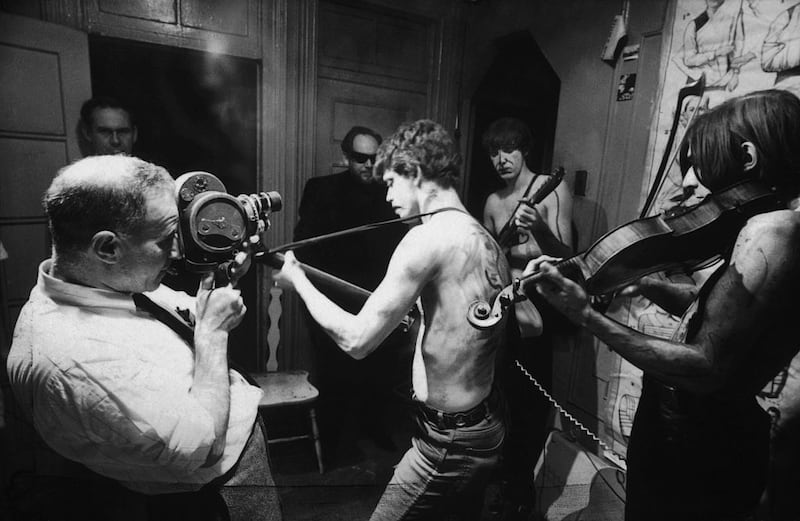 The Velvet Underground performing for Venus in Furs, an underground film by Piero Heliczer, in November 1965. Photograph: Adam Ritchie/Redferns
Has he seen evidence of the sleeping-beauty phenomenon in his own career? He laughs.
“I’ve been doing music for long enough that I’ve seen my career and acceptance or public awareness go up and down.”
How are things right now?
“Judging by my last concert tour, which I just finished on Saturday, after a year, the venues we were playing and the kind of reaction that the audiences had, it equalled and sometimes surpassed what happened with Talking Heads.
“So I realise there are moments when something becomes relevant or is accepted or is exciting to the public and moments when … not so much.”
What does Byrne put his current popularity down to?
“I’m going to give some credit to streaming in my case,” he says. “I have a lot of problems with streaming income and what artists make from all that, but I think it’s had a positive effect in that it doesn’t cost anyone anything to check something out, to try something and see if they like it or not.
“There’s also, in streaming, a lack of contextual information. You don’t automatically know, ‘Oh, when was this done? What’s the context? Did people like it at the time?’ All those kinds of things are missing. It’s just you and maybe some of your friends who are listening and going, ‘Oh, I like that.’ You’ve just stumbled on it. So you find younger audiences.”
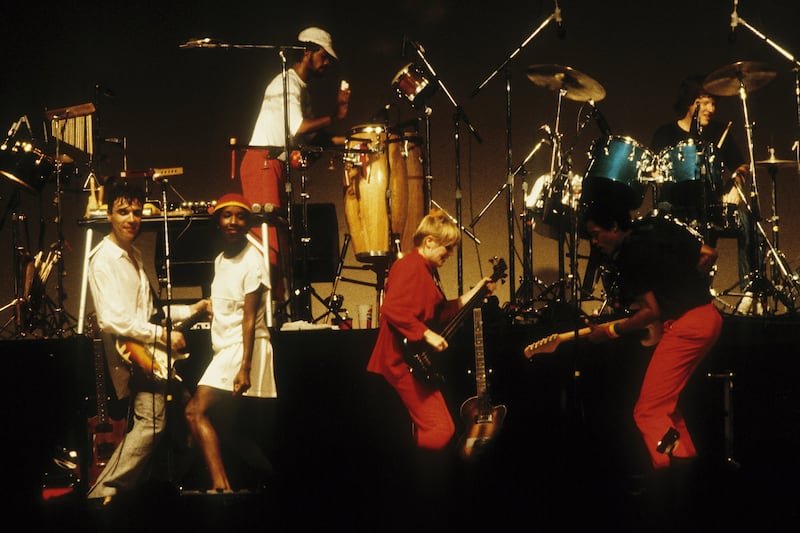 Talking Heads in Davis, California, in 1983. Photograph: Larry Hulst/Michael Ochs Archives/Getty Images
In the early, punk-influenced era of his career, Byrne and Talking Heads had a role in putting the prog rockers, his immediate forefathers, to sleep.
“I think there was an unspoken feeling we were going to topple the giants,” he says. “Not that we ever did or would, but there was a feeling: These dinosaurs have to go.”
And now the prog music they were deciding to topple is coming back, like a sleeping beauty. He laughs.
“It’s coming back! It’s really popular again.”
He refers to the Canadian band Angine de Poitrine in this context but adds, “They’re doing it in a more punk DIY way.”
[ David Byrne: ‘I see new chicanery every day’Opens in new window ]
Punk’s DIY ethos is still at the core of what Byrne does. He never had conventional musical training. “I bought songbooks. I still have a lot of them up there.” He gestures to an out-of-shot shelf to his right. “I have a Burt Bacharach songbook and a Bob Dylan songbook and a Beatles songbook and Cole Porter.
“I’d start with the simple ones and teach myself through other people’s songs. ‘Oh, this is how it’s constructed. Oh, this is how it’s made. You can go from this chord to this one.’ I highly recommend that kind of approach.
“Often when you go to music school you’re playing scales and playing an instrument that might be really difficult, and you don’t get the visceral reward of, ‘Ah, I can sing a song with this.’
“Whereas taking really simple things and learning them, you get feedback and a reward for yourself right away. With three chords or two chords, you can do something. You can express yourself and actually connect to people with very simple means.”
This approach has taken Byrne a long way. He’ll be on the road again in November, doing events around the book. Right now he’s relaxing at home after the long tour. “It’s a big physical and emotional reorientation for me, as it always is.”
What’s that process of post-tour reorientation like?
“Some of it’s very mundane. You come home and find, ‘My printer’s broken!’ There’s a lot of that mundane stuff.”
Will he then start a new project? He nods.
“When I get my printer fixed. When I get the bathroom door to actually lock.” He laughs. “I don’t know yet. It’s early.”
Sleeping Beauties: Why Good Ideas Go Dormant and How They Wake Up is published by Canongate