
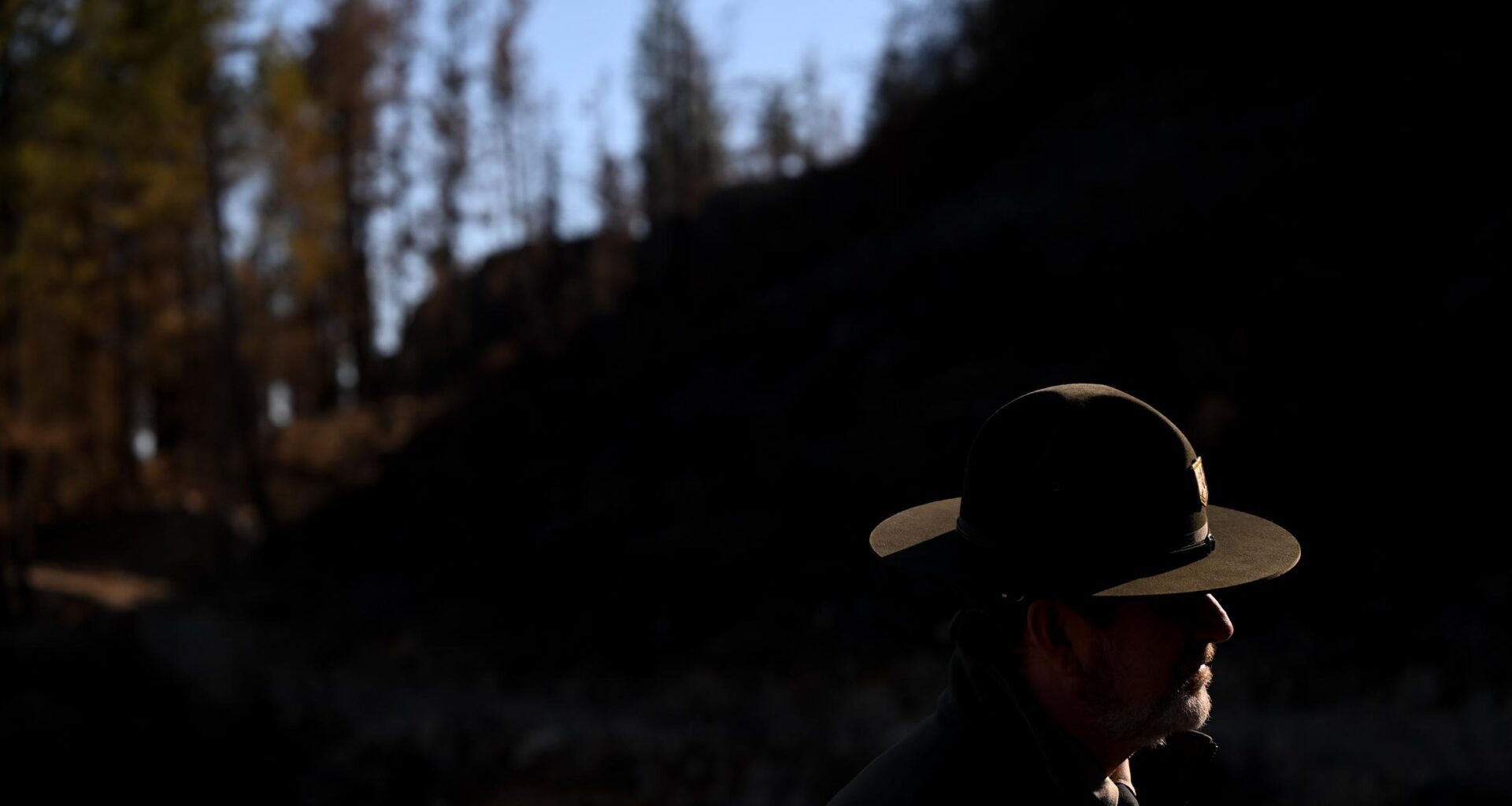
Washington State Parks ranger Justin Krogstad peered down into a roughly 2 -foot -deep hole and nudged some dirt into it with his boot.
The hole was left by a burned ponderosa pine that sat right off popular Riverside State Park Trail 210. Large enough to engulf a Chihuahua, the hole is one of many that now litter the park.
“We have these all over our trail system,” Krogstad said. “Most of them will need to be filled in.”
When wildfire incinerates a tree, it often doesn’t spare the root system.
Park spokesman Rex Schulz said he found one tree well with an active flame more than two weeks after a pair of wildfires tore through Riverside on Aug. 1, leaving swathes of the park resembling a moonscape.
Local residents won’t be allowed to witness the damage for months, Krogstad said. The affected area that’s closed to public access encompasses more than a quarter of the park.
More than 1,500 acres of the park burned in the Old Trails and Autumn Lane fires, with the most significant damage occurring in some of the park’s most popular locations.
“We had a lot of damage to trails, a lot of damage to the natural resources, and so we have spent the time since the fires were completely put out, evaluating,” Schulz said. “We were dealing with hot spots in the park for a good three weeks after the fire.”
Cyclists on the Centennial Trail would bike through forests of blackened trees if it were open.
A float down the Spokane River along Rifle Club Road shows scorched tree tops to the west and the remnants of burned homes to the east.
Trails were also damaged, either through fire lines dug to stop the blazes, or the fire itself. The Little Spokane River Natural Area sustained extensive damage aside from the lush interior where the water runs. The Bowl and Pitcher area will be completely transformed after a salvage logging operation clears the burned trees that now litter the area.
Trail 210 comes to a point above the river, and much of the parkland, where a hiker can see for miles to the northeast. Krogstad and Schulz showed the area during a media tour Thursday highlighting the damage to the park and the work underway to allow for the affected areas to be safely reopened.
From the viewpoint, one can see the fire’s path: how wind-driven flames spilled over a bluff, through hundreds of trees and across the river to city neighborhoods.
Acres upon acres of changed public and private land.
“It looks very different than it used to look,” Krogstad said.
Lots and lots of burned trees
The effort to clean up Riverside has been underway for a couple of months.
State park forestry workers and a Department of Natural Resources crew out of Airway Heights have focused on removing trees that could pose a hazard to park visitors or nearby properties. Day -use areas and Aubrey White Parkway were priorities, Schulz said.
“Anywhere where we have hazard trees that could potentially impact folks on the ground in the park, those are challenges that we need to take care of,” Schulz said.
Avista arrived after the fires were extinguished to replace burned power poles and chip downed trees within power line easements. Large burn debris is chipped to allow it to return to the soil sooner, and to do away with would-be habitat for invasive pine beetles.
Driving around the closed parkland, Krogstad pointed out the many trees carrying a blue stripe that still lined roadways. All of the marked trees will have to come down, but state parks have only two arborists for all of Eastern Washington. The agency will need to hire more contractors, which means additional funding will be needed, Schulz said.
“Washington State Parks and the state of Washington in general is not exactly flush with cash right now,” Schulz said. “So we’re working through those challenges.”
The park’s foundation has, and will continue to help, with some of the funding, Schulz said. But affording the cleanup could mean delays. About 30% of the burned area will be salvage logged, with most of the work occurring in the most popular areas of the park.
“Across the river from Bowl and Pitcher, along the neighborhoods along Rifle Club Road, and then up in the Little Spokane River Natural Area, the Knothead Loop Trail,” Schulz said. “Those are kind of our first areas of focus for salvage logging.”
Most of the trees that will be removed are ponderosa pines, which don’t have much market value, Schulz said. Intermixed are some burned Douglas firs that will fetch a bit more and help cover the costs of taking the trees out.
The logging project is expected to cost $200,000, and will take place during the coming fall and winter.
The thinning will have a significant effect on what the park will look like to frequent visitors who have hiked and biked the trails for many years. Instead of 200 to 300 trees in a single acre, crews will leave only 20 to 25. Some will be dead trunks that will serve as wildlife habitat, others are trees that should be able to recover from the damage they sustained.
The Little Spokane River Natural Area showed significant fire impacts. The park is keeping it closed as the area is cleaned up, but also to allow wildlife to use it.
“It’s actually giving wildlife some habitat, a little shelter,” Krogstad said.
Miles and miles of trails, wanted and unwanted alike
Spokane’s closest state park features over 100 miles of trails where Inland Northwest residents are known to run, hike and bicycle.
But miles of those trails fall within the burn area and remain closed. Some were damaged by firefighting equipment. Some of the repairs needed include filling in paths cut by bulldozers during the attempts to stop the fire. DNR is expected to help.
“We’re going to be working together to get all the heavy equipment that we need to get out there, out there this fall and winter,” Schulz said.
By springtime, parks officials will start assessing which trails need to be repaired. Krogstad said that could mean filling in tree wells, or more significant measures like rebuilding where the trail once ran.
Wildland firefighters often use trails, Schulz said. They can provide access to thickly wooded areas, or serve as the basis of a break lines dug by firefighters.
“Some of this will be professionally done and some of this will be experienced volunteers,” Schulz said.
Many frequent Riverside users are finding new areas to explore as closures remain in place, Krogstad said, but some people are riding or walking past the closure notices at their own peril.
A strong wind could snap a charred tree with ease, he said. As winter approaches, snow weight and moisture will present new threats.
Krogstad said he’s written dozens of $99 tickets to people in the closed sections of the park over the last few months. On Thursday, he stopped a cyclist during the media tour riding along the still smoky-smelling Centennial Trail.
“I don’t know how you got out here. You would have had to come across several signs and barriers,” Krogstad said.
The cyclist proclaimed ignorance, and claimed to have taken a back trail in.
Krogstad spared him a ticket and sighed as he kept driving.
New growth ahead
Fire might destroy homes, but it does not destroy a state park.
Fire is part of the natural cycle of forestland, Schulz said. The burned areas will regrow, and for the most part, state parks plans to let nature take its course.
“Some of it, we’re going to help it along a little bit,” Schulz said. “As best we can.”
Krogstad and Schulz pointed to the 1994 fire that burned through more than 400 acres of the park. Nearly 30 years later, wildflowers filled the meadows this spring. Krogstad said he’d like to do an interpretive trail through some of the areas affected in the Old Trails fire to highlight to the community the regrowth process in the years to come.
There is a lot of work to be done, and it’s of such a scale that archaeologists are coming in to ensure that anything overturned thus far, or in the months to come, is protected. Schulz said it’s common practice on public land with strong ties to Indigenous history.
Schulz said he could not disclose if any artifacts have been uncovered.
Krogstad asked for the public’s patience as the work to open the park continues. They hope by spring to reopen parts of the Little Spokane River Natural Area, and at least some trails in the Seven Mile that are heavily used, including by attendees of such major events as the Spokane River Run in April, the 24 Hours of Riverside mountain bike race on Memorial Day weekend, and the Wednesday Night Mountain Bike Races series in the months of May and June.
But much of the timing will be dependent on funding, Krogstad said.
“We need to find the funding, number one, whether that’s going to be from the state, from contingency funds, from special legislative action, from grants, from donations from some of our friends groups, so that’s number one.
The park will be open, and lush again, quicker than locals realize, Schulz said. He pointed to some of the greenery already poking through the scorched landscape.
“Just shows you the resilience of the land,” Schulz said.