
Dear readers, faithful companions of the lantern and the basketball,
First, I must ask your forgiveness for a long silence. If you have read nothing from me for several weeks, it is neither from laziness nor from forgetfulness. It is because I was bound to duties that, though less poetic than the stars, are no less demanding. I was teaching in Zurich, and sitting on the panels for the thesis defences of young doctoral students in physics. These mandates return periodically, like the tides, and one must then plunge into equations, listen, correct, encourage. The little time that remained, I gave to my family — to Jocelyne, to the children, to the house at the edge of the forest, to Gino, to Tsigane and Safira. For there are loyalties that come before galaxies.
And then there is the other uniform. For I am also a captain, a helicopter pilot in the Swiss militia. This role requires an annual refresher course and a minimum of fifty hours of training flight, which I must complete each year, whatever time the stars may demand of me. Up there, in the cockpit, I am no longer the astronomer contemplating the sky, but the one who crosses it. And believe me, the experience is complementary: one teaches patience, the other precision.
 My Little Angel: WendyFoto privée
But let us return to you, dear readers, and above all to America. For Jocelyne, my adorable Jocelyne, is horrified. She said it with that quiet frankness that characterises her: she is revolted by the cowardice of your president. According to the news, he has just destroyed the little credibility that remained to your beautiful country. She pities you, sincerely. She pities the Americans of good faith who endure, powerless, the spectacle of their own decline. And she wishes, with all her heart, that the true Americans — those who still believe in democracy, in science, and in dignity — may succeed in countering this crude criminal. She tells you so with the tenderness of a distant friend, from our little Switzerland, which knows what it costs to defend one’s freedom.
That said, dear readers, let us return to the sky. For that is indeed what I want to speak to you about tonight. We have explored the nebulae, the distant galaxies, the Milky Way, Andromeda, the Sombrero. But there are two galaxies we have never visited, and which are, in a sense, our closest neighbours. Two galaxies visible to the naked eye from the southern hemisphere, two clouds of light set upon the velvet of the austral night. Two galaxies called the Magellanic Clouds, and they are dying, slowly devoured by the Milky Way.
1. Two Clouds in the Southern Sky
First, one must imagine the sky of the southern hemisphere, the one seen from Chile, from Australia, from South Africa. A sky I know well, having spent so many nights at Paranal, on the Cerro, contemplating the Milky Way. And there, in that sky, are two milky patches, two luminous clouds that are not clouds at all, but galaxies. The Large Magellanic Cloud, the vaster, and the Small Magellanic Cloud, more modest. They are visible to the naked eye, without an instrument, like fragments detached from the Milky Way. Portuguese sailors used them as landmarks for navigation, before Magellan, on his voyage around the world, made them known to Europe — hence their name.
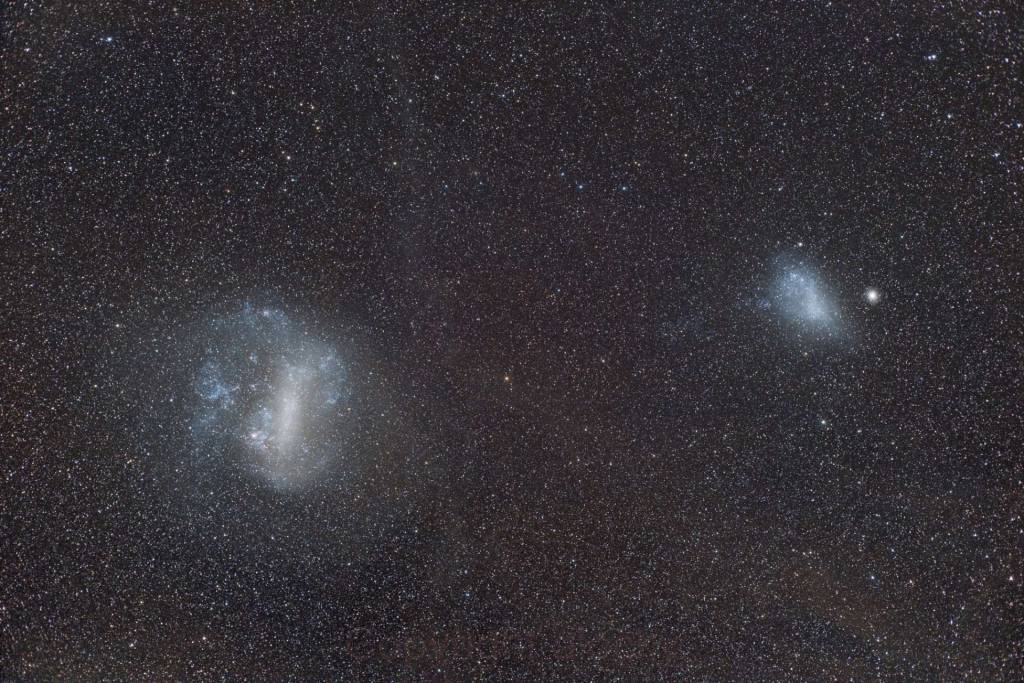 Les Nuages de MagellanESO.org
The Large Magellanic Cloud lies about 160,000 light-years from us, and the Small about 200,000. They are the closest galaxies to our own, along with the Sagittarius Dwarf. But their proximity is deceptive: they orbit the Milky Way, captured by its gravity, and they are being deformed, stretched, torn apart by the tidal forces of our giant. They have already begun to die.
2. The Tarantula: A Monstrous Nursery
The Large Magellanic Cloud harbours an object that, on its own, deserves a journey. It is the Tarantula Nebula, the largest region of star formation known in the entire Local Group. It stretches over nearly 1,000 light-years, and it is so bright that it illuminates the entire Cloud. It owes its name to its filaments of gas and dust, which resemble the legs of a giant spider. Within it, hundreds of thousands of young, massive, blazing stars are being born. It is a stellar factory, a cosmic furnace, a natural laboratory for understanding how stars are born.
The Tarantula is so luminous that, if it were at the distance of the Orion Nebula, it would light the Earth’s night sky like a full Moon. It harbours R136, a cluster of stars so young and so massive that they surpass anything we know in the Milky Way. Some of them are more than a hundred times more massive than the Sun, and they will live barely a few million years before exploding as supernovae. The Tarantula is a factory of stars, and of stellar deaths.
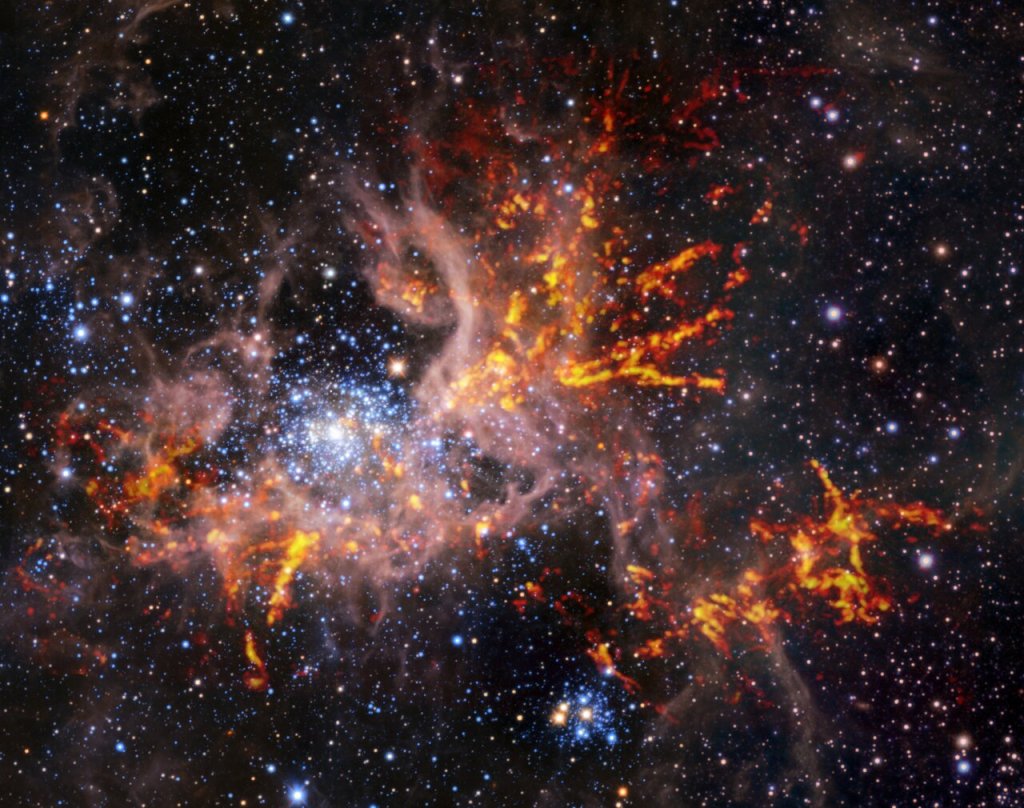 The Tarentula,,,ESO, ALMA (ESO/NAOJ/NRAO)/Wong e
3. A Torn Structure
The Magellanic Clouds are not ordinary galaxies. They are irregular galaxies, dwarfs, deformed by their interaction with the Milky Way. The Large Cloud is crossed by a bar of stars, and it is linked to the Small Cloud by a bridge of gas, a filament of matter torn away by tidal forces. That bridge is the witness of their gravitational dance, of their slow and inexorable approach.
Astronomers have discovered that the Magellanic Clouds are also surrounded by a halo of hot gas, a halo extending far beyond their visible disk, and which is being torn away by the Milky Way. This gas, heated to temperatures of millions of degrees, is the result of tidal forces, but also of the supernovae exploding within the Clouds. It is a spectacle of destruction, but also of creation: the gas torn from the Clouds will one day enrich the Milky Way, which will form new stars from its ashes.
4. A Tragic Destiny
The Magellanic Clouds are condemned. They have orbited the Milky Way for billions of years, and they will end up absorbed, torn apart, digested. The Large Cloud might survive a few billion years more, but the Small Cloud is already being dislocated. Numerical simulations show that in a few billion years, nothing will remain of the Clouds but a stream of stars and gas, a river of light crossing the halo of the Milky Way.
This end is inevitable. It is inscribed in gravity, in the dance of galaxies. But it is also a birth. For the stars of the Clouds, their gases, their dusts, will come to enrich our galaxy. They will form new stars, new planets, perhaps new lives. The Magellanic Clouds will not disappear. They will transform. They will become a part of us.
5. Why Observe Them
The Magellanic Clouds are a treasure for astronomers. They are close, and therefore easy to study. They are young, and therefore rich in massive stars, in nebulae, in supernovae. They are deformed, and therefore they show us the effects of tidal forces, of galactic interactions. They are condemned, and therefore they remind us of the fragility of everything, even galaxies.
For amateur astronomers of the southern hemisphere, the Magellanic Clouds are an unforgettable spectacle. The Large Cloud, with its luminous bar and its Tarantula, is visible to the naked eye as a milky patch detached from the Milky Way. The Small Cloud, more discreet, is a faithful companion. And between the two, the bridge of gas, invisible to the naked eye, links the two galaxies like a thread of cosmic silk.
6. The Watchman’s Lesson
Dear readers, the Magellanic Clouds teach us fragility and beauty. They remind us that galaxies, like beings, are born, live, and die. They remind us that destruction is sometimes a form of creation, that the death of one galaxy is the birth of another. They remind us that we too are stardust, and that our galaxy, the Milky Way, is itself the fruit of the destruction of smaller galaxies.
I set down my lantern. It flickers gently, like the Magellanic Clouds dancing around our galaxy. The basketball is in its place. And I think of Jocelyne, who is horrified by the cowardice of your president, and who pities you, dear Americans. She wishes that the true Americans, those who still believe in democracy, may succeed in countering this crude criminal. So do I. For the beauty of the cosmos, the grandeur of galaxies, the fragility of the Magellanic Clouds, all of it reminds us that freedom, like light, is a fragile treasure that must be protected.
The next time you lift your eyes toward the southern sky, remember: out there, in Dorado and in Mensa, two clouds of light dance around our galaxy. They are beautiful. They are condemned. And they are, at this very moment, becoming a part of us.
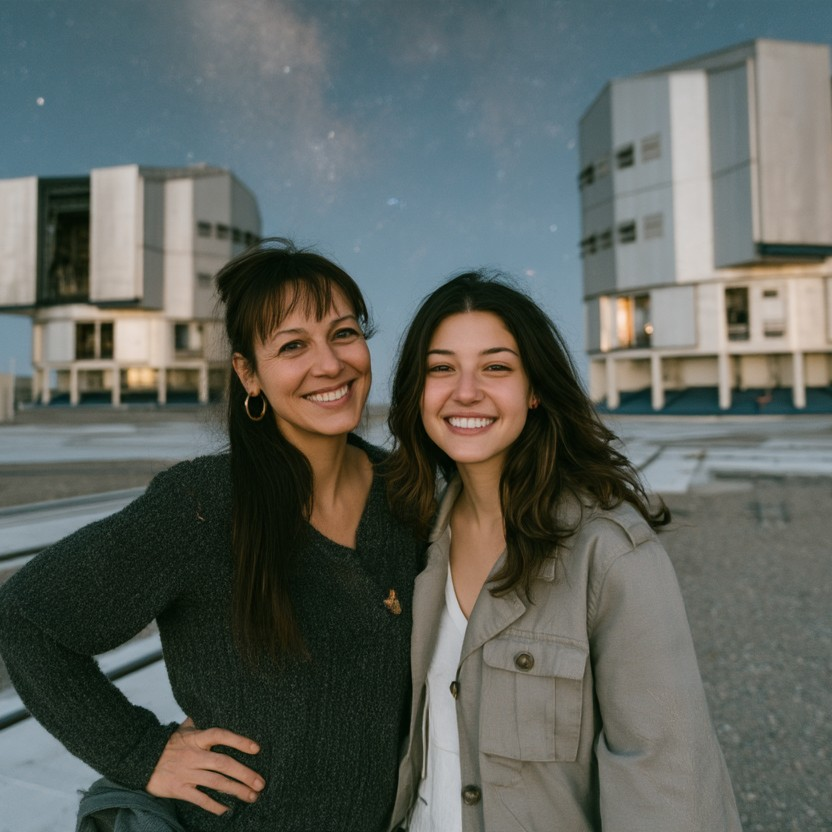
To read more stories by Swissman, click on the photo, Jecelyne et Jessica at Paranal, 2024
Prenez Soin de vous mes amis et à bientôt
François
 Click on me to read more StoryPhoto Privée