
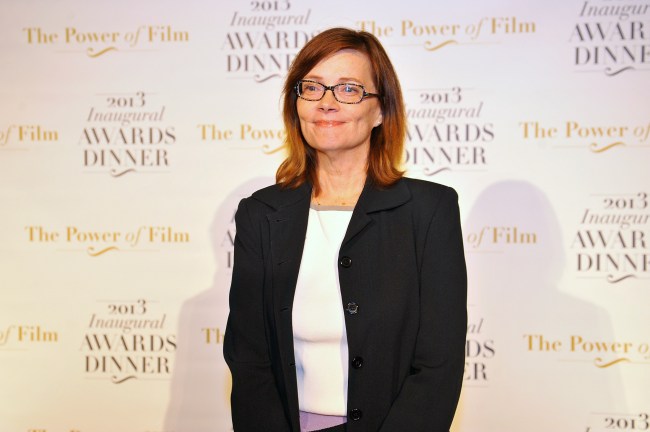
On Monday, after learning the sad news of Washington Post critic Ann Hornaday‘s death at age 66 from brain cancer, I walked out of a screening full of film critics with Thelma Adams (The Wrap). We talked about how Hornaday was a pioneering woman reviewer who raised a family, wrote well for decades with thoughtful finesse, and outlasted most of her peers, many of whom now write Substacks or work freelance. Daily newspaper film criticism is dying, we agreed.
I used to hang out with Hornaday at Cannes, or at the annual AFI Awards Lunch, where she presided over the jury. She was always lovely — and fun to be with — but beyond that I respected her criticism. I was not alone: her reviews and essays made her a Pulitzer Prize finalist in 2008.
She cared about reaching people with her writing, not talking down to them. She published the enjoyably readable “Talking Pictures: How to Watch Movies” (2017), in which she talked to filmmakers about their art, among them wordsmith Kenneth Lonergan on dialogue, Robert Altman, the master “of realism in sound,” Jack Lemmon on acting, and Spike Lee on cinematography.
In 2022 Hornaday wrote: “Of all artistic mediums, cinema occupies the trickiest space between fabrication and reality, exploiting the porous nature of both to become a third thing entirely: the distortion of the literal truth that becomes internalized as consensus history.”
One of her favorite movies, Ridley Scott’s “Thelma and Louise,” echoes one of her ongoing concerns — women. The film “had nothing to do with my real life,” she wrote in 2023, “other than the exhilaration of watching two women light out for the territory, with zero figs to give and needing only each other for support. Is this what ‘Easy Rider’ felt like to baby boomer men?”
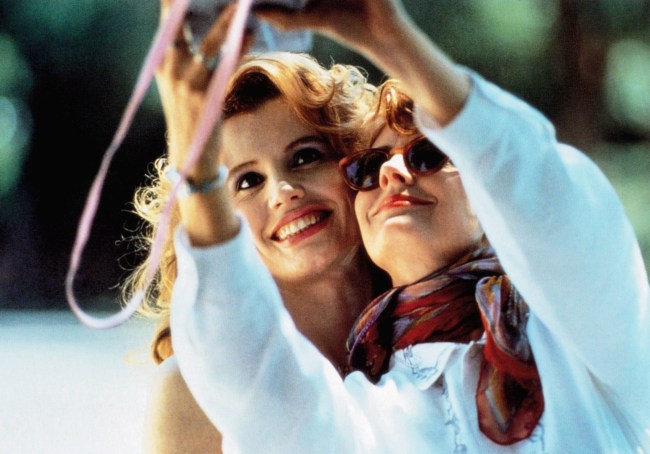 ‘Thelma & Louise’©MGM/courtesy Everett / Everett Collection
And Hornaday supported women in her life: “She was also generous and funny and kind and would send random notes praising your work and sign them, ‘Your fan, always,’” tweeted former Washington Post writer Jada Yuan. “When she got sick, right after taking the buyout, she called because she knew I was going to film festivals and didn’t want me to worry about keeping anything secret from her friends. So, please, talk about Ann. Share your stories.”
Thanks to the Washington Post for much of the following biographical information:
Born on March 9, 1960, in Iowa City, Ann Mills Hornaday was adopted at birth by urologist William R. Hornaday Jr. and his wife, the former Mary Mills, who worked in local charities.
Hornaday was raised in Des Moines and graduated from Smith College in 1982, majoring in government. She spent two years at Ms. Magazine in New York as the personal assistant to the magazine’s co-founder and feminist activist, Gloria Steinem, who died in September.
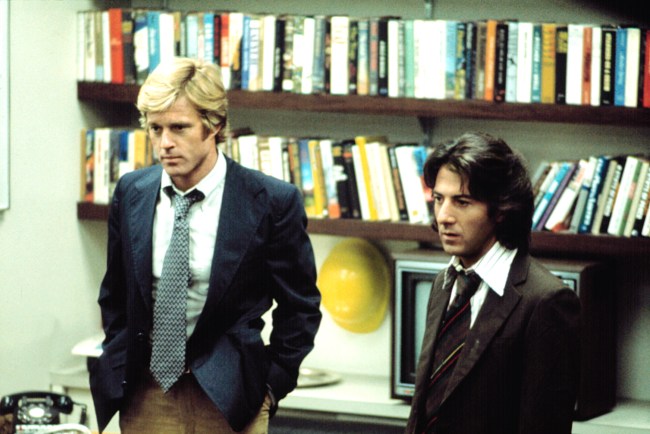 ‘All the President’s Men’Courtesy Everett Collection
She freelanced in New York, contributing to the New York Times, Premiere magazine, and more. She was the Austin American-Statesman’s film critic from 1995 to 1997, followed by the Baltimore Sun, before joining The Washington Post in 2002. After 23 years, Hornaday took a buyout in 2025.
She is survived by Lawrence Greenia, her husband of 26 years; their daughter, Victoria Greenia; a stepdaughter, Leila Greenia; and a brother, William Hornaday III.
Shortly before she died, Hornaday finished writing a behind-the-scenes book about the filming of Alan J. Pakula’s 1976 “All the President’s Men,” starring Robert Redford and Dustin Hoffman as the infamous Woodward and Bernstein, respectively. Hornaday had called the movie a “masterpiece” that “exemplified film as a supremely collaborative medium, with all the artists and technicians involved demonstrating superb craft, skill, taste and smarts.” The book is tentatively scheduled for release in 2028.