
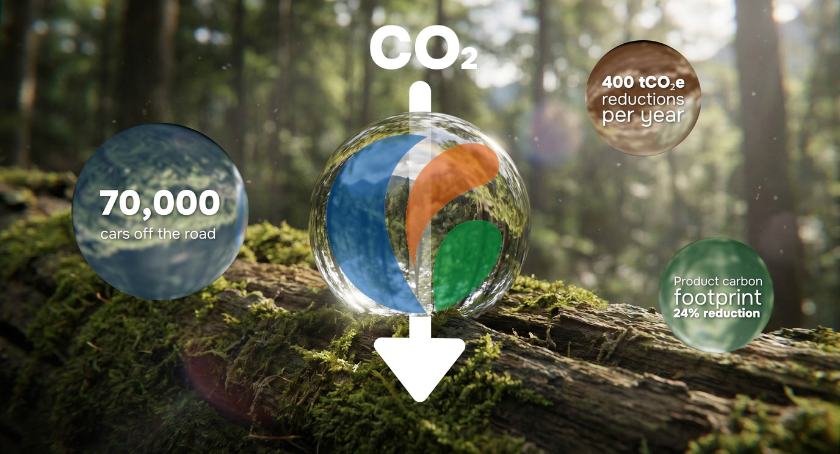
Futamura UK Ltd. has reported a 24% average reduction in the carbon footprint of its NatureFlex cellulose films between 2019 and 2025, reflecting ongoing investments in energy efficiency and manufacturing improvements.
According to the company, the reductions represent approximately 100,000 metric tons of avoided CO₂-equivalent emissions over the period, based on an independent third-party life cycle assessment conducted by ERM. Futamura estimates the savings are equivalent to removing approximately 70,000 cars from UK roads for one year.
The calculations cover lacquered and plain cellulose film production, including NatureFlex NVS, and use IPCC AR6 GWP100 methodology.
Futamura is continuing to invest in technologies intended to further reduce the environmental impact of its cellulose films, which are used in flexible packaging and other applications.
Among the company’s planned investments is a Wet Sulphuric Acid (WSA) project, scheduled for implementation by 2027-2028. The system will divert waste gases from production and convert them into a usable raw material through an oxidation process. Heat generated during the reaction will be recovered to produce steam for manufacturing operations.
Once operational, the WSA installation is expected to generate approximately 15% of the site’s total energy requirements. Futamura projects that the investment, together with other planned improvements, will deliver additional annual emissions reductions equivalent to removing approximately 4,000 cars from UK roads.
Recent improvements also include the installation of a high-performance compressed air system equipped with heat recovery technology. Waste heat from the compressors is used to preheat thermotanks, reducing the amount of steam required during production.
According to Futamura, the compressed air and heat recovery improvements have reduced emissions by more than 400 metric tons of CO₂-equivalent annually.
Additional initiatives include upgraded lighting systems, improved air conditioning controls and more efficient laboratory equipment operation. Approximately 80% of the manufacturing site has transitioned to LED lighting, with the company reporting that the investment achieved full payback within its first year.
“The reductions in our operational and product carbon footprints reflect the dedication of our workforce and their commitment to continuous improvement,” states Lucy Cowton, sustainability manager at Futamura. “We see this as just the beginning, with future investments, such as the WSA plant, expected to reduce our operational emissions even further.”
Futamura said the initiatives are part of its ongoing efforts to lower the environmental impact of cellulose film production while supporting packaging customers seeking materials with reduced carbon footprints.