
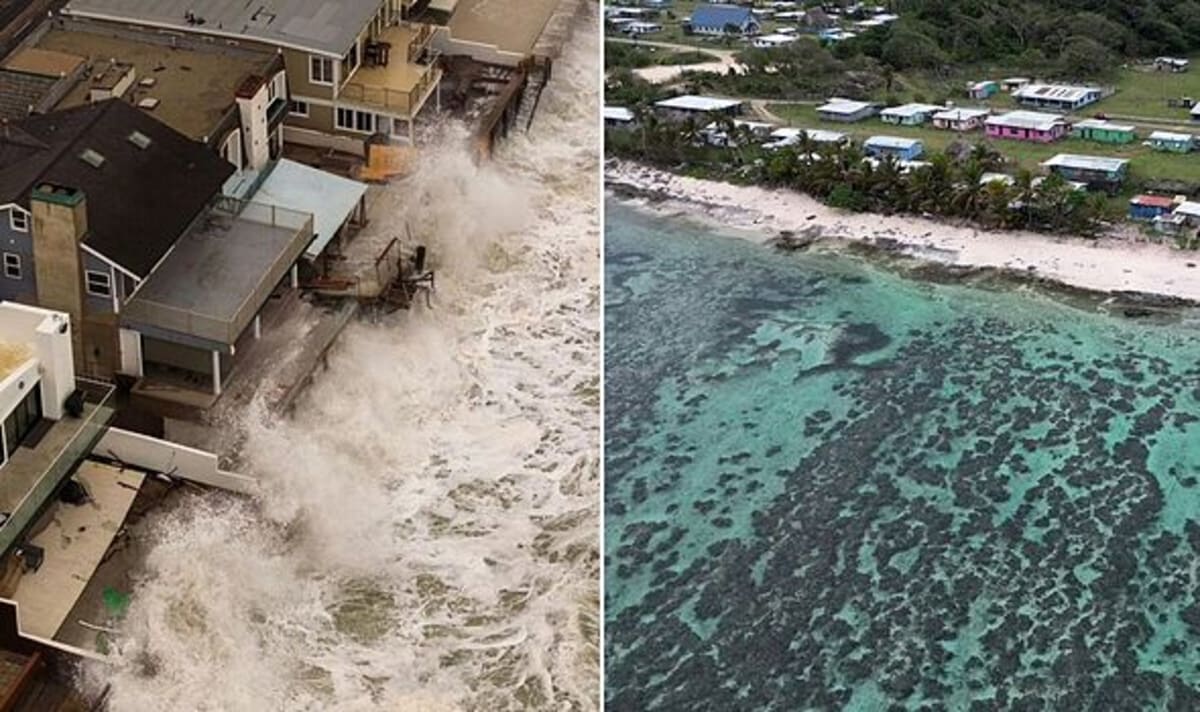
A Super El Niño is changing the color of the ocean – as record-breaking temperatures kill marine life.
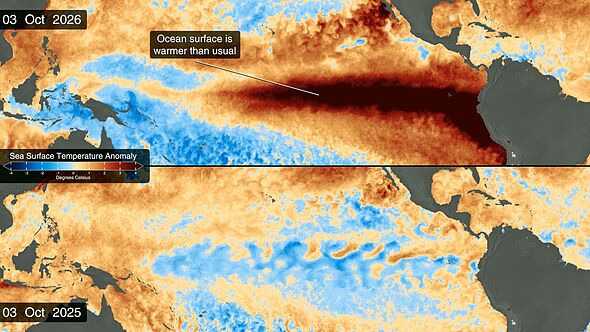
NASA satellite images have revealed that the equatorial Pacific has turned from a lush green to a bright blue over the past year.
El Niño has disrupted the currents that bring cold, nutrient-rich water to the surface, which is key for photosynthesizing plankton.
NASA satellite images have revealed that a super El Niño is changing the color of the world’s oceans.
The equatorial Pacific has turned from a lush green to a bright blue over the past year. El Niño has disrupted the currents that bring cold, nutrient-rich water to the surface, which is key for photosynthesizing plankton.
This turns the areas they inhabit a deep emerald green. However, without that food, the plankton are starving, and a deep, lifeless blue has returned to the ocean.
A side-by-side comparison with 2025 satellite data shows that this area retained its green color throughout the year.
But by that time, most of the recent data, which covers up to this month, the area around the equator has turned blue.
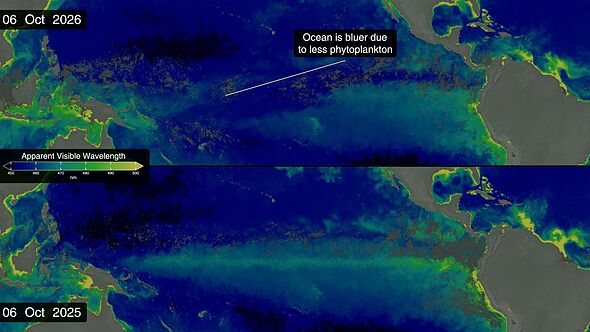
Side-by-side (Image: -)
A super El Niño has changed the color of the Pacific Ocean over the past year, according to satellite images from NASA.
The weather phenomena interfered with currents that carry cold, nutrient-rich water to the surface, a key source of nutrients for photosynthesizing plankton.
Because of this, the plankton is starving, and the deep emerald green water has become a lifeless blue.
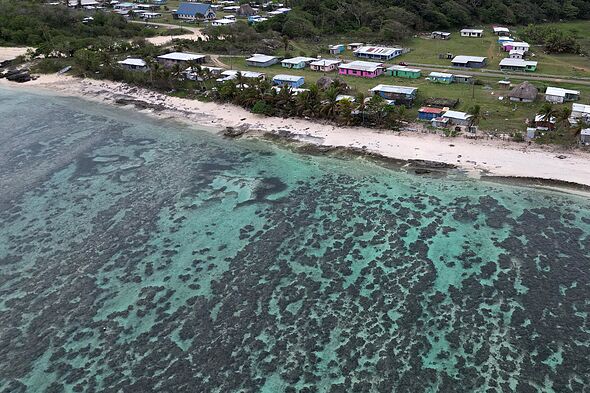
Rising sea levels (Image: AFP via Getty Images)
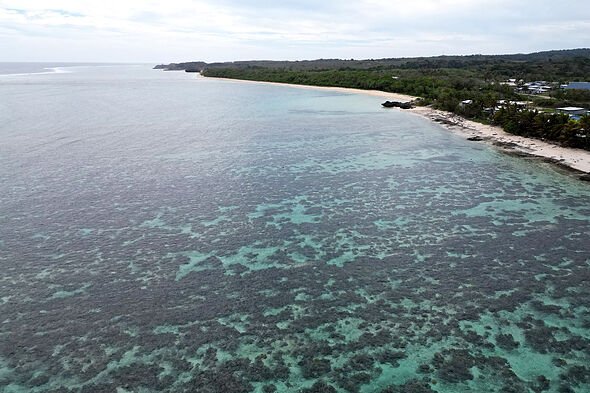
An aerial view shows coral reefs off Naidiri Beach, some 32 miles from Nadi. Coral reefs across Fiji are increasingly threatened by rising ocean temperatures.
This triggers coral bleaching and degrades reef ecosystems, while rising sea levels contribute to coastal erosion and increase risks for low-lying villages along the shoreline.
El Niño is part of a naturally occurring climate cycle known as the El Niño Southern Oscillation. Every two to seven years, this pattern brings either a hot El Niño period or a cooler La Niña phase.
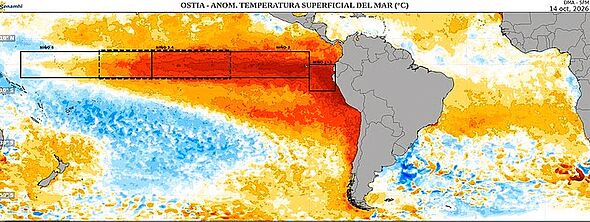
Weather phenomena (Image: -)
During the El Niño phase, warm waters accumulate in the tropical Pacific Ocean off the coast of South America, raising sea surface temperatures and affecting global weather patterns.
Scientists believe Earth is in the early stages of a massive El Niño cycle, which could have catastrophic effects in the coming months and throughout 2027.
Experts’ warning (Image: -)
As of October, the National Oceanic and Atmospheric Administration predicts an 83% chance this will be the strongest El Niño since records began in 1950.
Meanwhile, NASA’s satellite measurements show that sea surface temperatures in the eastern Pacific are currently 3°F above the long-term average, and could rise another fraction of a degree higher in the coming months.
Rising temperatures (Image: AFP via Getty Images)
This warm-water trend expanded throughout the spring and now covers millions of square miles, from the coast of South America to the heart of the Pacific.
This is also the first El Niño year since NASA launched the Plankton, Aerosol, Cloud, Ocean Ecosystem (PACE) satellite in 2024, giving scientists a view of the threat.
PACE observations (Image: AFP via Getty Images)
The Ocean Color instrument with PACE observes the ocean in “hyperspectral color,” measuring wavelengths in the visible, ultraviolet, and infrared spectra.
“Some people think of water as being just blue, but it’s amazing the multitude of colors the ocean can be,” said Dr. Matthew Kehril, a lead research scientist at NASA’s Goddard Space Flight Center.
Warm waters (Image: AFP via Getty Images)
During El Niño, the trade winds, which usually transport warm water westwards toward Australia, weaken or even reverse.
This lowers the upwelling of nutrient-rich waters from deeper parts of the ocean, leading to a decline in algae numbers and bluer waters, according to PACE’s observations.
This decline can trigger cascading effects across the entire marine ecosystem, forcing animals to relocate to new feeding grounds in search of phytoplankton.
Working with data (Image: AFP via Getty Images)
“You have expectations of what you would think would happen, but to visually see the results with the data products that you’re working with in real time is gratifying,” said Dr. Kehril. Thanks to satellite observations, scientists actually got their first hint that a major El Niño year was coming back in January.
Satellites built to measure sea levels picked up something called a Kelvin Wave building near Micronesia, in the western Pacific Ocean. Kelvin Waves are slow-moving water pulses spanning thousands of miles that act like underwater motorways transporting heat from west to east across the Pacific.
Chain reaction (Image: Getty Images/iStockphoto)
The heat warms the air above them, causing it to rise and create a change in air pressure that weakens the trade winds, sparking the El Niño chain reaction. “Kelvin waves are like the heartbeat of El Niño,” said Dr. Josh Willis, a project scientist for sea level missions at NASA’s Jet Propulsion Laboratory in Southern California.
“And our sea level satellites let us peer into the ocean and watch every beat.” By early April, NASA’s satellites saw that the Kelvin wave had reached the eastern Pacific and was already warming sea surface temperatures.
Understanding the waves (Image: AFP via Getty Images)
Since warm waters also expand and rise, this can lead to a massive increase in sea levels within El Niño’s critical region.
Sea levels rose as much as 1.3 feet near South America and the coast of California, while sea levels dropped by up to eight inches near Indonesia and Australia.
“El Niño touches almost all of us in some way every time it occurs. While many have seen what it can do, we look to the ocean to understand why,” said. Dr. Willis.