
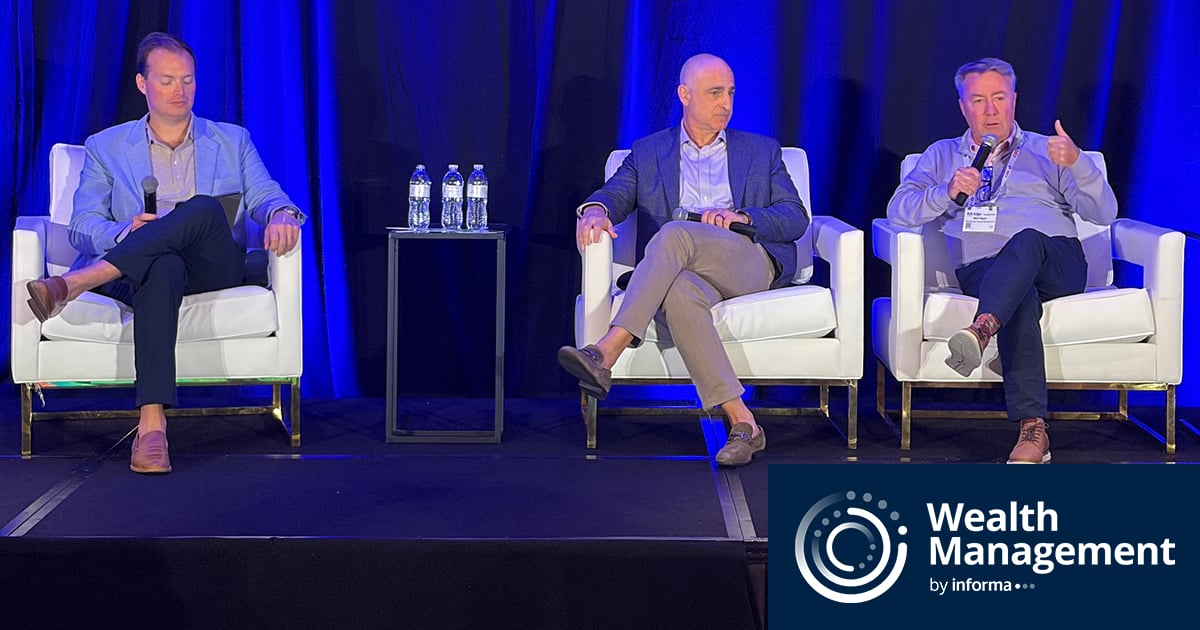
The pressures of running a modern registered investment advisor, including filing and maintaining a Form ADV with the Securities and Exchange Commission, are pushing some advisors to consider a 1099 affiliation, according to two aggregators speaking at RIA Edge Orange County on Wednesday.
Matt Regan, president of Wealthcare Capital Management, said his firm has been benefiting from solo practitioners getting fed up with increased reporting requirements stemming from the advancements and risks of wealth technology.
“We had an SEC audit last year on one of our ADVs—104 questions, all on cybersecurity,” he said. “If you are a $250 million advisor, you’re dead in the water for six weeks trying to get through that. I think that’s what’s changing in terms of these good-sized firms … saying I’m going to shut down my ADV and join your 1099.”
Rob Sandrew, head of Mariner Independent, the RIA’s 1099 independent contractor division, said he also sees AI advancements driving solo practitioners to join larger platforms. In his view, though, it will be driven by fear of being left behind by larger firms that can outspend them on the technology.
“I think there is going to be a massive consolidation and massive chasm between the haves and have-nots going forward,” he said. “There’s a very strong consensus that in the next three to five years, client expectations are rising significantly. … That dynamic between the advisor and the client is probably going to morph into something that is heavily EQ driven, and I think firms need to be thinking about that and that should be part of the decision-making process.”
During the panel, the RIA leaders were pitching their 1099 models to the RIA audience as a path to shed obligations while maintaining a firm’s brand and identity. Regan’s Wealthcare, owned by insurance holding company Sammons Financial Group, is a 1099 aggregator that also operates a W-2 employee platform. Sandrew’s Mariner division is for 1099 firms only, but advisors can also consider moving to Mariner’s employee-owned RIA at some stage.
During the panel’s Q&A, one audience member challenged the executives to consider how advancements in wealth technology may make it easier, not harder, to operate as a solo operator at a reasonable cost base.
In response, Regan agreed with the notion, but stuck to the argument that “supported independence” allows for RIAs to maintain their clients and have the option to monetize their business, but “not spend time on things they shouldn’t be spending on.”
According to a recent study by the consultancy Winthrop & Co., supported independence channels tend to run advisors at 10% to 20% of revenue in exchange for offloading back-office tasks and gaining access to scaled resources and technology.
During the panel discussion, moderator Stephen Caruso, director of wealth management at Cerulli Associates, also noted that his firm’s RIA surveys show that many advisors question whether the cost of joining a platform is worth it, especially if they risk losing some of their decision-making.
In response, Regan noted that independent firms, especially as they grow, have to start paying for additional staffing and services, which may be more expensive than giving up some revenue to the consolidator.
“I’ll make the case that if you’re an independent firm and your next step is to hire a CIO, a trader, a compliance officer, that it’s actually more economic to join me than pay me the 20 basis points,” he said.
Sandrew argued that Mariner’s role in taking on back-office tasks and offering lead-generation resources could give advisors more time to make decisions based on clients and growth strategy.
“We will ultimately give you that time back to go deeper with your clients, to go and be more deliberate with your growth strategy,” he said.
Mariner and Wealthcare are among a now-extensive, well-capitalized list of 1099 RIA platform providers, along with W-2 employee aggregators, making their case to solo RIA practitioners.
On a separate panel, Nate Angelo, CEO of Composition Wealth, called the recruiting push in wealth management a “war on talent,” specifically for those “mature” advisors who are not near retirement, but have a strong track record and book of business.
For firms like Composition Wealth to grow, he said, they need to both bring on that talent and invest further in it to help it expand once at the firm.
“We do not see our path to growth through cutting costs; we see our path to growth through investing,” Angelo said. “If we want to grow organically, we’ve got to invest; if we want to fuel our existing teams, we’ve got to invest.”
Regan of Wealthcare said advisors shouldn’t assume they need to become W-2-employed advisors to achieve a high valuation for their practice.
“We are paying full boat for 1099 independent contractors,” he said. “We’re paying the same multiples as everyone else because we know them, we like them.”