
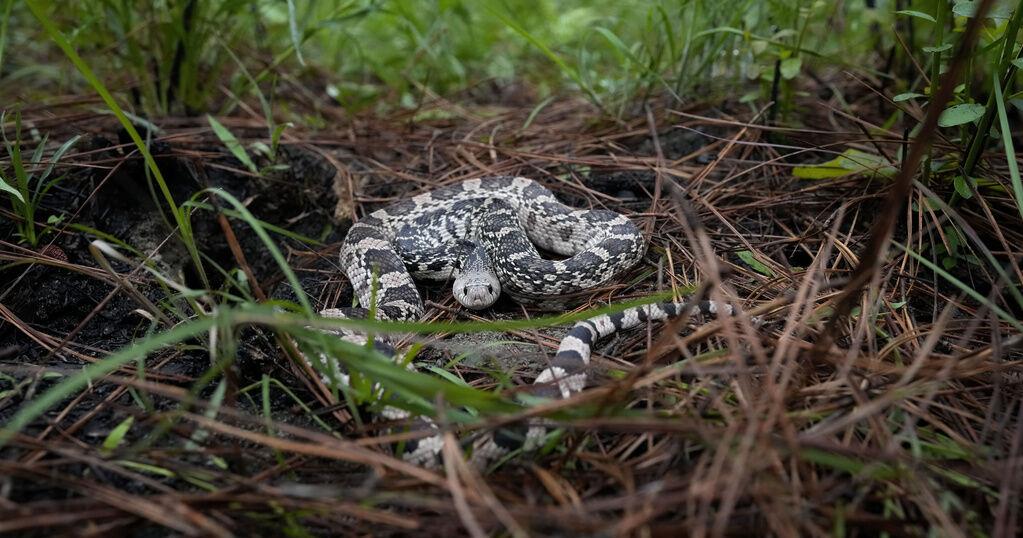

A Louisiana pinesnake is seen as it is released along with several of about 100 Louisiana pine snakes, which are a threatened species, in Kisatchie National Forest, La., Friday, May 5, 2023. (AP Photo/Gerald Herbert)
Gerald Herbert
When it came time to release 14 captivity-bred yellow and brown Louisiana pinesakes into the Kistachie National Forest, it was important to find just the right spot.
The threatened constrictors needed an expanse of some 7,000 acres of longleaf pine forest with plenty of pocket gopher holes to thrive.
Researchers carried the pinesnakes to an ideal place under the tree canopy, recalled Lindsay Reeves, who attended several such releases in her role as a senior attorney at the Center for Biological Diversity, an environmental law group.
They put them down near a gopher hole or hollow stump. In a flash, every snake disappeared underground.
“It’s like they know this is where they’re supposed to be,” Reeves said.
Destruction of the snake’s longleaf pine forest habitat without mitigation would have historically been considered a violation of the federal Endangered Species Act, as the Louisiana pinesnake is threatened and one of the rarest snakes in the U.S. But a new interpretation of the landmark law is easing that rule.
Proponents argue the law has been applied too broadly, and the changes are needed to pave the way for economic and energy development. Environmental advocates argue that changing the rule could have far-reaching consequences for some of the country’s rarest animals, including the pinesnake, whooping crane and gopher tortoise in Louisiana.
The act’s core protections remain in place, administrators for the Interior Department assured in a news release over the summer: It still will protect listed wildlife from acts that “directly injure or kill.” But it will remove federal overreach with regulations that interfered with people’s private property rights, the release said.
“This administration is committed to protecting wildlife using Gold Standard Science, the law and the tools Congress actually gave us,” U.S. Fish and Wildlife Service Director Brian Nesvik said in the news release. “We can protect species and respect communities at the same time.”
A U.S. Fish and Wildlife Service internal memo went a step further in September and stated that the definition of “take” of an endangered or threatened species would only apply to intentional acts.
Environmental advocates, including the Louisiana Wildlife Federation, sued the government, aiming to get the changes reversed.
In the meantime, endangered species are at risk, said Steven Whitfield, director of terrestrial and wetlands conservation at the Audubon Nature Institute in New Orleans.
“If we don’t go back to the old definition of harm, we could lose more species,” Whitfield said. “Destruction happens much quicker than recovery.”
Pinesnakes
For a species like the Louisiana pinesnake, habitat protection is critical, Whitfield said. The Audubon Zoo has released 58 pinesnakes into the wild over the course of about 30 years, according to its website.
The four-foot-long constrictors live in longleaf pine forests, a fire-dependent ecosystem that once dominated the Southeast but has been dramatically reduced. When the pinesnakes are released into the wild, researchers look for longleaf pine habitat that has been burned recently, to clear out underbrush and debris from the forest floor.
Only about 5.2 million acres of longleaf pine forest remain in the U.S., a fraction of the 90 million acres the forest historically occupied, according to The Nature Conservancy.
“When you talk about protecting a species, you need to be able to think about the habitat itself,” said Mitch Reid, a regional executive director at the conservancy. “If the purpose of the [Endangered Species Act] is to prevent extinction, then we need to have a conversation about what all species need to survive and thrive.”
Dozens of other endangered and threatened species rely on longleaf pine forest habitat, too.
“They’re so interconnected,” he said.
Biologists from the Memphis Zoo hold several Louisiana pinesnakes to demonstrate their color variations, during the release of several of about 100 of the snakes, which are a threatened species, in Kisatchie National Forest, La., Friday, May 5, 2023. (AP Photo/Gerald Herbert)
Gerald Herbert
Development accountability
The new interpretation of endangered species regulations could make it harder to hold companies accountable for injuring species or destroying habitat, Whitfield said.
Under the Endangered Species Act, the federal government prohibits “taking” endangered and threatened species. “Take” refers to 10 actions: harass, harm, pursue, hunt, shoot, wound, kill, trap, capture, collect, or attempting any of those actions.
For many years, “take” applied to both intentional and unintentional acts. But federal agencies now only consider “take” when it’s intentional, according to an internal memo obtained by the Center for Biological Diversity.
The U.S. Department of the Interior, which houses the fish and wildlife service, confirmed to news outlets that the memo reflects its new policy.
“The Service remains committed to faithfully carrying out the ESA, providing regulatory clarity and certainty while conserving and recovering threatened and endangered species in accordance with the law,” the U.S. Fish and Wildlife Service told The Times-Picayune in an email.
Local environmentalists will be watching to ensure compliance with the two dozen economic project planned or underway in the state, including the $100 billion SpaceX development in southwest Louisiana and $50 billion Meta data center in Richland Parish.
A precarious population of whooping cranes lives just across from the forthcoming SpaceX development in Vermilion Parish.
One of the most iconic endangered species in the country, the crane was almost driven to extinction because its feathers were so desirable. The cranes are still exceedingly rare today: the Audubon institute estimates there are just 834 in existence.
The Audubon Zoo was the first place in the U.S. where whooping cranes were tended to by humans in the 1940s, Whitfield said. Today, the white birds are bred at the Audubon’s species survival center in Lower Coast Algiers and released in southwestern Louisiana.
The zoo says the goal is to create a self-sustaining whooping crane population in the White Lake Wetlands Conservation Area in Vermilion Parish.
The conservation area lies near Pecan Island, where SpaceX’s 10 launch pads are planned.
Extending “take” to include actions that aren’t intended to impact endangered species, such as clearing habitat, is a provision that “makes the act really effective,” Whitfield said. He said he’s worried the impact to the cranes, though unintentional, could be expansive.
The Louisiana Association of Business and Industry did not advocate or participate in discussions about the federal rule changes, said Patrick Robinson, the association’s vice president of government relations. But its members support “common sense deregulation and permitting predictability, balancing responsible economic growth with stewardship for Louisiana’s unique environment,” Robinson said in an email.
In August, Gov. Jeff Landry told CBS News he wasn’t concerned about the environmental impact, arguing instead the space port will provide the necessary funds for coastal restoration in the area.
A road and wharf to be built as part of the space port likely will have no effect on whooping cranes, according to a study commissioned by SpaceX earlier this year. The company has not yet submitted permits for the vast majority of the development, however.
A whooping crane family stands at a nest in shallow water.
Courtesy of the Louisiana Department of Wildlife and Fisheries
‘Better approval ratings than any politician’
Conservation is already challenging, Whitfield argues. When breeding new whooping cranes, for example, biologists dress up as cranes to prevent the chicks from having any “human” contact, as the chicks can imprint on humans.
But Whitfield and other environmental advocates aren’t giving up. In fact, these changes only “strengthen our resolve,” he said.
Most people want to protect plants and animals, Whitfield said. He said he’s optimistic that future administrations will revert to the old interpretation of the Endangered Species Act.
“People really do care about wildlife,” Whitfield said. “Whooping cranes have better approval ratings than any politician.”