
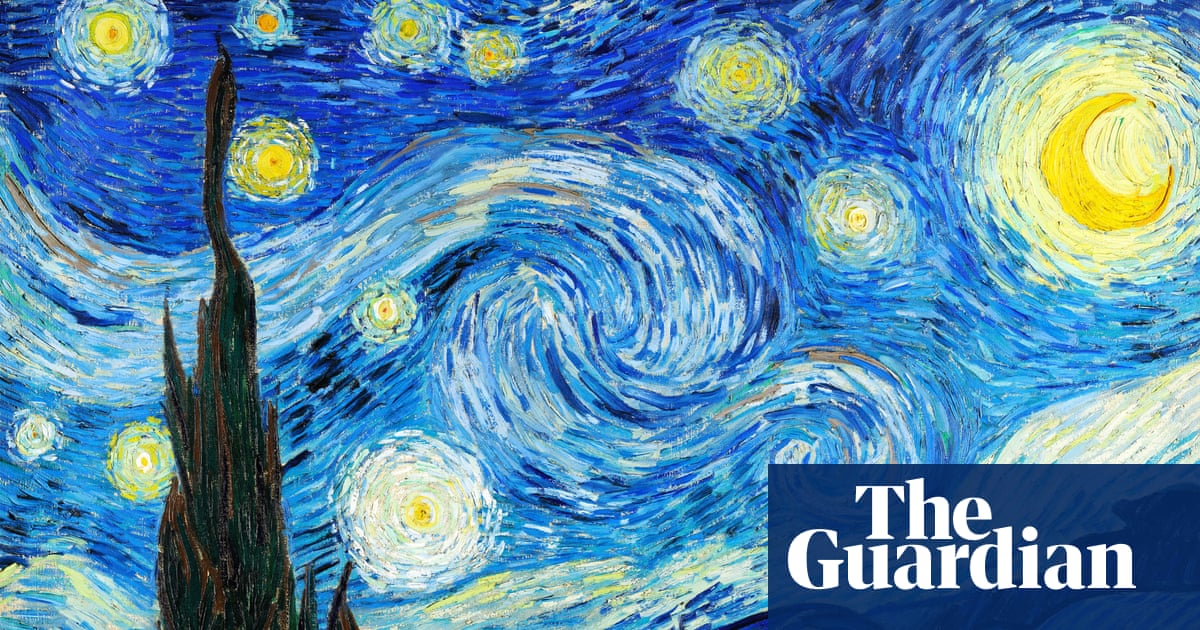
It was long assumed to be a product of Vincent van Gogh’s rich imagination – but scientific sleuthing now suggests The Starry Night may be based on a real dawn sky.
Researchers say the celestial bodies depicted in the famous painting match the sky the Dutch artist may have seen on about 22 July 1889, a month later than the usual date given for the work.
At that time, Van Gogh was living at an asylum in Saint-Rémy-de-Provence, where he had admitted himself after a series of mental health crises.
The June date rests on a letter Van Gogh wrote to his brother Theo on about 18 June, describing “a new study of a starry sky” and on a mental breakdown in July, thought to have left him unable to paint for weeks. However, the authors of the new paper argue that the idea of the sky being imagined also rests on the assumption that the celestial arrangement of the painting did not match what would have been seen in southern France in June.
Moving the date to July, they say, means the moon, Venus and a star cluster called the Hyades that are shown in The Starry Night could have been seen by Van Gogh from his window at the asylum, making the painting an exaggerated reality rather than pure fantasy.
A Vincent van Gogh self-portrait from 1889, the year he painted The Starry Night. Photograph: National Gallery of Art/Washington DC/PA
To make their discovery, researchers in South Korea identified a ridge south-west of the asylum and matched an earlier sketch by Van Gogh to the real landscape.
The sketch showed he drew a surprisingly narrow slice of the scene. “I was standing where Vincent had stood 130 years earlier,” said Elijah Jeong-hyun Kim, the study’s first author and an astronomer at Kyung Hee University in Yongin, South Korea.
The team used astronomy software to recreate the dawn sky for every day in June and July 1889. In the painting, the moon sits above Venus, so they looked for dawns where this occurred and both fitted inside the narrow frame. Only three dates qualified, and 22 July was the closest match, with a thin crescent moon, Venus and the Hyades arranged as in the painting.
“To bring the question into science, which needs quantitative data we had to measure the degree of resemblance between the star patterns in the painting and the real sky, using shape geometry and statistics,” Kim said.
The study is published in the journal Scientific Reports. However, the researchers acknowledged the results were not conclusive, with Kim noting that Van Gogh may have combined the skies of several days.
skip past newsletter promotion
Sign up to Art Weekly
Your weekly art world round-up, sketching out all the biggest stories, scandals and exhibitions
after newsletter promotion
The Van Gogh Museum in Amsterdam, which was not involved in the research, said its experts had established that Van Gogh painted The Starry Night in June 1889. It said the painting was made on a roll of canvas he received in early June, and on 2 July Van Gogh sent his brother Theo a drawing based on it. The museum also said the artist had a severe breakdown on about 22 July that left him unable to paint for more than a month.
“Van Gogh was not concerned with exact likenesses,” a museum spokesperson said. “The positions of the celestial bodies depicted can therefore not form a reliable basis for dating the work.”
Donald Olson, professor emeritus of physics and astronomy at Texas State University, was also not convinced by the study because the positions of Venus and the Hyades cluster in the painting do not match their calculated position.
He added: “The authors’ assumed narrow field of view, essential for their theory that the stars of the Hyades fill most of the canvas, is inconsistent with the much wider field of view required to encompass Starry Night’s round hills and cliffs.”