
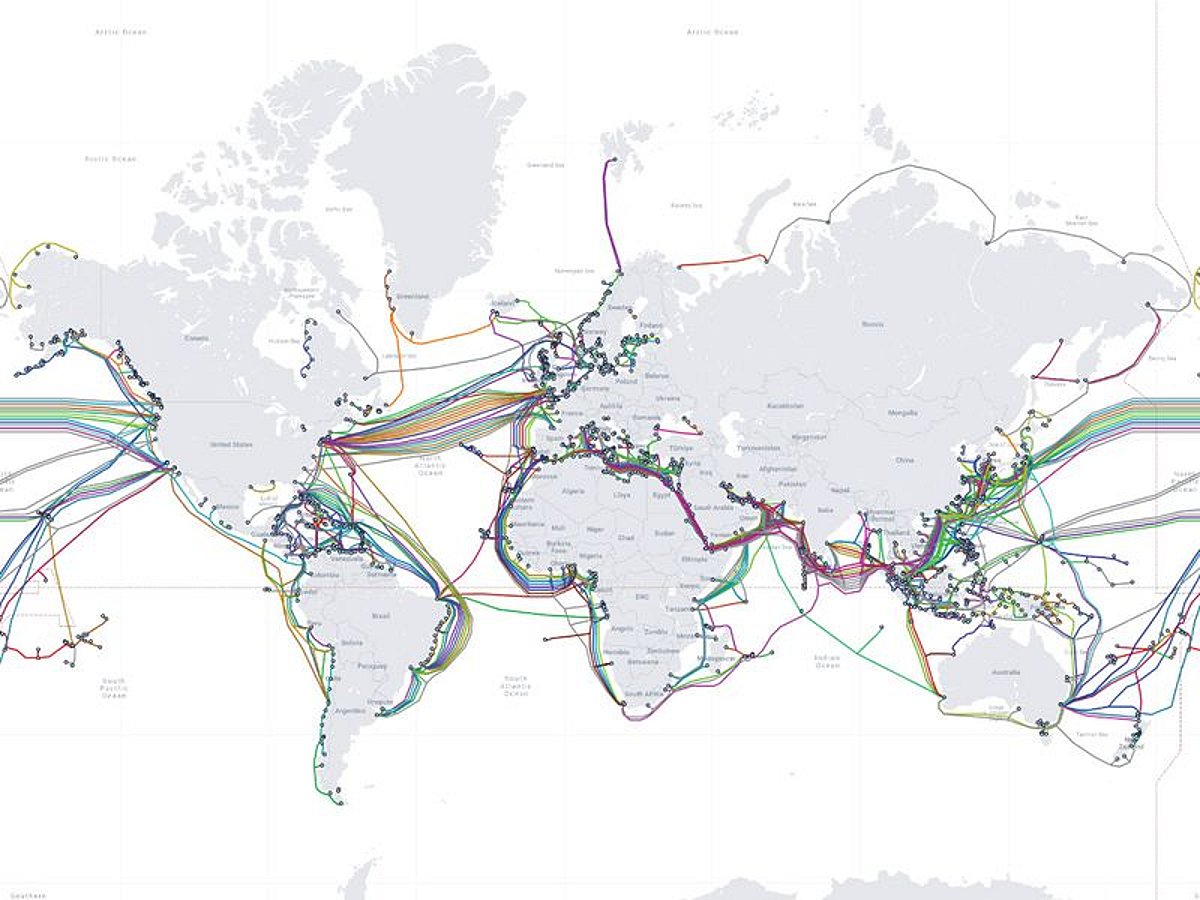
Submarine fibre-optic cables carry the overwhelming majority of international data traffic today, providing enormous capacity at relatively low cost per unit of data.
Satellite networks offer an alternative route that can bypass damaged infrastructure, but their available capacity is limited relative to the world’s total internet demand.
The maths: Why satellites cannot replace undersea cables
The scale difference is substantial.
Consider a simplified illustration using a hypothetical submarine cable route with 20 terabits per second (Tbps) of usable capacity and a satellite backup link with 1 gigabit per second (Gbps).
Since 1 Tbps equals 1,000 Gbps:
Submarine cable: 20 Tbps = 20,000 Gbps.
Satellite backup: 1 Gbps.
Capacity difference: 20,000 to 1, or 20,000 times.
Share of cable capacity replaced: 0.005%.
In this example, a 1 Gbps satellite connection could replace just 0.005% of the cable route’s capacity.
To match a 20 Tbps cable route using 1 Gbps satellite links, operators would need 20,000 such links running simultaneously at their full rated capacity.
What happens when an undersea cable is cut?
A cable failure does not necessarily disconnect an entire country. Internet traffic can often be rerouted through other cables, provided alternative routes have sufficient spare capacity.
The real danger arises when multiple cables fail, when a country depends heavily on a small number of international links, or when remaining routes become congested.
The International Telecommunication Union says submarine cables carry more than 99% of international data traffic. It also identifies physical damage, geographical concentration and lengthy repair times as major resilience challenges.
Satellite connectivity can provide an additional route while engineers locate and repair damaged cables.
Depending on the damage, weather, vessel availability and operating conditions, repairs can take days or weeks.
What Starlink can—and cannot—do
Where satellites can help:
Emergency communications, messaging and limited data access.
Disaster response when mobile towers, power supplies or terrestrial backhaul are damaged.
Connectivity for remote islands, ships, aircraft and isolated communities.
Essential business operations, including selected government services and limited financial transactions.
A temporary alternative route for selected traffic during cable outages.
Where satellites face limitations:
High-volume video streaming and other bandwidth-intensive applications across entire populations.
Large-scale cloud computing and data transfers.
Financial and enterprise systems requiring consistently low latency and high reliability.
Replacing the aggregate capacity of multiple submarine cables serving major cities and data centres.
Satellite performance also varies by technology.
Why satellites matter to the internet
A damaged submarine cable can disrupt international connectivity. Satellite links can help emergency responders, local governments, hospitals and businesses maintain communications when conventional infrastructure fails.
But satellite backup tend to complement — not replace — investment in submarine cables.
In general, countries would benefit from diversifying cable landing points and international routes, improving fibre connectivity, strengthening terrestrial network redundancy and establishing satellite backup arrangements for critical facilities.
The objective should be to prevent a single failure from becoming a nationwide digital emergency.