
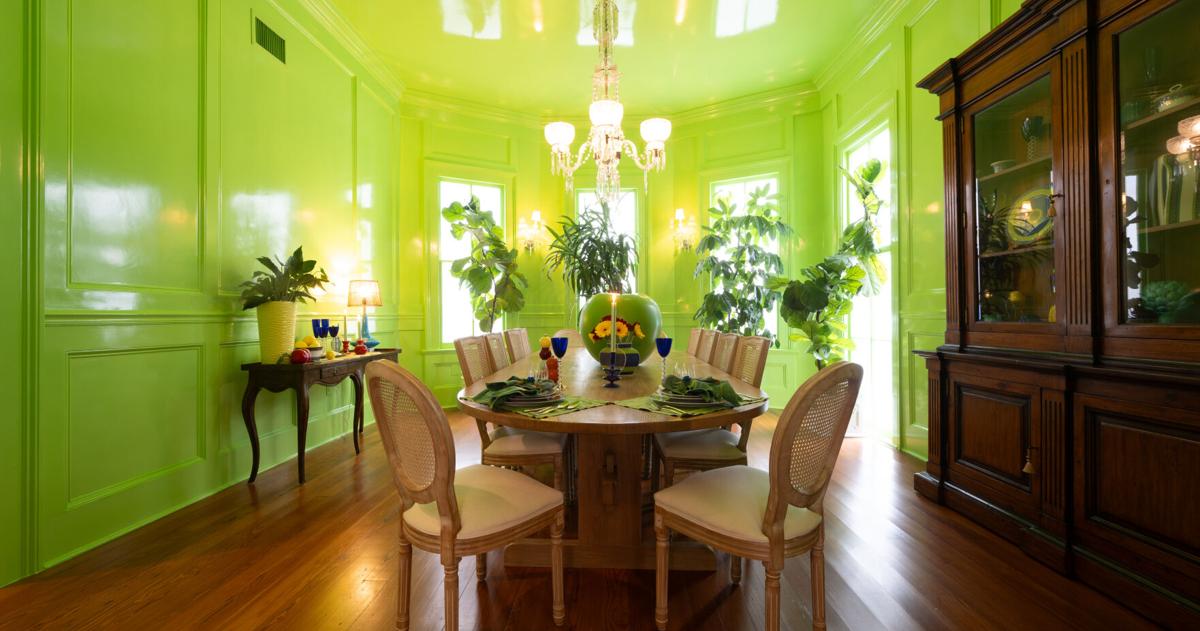
After a spring visit to Richmond, Virginia, Edie Pitt noticed a growing trend of bold — borderline outrageous — formal dining rooms.
She brought the trend home to Uptown, where the house she shares with her husband, Jeffrey, overlooks one of New Orleans’ iconic parks.
“I was inspired by Audubon Park,” Pitt said. “I wanted to bring the feeling of the park inside.”
She banished the piles of junk mail and business correspondence covering the dining room table and gave the space a serious overhaul.
But she’s not the only one taking a new look at the formal dining room. After decades of renovations for more open floor plans, experts say American homeowners are reverting back to layouts that provide more privacy and have dedicated spaces for socializing.
A room that was a catch-all for junk is now the Pitt family’s favorite place in the house. The couple now has dinner together and sets the table with their wedding china, once rarely used.

Edie Pitt kept her dining room devoid of rugs, artwork and window coverings. Her large potted plants and trees thrive in the sun-splashed space.
Jeff Strout
“I started throwing dinner parties again. I have had eight dinner parties in the past six months. Before that, even though I love to cook, I hadn’t had a dinner party in the six years since my youngest daughter went away to college,” she said. “Now, people want to come over and sit in this amazing room. I have inspired others to overhaul their dining rooms and start using them again, too.”
Pitt, a property developer, put her crew to work on the dining room walls, trim and ceiling in an exhaustive, two-month color-drenching process. They used Fine Paints of Europe Hollandlac Brilliant 98 extreme high-gloss paint — color-matched to Benjamin Moore’s Spring Meadow Green.
The result is jaw-dropping.
“Everyone who walks in the room just shrieks, ‘Oh my God.’ It’s almost as though the room is living,” Pitt said. “It is constantly moving due to the light coming in from the windows and reflecting off every surface on the walls and ceiling.” She deliberately kept the room free of artwork, draperies and rugs so they wouldn’t compete with the paint’s extreme intensity.
A dedicated space
For the past three decades, people have gotten rid of the formal dining room to create ever-larger, open kitchens that segue into casual living and dining areas.
But that is changing. According to an April 2025 Southern Living article, homeowners are reverting to formal dining rooms to create an intentional space for quality time, digital disconnection and relief from the noise of open-concept floor plans. Also, rising costs have led homeowners to romanticize hosting and creating special restaurantlike experiences.
“In New Orleans, where lots and building footprints are often constrained, we’re always encouraging clients to think carefully about how they use their space and what matters most to them,” said architect Jennifer Zurik, a partner of MZ Architecture. “We ask them to establish priorities, and we often find that sharing meals and spending time together is high on that list.”
Zurik shared that for years, everyone was obsessed with large kitchen islands. While they have their purpose, sitting in a line at a counter doesn’t offer the same opportunity for conversation and connection as sitting around a table.
“This is one area where we encourage (clients) to consider the value of a dining room or defined dining space that genuinely fits,” Zurik said.
Architect Jennifer Zurik designed these built-in features for her clients’ dining room. They are a contemporary interpretation of traditional serving cabinets. She also incorporated an ice maker and specialized storage, making the cabinetry as practical for everyday living as it is for entertaining.
Jeff Strout
For Sara and Phil Cossich’s recent renovation, Zurik designed built-in cabinetry. With demanding careers and two children under 10, the couple wanted a dining room that would always be tidy and organized. The floor-to-ceiling built-ins bracket a window covered with a Roman blind above a buffet counter. Below is climate-controlled wine storage, a beverage refrigerator and an ice maker. The mesh fronts of the cabinetry offer a glimpse of the formal dinnerware within. A dramatic saucer-shaped chandelier illuminates the space.
Zurik noted that since food is such an important part of local culture, spaces should encourage authentic engagement. “There’s arguably no better way to do that than breaking bread together,” she said. “The dining table is reclaiming its importance.”
A stand-alone dining room allows for more creative expression. You can take things to the next level with intense colors and finishes, exuberant wallpaper, statement lighting fixtures or picture-frame molding, instead of limiting yourself to one color palette. In an open-floor concept, you must worry about colors and finishes clashing.
Whitney Wilkinson, interior designer for the Cossich home, used Parma Gray by Farrow & Ball on the walls and trim. A textured pearl-finish wallpaper with an undulating pattern covers the ceiling, creating a sense of drama.
“It is not a large room, so I wanted to draw the eye upward as you walk in,” Wilkinson said. “A last-minute decision to paint the interiors of the built-ins a rich oxblood color is a subtle detail that you really appreciate as you get closer, with the color peeking through the metal mesh cabinet fronts.”
Grate Tate, an interior designer and partner of Magazine Street’s luxury decor store Tyler + Tate, agreed there is a renewed interest in dedicated dining spaces. Tate attributes this to a cultural shift — people are craving moments of connection that bring a sense of occasion to everyday life, rather than returning to the formality of previous generations.
“We’re seeing a real yearning for something nostalgic,” Tate said. “People are rediscovering the pleasure of sitting around a beautifully appointed table, putting their cellphones away, sharing a home-cooked meal and simply enjoying conversation with family and friends.”
This tablescape by Tyler + Tate illustrates a return to opulence and artistry. Setting a lavish table can make any meal an occasion.
Provided by Tyler + Tate
Tate and his team have also noticed an enthusiasm for beautifully crafted tabletop accessories, including placemats, napkins and tablecloths; locally made, hand-blown glassware; and distinctive decorative objects.
“Our customers increasingly want pieces that feel collected rather than mass-produced,” he said. “They’re looking for craftsmanship, interesting materials, beautiful colors and objects that have a sense of history or personality.”
Serving many purposes
An advantage of a dedicated dining room is closing the door on kitchen clutter and focusing on your guests. Another trend is using the dining room for double duty as a quiet library, art studio, board game hub or remote workspace.
Kevin Gillentine, a local artist and interior designer, has long used his dining room for the many dinner parties and book club meetings he and his husband, Vincent Bergeal, host.
Kevin Gillentine and Vincent Bergeal’s dining room is, aside from the kitchen, the heart of the home. They frequently host book club meetings and dinner parties in the space.
Jeff Strout
Gillentine originally wanted all white walls in his home, keeping things simple and allowing art to stand out.
“But Vincent wanted one room to really have a color, not just some accents,” Gillentine said. “We settled on the dining room, and he chose Starburst Orange (Benjamin Moore). I used a matte finish because it has a softness to it. That color is intense enough. It really makes a statement. I’ve come to love it.”
Beyond color drenching, current dining room trends include statement ceilings with murals, lacquer or fabric draping; architectural millwork in both historic renovations and new builds; richly colored cabinetry with deep accent hues; and intimate banquettes in place of formal matched dining sets.