
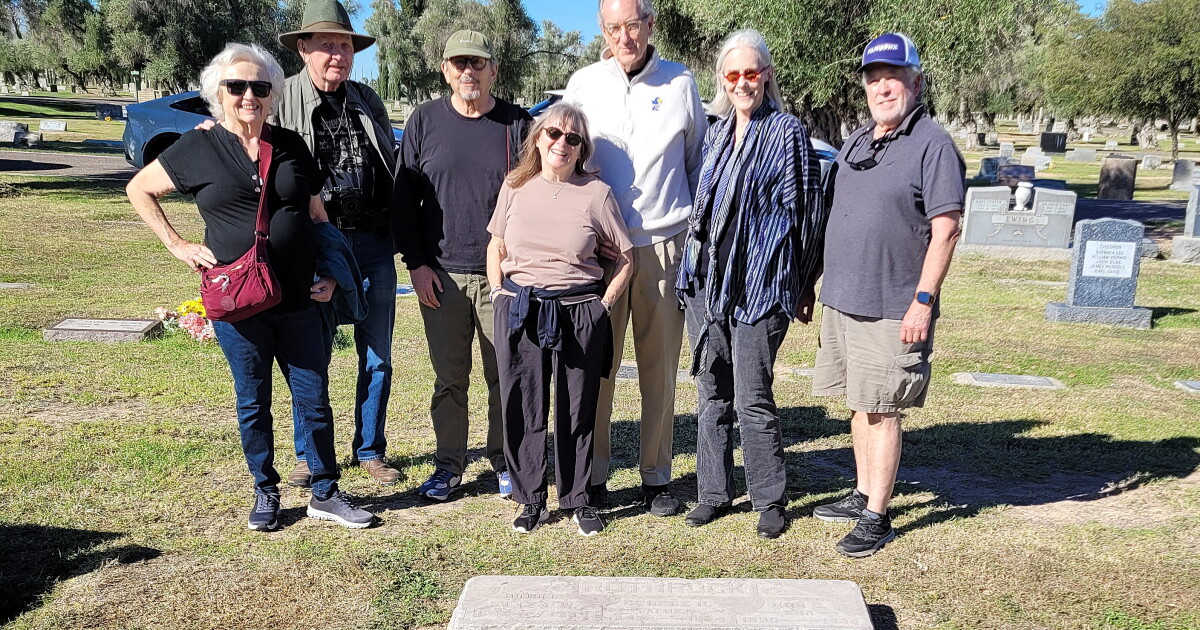
MARK BRODIE: Members of the Arizona Photography Alliance will be meeting Monday at Mesa Cemetery, in an effort to draw attention to one of the people who’s buried there.
The group has raised more than $3,500 to get a new headstone for a photographer named George H. Rothrock. He lived and worked in Arizona in the latter part of the 19th century, although he was originally from Missouri.
Jeremy Rowe is an emeritus ASU faculty, writer and member of the Arizona Photography Alliance. He joins me to talk more about this. And, Jeremy, how did Rothrock end up in Arizona in the first place?
JEREMY ROWE: He was a photographer in California originally. He was born in Missouri, came to California, went to Nevada, sort of bounced around the West. He and a partner, Mr. Young, came to Yuma and started a photography studio in Yuma, and then moved from Yuma to Phoenix.
He built supposedly the first wooden structure in Phoenix. Everybody was using adobe. They did a small wooden studio, about 10-by-12 feet, and then he used the additional wood that he had available to build the first wooden home in Phoenix. This is roughly 1875. He came across from Yuma to Phoenix, and then ’76, his partner, Mr. Young, passed away, and then Rothrock kept the photo equipment, worked with his widow to be able to maintain the photo equipment, started the first photographic studio in the Phoenix area and then carried on from there.
MARK BRODIE: What was photography like in the latter part of the 1800s?
JEREMY ROWE: He was doing it in the last of the 19th century. He was primarily working in wet-plate, which is wet-plate photography, which uses collodion on glass. It’s a mix of guncotton and ether. It’s a very thick, syrupy material that’s poured on a sheet of glass, then it’s dipped in chemistry to sensitize it, put in the back of the camera, a view camera, while it is still wet, and then exposed, processed, and fixed, dried, and packed away.
Photographers would have to carry all the chemistry with them. Rothrock and others in Arizona also had to carry water, typically about 150 pounds of material, and every negative was a piece of glass. So they had to carry glass for making the images, and they had to make sure the glass got back to the studio to be able to print without being broken. Very, very elaborate process, very tenuous when the heat in Arizona and the low humidity here, so it made it very difficult for many photographers.
MARK BRODIE: Well, not to mention dirt roads, no automobiles. That sounds like a lot to do.
JEREMY ROWE: They were carrying it on horseback, burro and wagon. There are many stories about the photographers out and about.
Collection of Jeremy Rowe Vintage Photography
/
Courtesy
George H. Rothrock
MARK BRODIE: What kinds of things did he photograph?
JEREMY ROWE: He started photographing in Arizona in Yuma. They had a small portrait studio. They did street scenes in Yuma, then he went up to Fort Mohave, photographed in Fort Mohave, Mineral Park, many of the small mining communities, the small towns and camps and forts around Arizona.
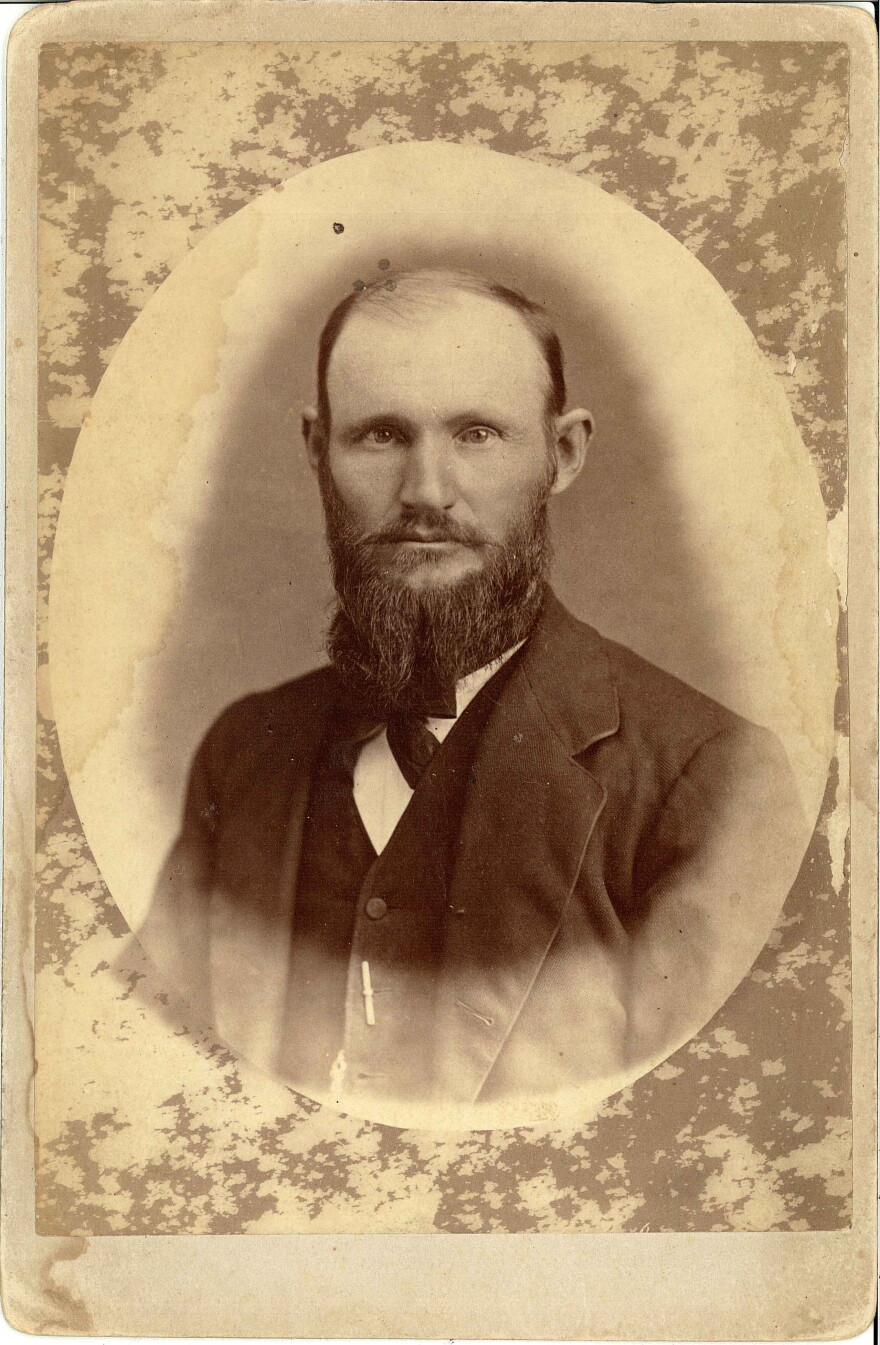
When he came to Phoenix, he started primarily a photo studio there. He did documentation of Phoenix in cartes de visite, which are small visiting card-sized photographs, and cabinet cards, which are slightly larger.
But bulk of his work during that time period was in stereo. He did some of the best documentation of visual documentation of Arizona between 1875 and about 1890 that exists, and it’s in its stereo format: two images, a left-eye image and a right-eye image taken with a camera with two lenses. When you print them and put them in the viewer, that gives you a 3D view.
And he did over 250 different titles of stereo views. Many of them are reproduced in books and magazines and historic articles, but they very rarely give credit to either the photographer or the format.
MARK BRODIE: And what do those photographs look like? What do they maybe tell us about Arizona at that time?
JEREMY ROWE: They capture visually what you much more — photographs are a primary source document, just like a manuscript or other sort of research objects people do. But the photograph actually conveys visually what you’re able to see. So you can look back and see what it looked like to live in an adobe building, what it looked like to live in a cave for early mining, or to visit on Ration Day at the San Carlos Reservation, or to look at the military scouts on formations.
He was one of the first to photograph the Natural Bridge in Payson, for example. So he and his assistant were posed on the rocks and showing the arch, which people had not been able to see. People didn’t travel as much, and the stereo views in particular were produced in small quantities, and people would buy them and have a little stack in their parlor with a stereoscope to view. That was a way people got to know and understand the West.
MARK BRODIE: You mentioned that Rothrock also did a bunch of portraits as well. Was this something that was particularly popular? Photography was relatively new at that time, right?
JEREMY ROWE: Yeah, photography was invented in 1839. The earliest Arizona photograph I’ve found in any collection anywhere is 1864. The portraits were sort of the bread and butter for a photo studio, much like today. There’s commercial photography they did: outdoor businesses and buildings and so on at that level. There’s also the bread-and-butter portrait photography. The cartes de visite and cabinet cards were the sort of underlying support for many of the photo studios. They would use that as the primary business, and then they’d take their equipment and either go out on the street or go on travels, make other images to try and sell for other markets.
MARK BRODIE: So when you think about photography in general, and specifically photography in Arizona, where do you see is George Rothrock’s legacy? Where does he fit into all that?
JEREMY ROWE: He’s probably the best documentation for that last quarter of the 19th century, the 1875 to about 1890, that was really his prime period, his heyday. There were other photographers like Henry Buehman of Tucson and Mitchell in Prescott that were competing, but Rothrock did a really good job.
He also had a wonderful sense of 3D. When he was making the images, he would place people under appropriate zones or layers when he photographed visually so that you couldn’t tell in a 2D image, but in a 3D image, they just pop, they just jump, and really a master.
So he was very interested in aesthetic photography. He was in very important places photographically. He visited places like San Carlos very soon after they were formed. Dudley Flanders was the first; Rothrock was probably the second to do documentation there.
He just liked to get out and about, he liked to explore, and apparently was very good at getting into places. So he photographed at Fort McDowell, he photographed many of the camps and forts and towns and mines, and really has a very interesting portfolio of images that he captured.
And again, they’re the mainstay of much of the photographic, of much of the Arizona history from that era, but they’re often not credited to him, and people don’t understand that he’s the source of them. So sort of an unnamed artist and unnamed influence on photographic history of Arizona. We’re trying to help resurrect his name and make people a little more aware of him with the marker that the Arizona Photography Alliance has helped put together.
MARK BRODIE: Yeah, I was going to ask if part of the goal of having a new grave marker for him is to sort of raise awareness of him and let folks know who this guy was and what he was all about, and sort of his role in Arizona history.
Arizona Photography Alliance
/
Courtesy
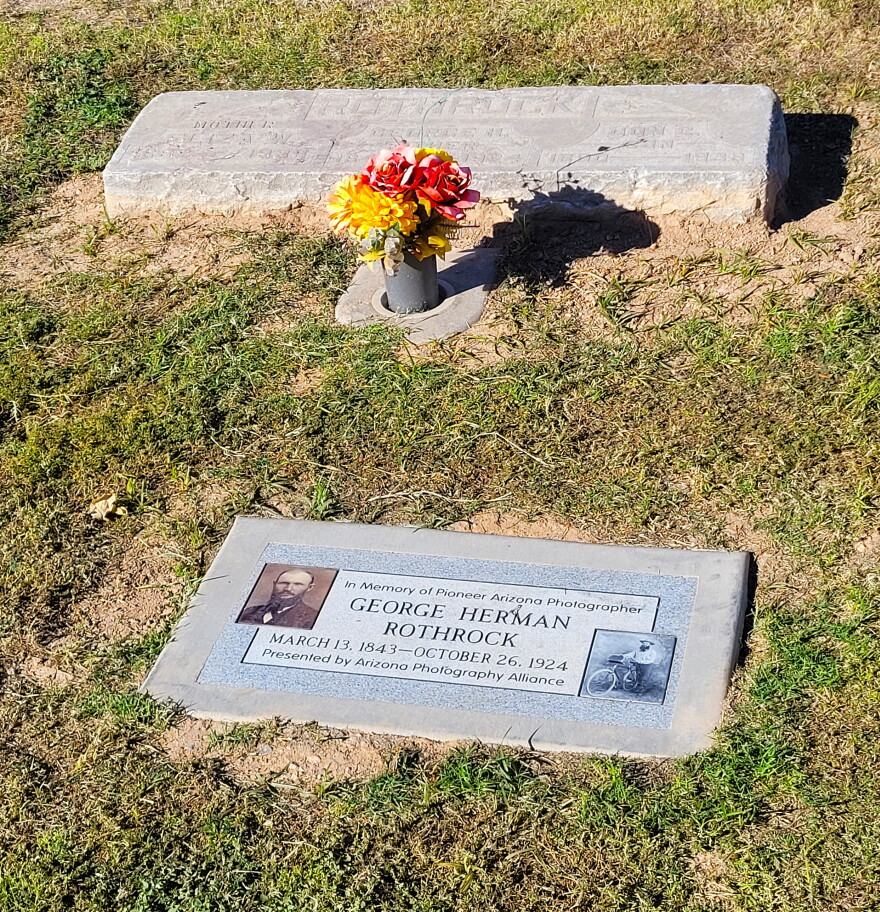
The new headstone, pictured next to George H. Rothrocs’s old headstone in Mesa Cemetery on Oct. 26, 2026.
JEREMY ROWE: Yeah. The first marker that was put together by the Arizona Photography Alliance is for Frank Hartwell. He was a little bit later era, ’90s and turn of the century, but also very important in documenting the area. So the Arizona Photography Alliance has very genuinely put together a series of fundraisers to get money to be able to put headstones together for these individuals. We’ve got a format where we have a self-portrait of the individual, a little bit of background on them — birth dates, death dates, and so on — and then an example of their work.
George Rothrock had a headstone that was totally illegible, and the people at the cemetery didn’t even know he was there. They knew he was important, but they didn’t know he was buried in that cemetery. So this is going to help them with their tours and background. I think raising awareness of the photographic history of Arizona is really important, and these are two of the sort of pioneer photographers that really had an impact that people don’t understand or don’t know about.
So hopefully this process and the unveiling and everything we do around promoting this is going to be helping get them to be more aware, make the general population more aware of the photographic history and of the contributions of these two photographers.
MARK BRODIE: All right, that is Jeremy Rowe, a photographer, member of the Arizona Photography Alliance, among many other things. Jeremy, thanks so much.
JEREMY ROWE: Thank you very much. Thanks for making this work. Appreciate it.
KJZZ’s The Show transcripts are created for audience accessibility. Transcripts are created on deadline with the assistance of AI tools and then edited, and may not be in their final form. The authoritative record of KJZZ’s programming is the audio segment.