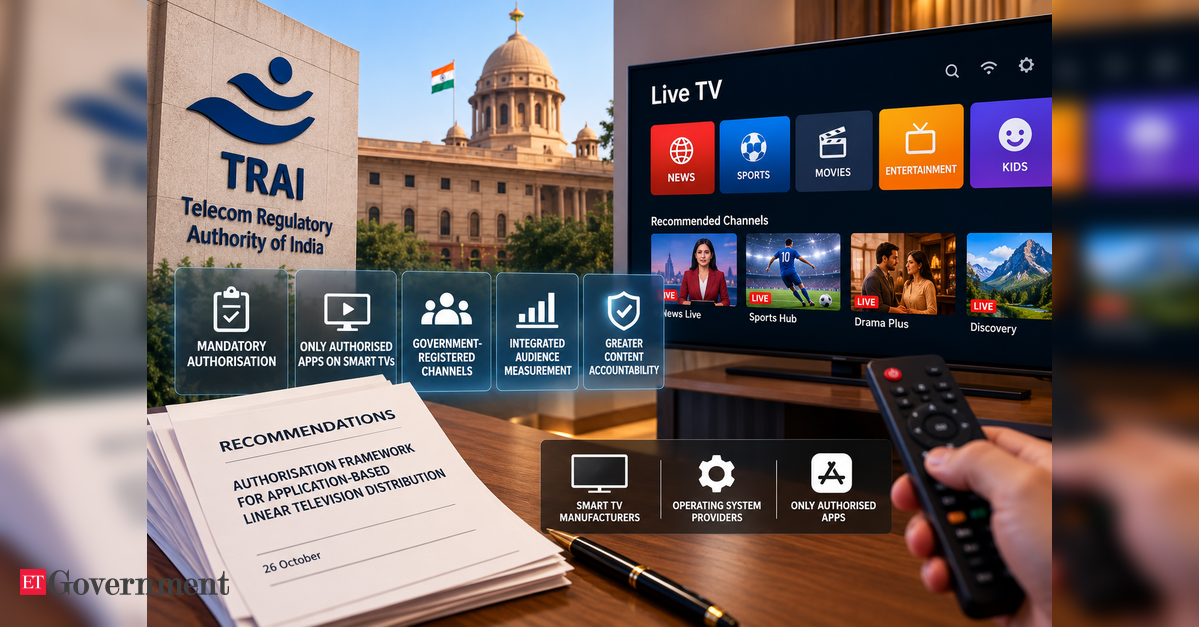
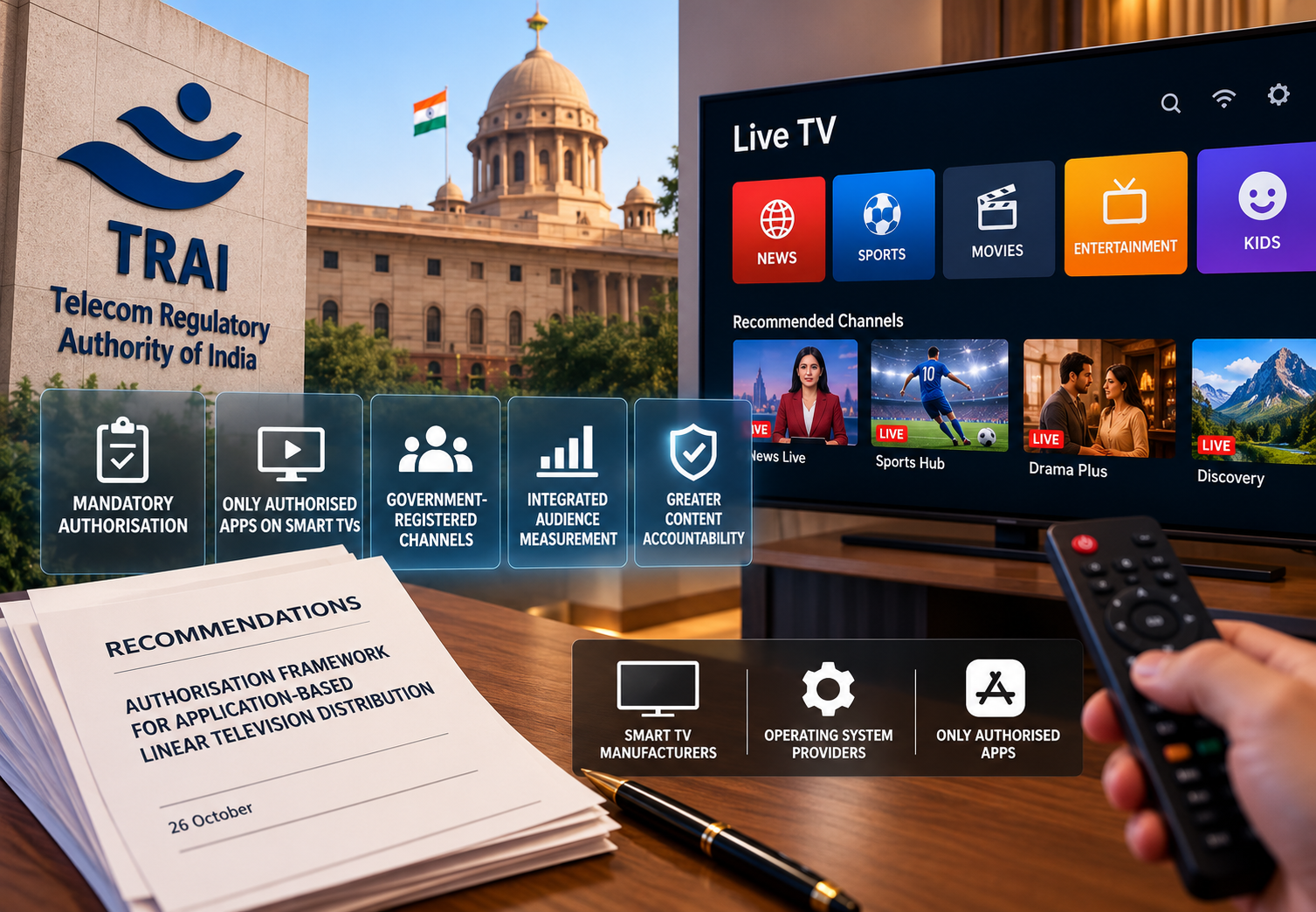
 TRAI has proposed mandatory government authorisation for internet-based live-TV applications, introducing new regulatory requirements for digital television distribution, smart-TV platforms, content accountability and audience measurement.
India’s rapidly changing television market could face a significant regulatory restructuring, with the Telecom Regulatory Authority of India (TRAI) recommending mandatory government authorisation for applications distributing scheduled television channels over the internet.The proposal seeks to bring internet-based television distribution closer to the regulatory framework governing conventional broadcasting, while addressing questions of content accountability, consumer protection and audience measurement.The recommendations, released on October 26, cover Application-based Linear Television Distribution (ALTD) services, including Free Ad-Supported Streaming Television (FAST). These services allow viewers to watch scheduled television channels through smart TVs, mobile applications and websites without necessarily subscribing to traditional cable or direct-to-home (DTH) services.The proposed framework would create a distinct authorisation category under the Telecommunications Act, 2023, bringing a growing segment of digital television distribution within a formal regulatory structure.The initiative originated from a reference sent by the Ministry of Information and Broadcasting (MIB) to TRAI on December 15, 2025, seeking recommendations on regulatory parity, content accountability and consumer protection. TRAI subsequently issued a consultation paper on April 6, 2026, receiving 207 stakeholder comments and 11 counter-comments.An open-house discussion followed on June 10. The resulting recommendations reflect the government’s attempt to address the increasingly blurred distinction between conventional television broadcasting and internet-delivered linear programming.What TRAI has proposed
Under the proposed framework, ALTD would become a separate sub-category of Television Channel Distribution Services under Section 3(1)(a) of the Telecommunications Act, 2023. Application providers would be responsible for obtaining authorisation and complying with applicable conditions.The authorisation would cover a national service area, remain valid initially for 20 years and be renewable for successive 10-year periods. TRAI has recommended a one-time entry fee of ₹1 lakh and an application processing fee of ₹10,000, without recurring authorisation fees, bank guarantees or security deposits.TRAI describes its approach as a “light-touch and future-ready policy framework” intended to promote innovation, ease of doing business, consumer protection and regulatory certainty. The relatively modest financial requirements indicate an attempt to avoid imposing the infrastructure-related compliance costs associated with conventional broadcasting networks on application-based distributors. Nevertheless, the authorisation requirement would introduce a new layer of government oversight for businesses operating in the internet television market.A significant recommendation concerns the responsibilities of smart-TV manufacturers and operating-system providers. TRAI wants the Ministry of Information and Broadcasting to maintain a central repository of authorised ALTD applications.Television manufacturers and operating-system providers would have to ensure that only authorised applications are available through their devices and application stores. They would also submit annual compliance reports to the ministry, extending regulatory obligations beyond content distributors to technology companies controlling television interfaces.Content accountability and regulatory boundaries
The proposed framework would permit authorised ALTD operators to distribute only television channels holding valid government permission, authorisation or registration. TRAI has also recommended a simplified registration mechanism for internet-native linear television channels, potentially creating a formal route for digital-first broadcasters that operate scheduled programming without conventional television distribution infrastructure.This distinction is important because the recommendations do not seek to regulate every form of internet video streaming through ALTD authorisation. Broadcaster-owned applications distributing exclusively their own channels or those of subsidiary or holding companies would be excluded. Live streams carried through social media intermediaries would also remain outside this particular framework.The regulatory focus is therefore on applications aggregating and distributing linear television channels, rather than the entire over-the-top entertainment industry.The proposed approach could improve accountability by identifying the entity responsible for distributing channels and handling consumer grievances. However, its effectiveness would depend on clear definitions and predictable registration procedures.Excessively broad interpretations could create uncertainty for hybrid platforms offering scheduled channels alongside on-demand programming, while inconsistent enforcement could disadvantage smaller digital broadcasters.Audience measurement and advertising implications
Another important recommendation concerns television ratings. TRAI wants viewership through ALTD applications incorporated into India’s television audience measurement framework. Authorised operators would also be permitted to publish anonymised periodic viewership information in accordance with the TV Ratings Policy, 2026.This could have considerable implications for broadcasters, advertisers and media agencies. As television viewing increasingly shifts towards connected devices, measurement systems focused primarily on conventional distribution risk providing an incomplete picture of audience behaviour. Incorporating internet-based linear television could improve the assessment of channel reach, advertising effectiveness and the distribution of advertising expenditure.However, integrating application-generated viewing data into a common ratings system presents technical and governance challenges. Differences in measurement methodologies, device identification, data verification and privacy safeguards would need to be addressed. Transparent standards would be essential to ensure that digital viewing figures are comparable with conventional television ratings and do not create opportunities for manipulation.Balancing innovation with oversight
The recommendations represent a broader regulatory shift towards treating comparable television distribution services consistently, irrespective of the technology used to deliver them. Conventional cable and DTH operators already function within established authorisation and compliance frameworks. Internet-based distributors, by contrast, have developed through different technological and commercial arrangements.Greater regulatory consistency could strengthen consumer protection and provide clarity for legitimate operators. At the same time, mandatory authorisation and application-store restrictions could raise market-entry barriers, particularly if approval processes become lengthy or compliance requirements expand beyond the proposed light-touch model.The next decision rests with the Ministry of Information and Broadcasting. TRAI’s recommendations have not yet been accepted, notified or implemented. Their eventual impact will depend on the rules adopted, the efficiency of digital authorisation procedures and the safeguards established for competition and consumer choice.For India’s television industry, the central question is whether the proposed framework can deliver greater accountability without restricting the innovation and accessibility that have driven internet-based broadcasting. The answer will help determine how conventional television and digital distribution coexist in an increasingly connected media market.