
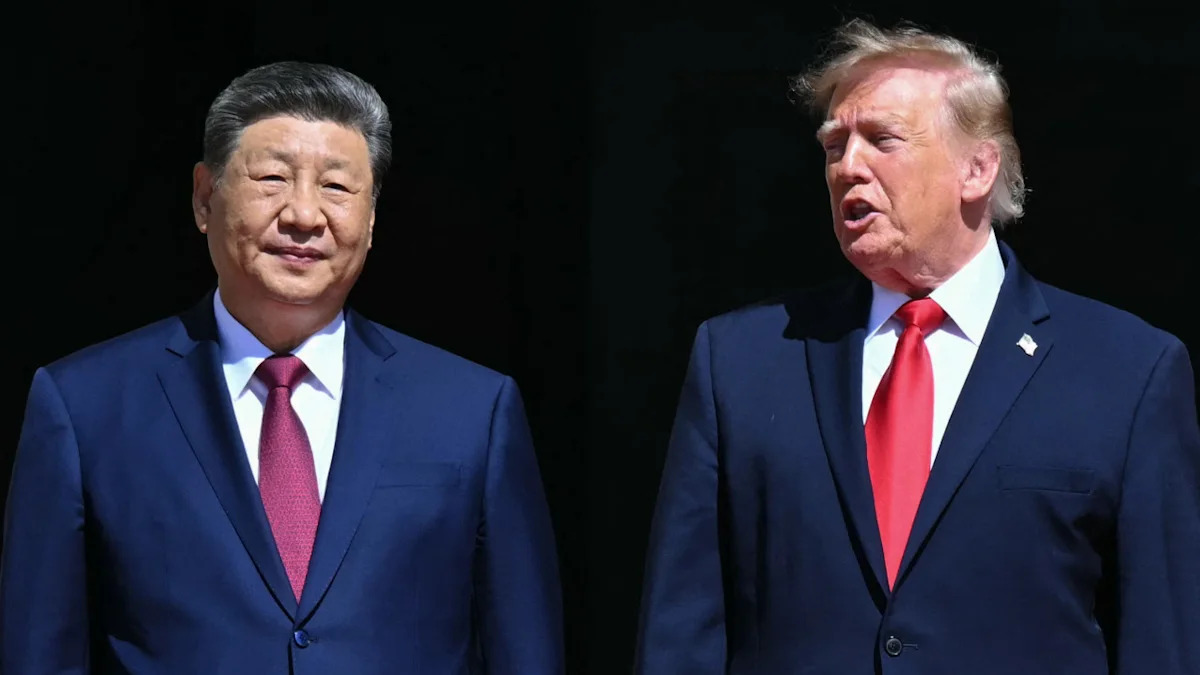
 SAUL LOEB / AFP via Getty Images
President Donald Trump’s tariffs were supposed to put pressure on China, but they seem to be doing the complete opposite
China is continuing to grow, raising questions about whether Washington’s strategy is actually delivering on the results the administration set out to achieve.
Must Read
The Asian nation’s gross domestic product grew 4.5% in the July-September quarter, just 0.1% above economists’ forecasts, according to Goldman Sachs economist Hui Shan.
“Contrary to our expectation of moderate fiscal loosening at the beginning of the year, fiscal data have shown effective tightening,” she said. “In the first nine months of this year, combined revenues from the general public budget and government managed funds increased by 1.4% [year over year], whereas expenditures fell by 3.5%.”
China appears to be reducing its deficit as a share of its GDP. The CBO’s long-term budget projections show total deficits averaging 7.2% of GDP over the next three decades (2026-2056).
A damaged relationship, but not an absent one
While the trade link between the countries has weakened, it hasn’t vanished, JPMorgan had pointed out in May. China is still dependent on trade. But it’s less dependent on the U.S. than it used to be. U.S. imports from China hit lows last year than during the pandemic and are expected to drop even further this year.
Tariff rates between the U.S. and China have simmered from their heat earlier on in the trade wars; levies between the two nations are still high compared to years past.
On the other side, China’s tariffs on U.S. exports have hovered at 31.9% as of August 2026, according to the Peterson Institute for International Economics.
Is there hope?
According to Fortune, recent data released by the Chinese government revealed that their exports leaped by 36.3% in September compared to the previous year. That’s their fastest growth since February.
Leverage is something the U.S. and China are both fighting for, with tariffs the most visible of the pressure points. The Americans, though, can also utilize semiconductor exports and investment restrictions to help their cause. Rare-earth supplies are just as important, though, and the advantage there goes to China, which accounts for roughly 70% of rare-earth mining, 90% of separation and processing and 93% of magnet manufacturing
JPMorgan (NYSE: JPM), in a note to investors, said it saw five forces that could reshape the equilibrium between the two countries. And that, in turn, could lead to everything from lower retail prices to increased optimism on Wall Street
“The chokepoints now run both ways,” JPMorgan wrote. “Both sides now know the pressure points. The goal is to manage them before they become shocks.”
A global relationship
China’s Belt and Road Initiative, a global infrastructure and economic development strategy designed to help China and its partner countries trade and share goods, spans roughly 150 countries. That means tensions are not just confined to the U.S. and China. But if those two countries can restore the equilibrium between them, it could benefit many other nations as well, making it easier to manage costs.
Dialogue could be the start of stabilization
A key question is whether the just-concluded summit was a one-off event or the start of a longer series of talks between the countries. If so, that reduces the risk of economic disputes becoming something broader, which should calm markets.
“It’s less about the dialogue and more about whether future engagement produces mechanisms to help manage disputes on things like trade and investment channels, purchase commitments, artificial intelligence (AI) dialogue, tariff language and working-level forum,” JPMorgan wrote. “Dialogue does not mean a reset, but rather a test of whether the world’s two largest economies can make a fragile relationship more predictable.”
What To Read Next
Join 250,000+ readers and get Moneywise’s best stories and exclusive interviews first — clear insights curated and delivered weekly. Subscribe now.
This article originally appeared on Moneywise.com under the title: China’s economy is outpacing the US despite Trump’s tariffs. Here’s what JPMorgan says it could mean for your money
This article provides information only and should not be construed as advice. It is provided without warranty of any kind.