
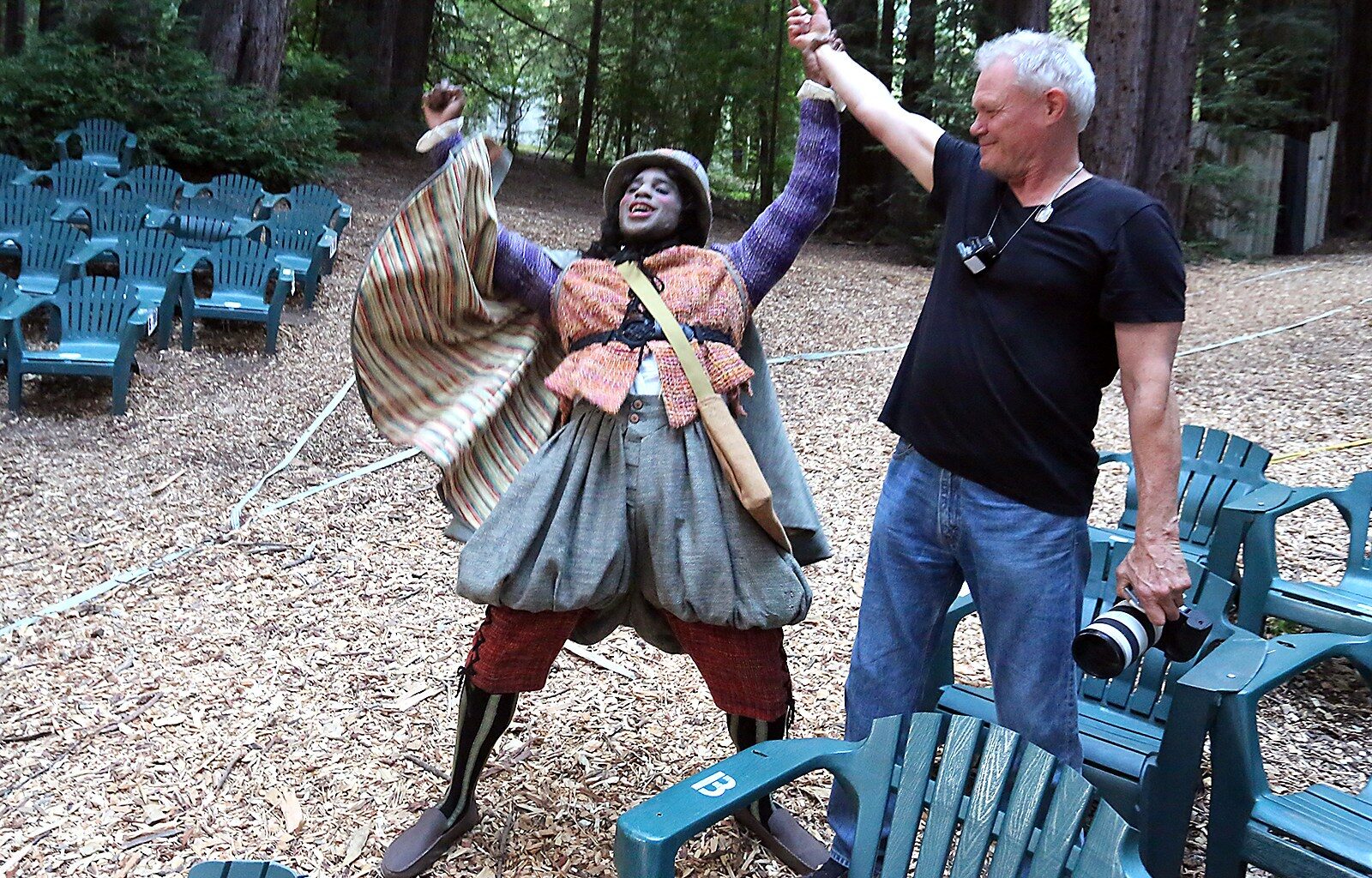
SANTA CRUZ — Whether capturing the vibrancy of Santa Cruz’s local art scene or the customs of different cultures abroad, Ron “R.R.” Jones used his camera to bring a light to the human experience. On Oct. 3, that creative voice was silenced when Jones died of complications from a rare heart disease. He was 76.
“He had a knack for capturing a moment in his art,” said his longtime partner Jody Alexander.
Jones went by many names. He was born Ronald Ray Jones, professionally went by R.R. Jones (sometimes stylized without capital letters as “r.r. jones”) and known to friends as Jonesie. He was the house photographer for local arts institutions like Kuumbwa Jazz, The Cabrillo Festival of Contemporary Music and Shakespeare Santa Cruz/Santa Cruz Shakespeare but also captured images of local and regional artwork as well as commercial photography for businesses like Pacific Cookie Co. and Love Apple Farms, and traveled to places like Mexico and Southeast Asia to document the cultures there.
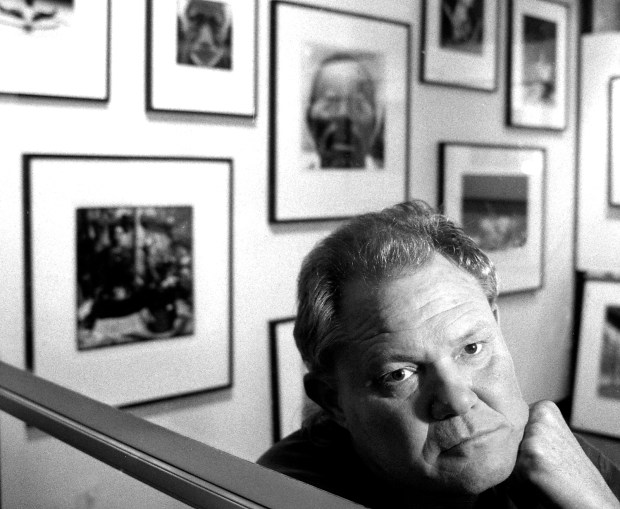 Ron “R.R.” Jones photographed in his Sash Mill studio in when he was honored with a Gail Rich Award in 2001. (Shmuel Thaler — Santa Cruz Sentinel file)
“When he was photographing live performances, he just knew what he was looking for,” said Alexander. “He knew when to click, and it was pretty amazing to see the outcome of that.”
Jones was born Nov. 7, 1949, in Houston, played football and took up surfing as a teenager, ultimately moving to San Diego at 17. At community college, he became enamored with photography after learning from masters like Justice Ahrend and Ross Russell, a jazz producer and historian who took photos of the Newport Jazz Festival. Starting in the ’70s, he began traveling to Mexico in a Volkswagen bus with a camera in hand.
Jones’ Mexico photography set the tone for a lot of his work. His photos are not the typical glamor shots of Cancun one can see on a scroll through Instagram nowadays, but the harsh realities the country has had to deal with for a long time. Photos include a shot of a graveyard commemorating the 45 victims of the 1997 massacre of a Catholic Indigenous prayer meeting and portraits of a Zapatista and blind man with his son. He also captured upbeat black-and-white photos of a rodeo queen, girls in Mayan garb and a cross-dressing performer at the Stardust nightclub in Michoacán.
“My job, as a photographer, is to find the particular moment when something profound, deeply personal, and true, is revealed in a way that can be shared,” Jones wrote in the artist statement on his website. “The message is there — I just have to find it in order to pass it along.”
Jones moved to Santa Cruz in 1986 so his then-wife could be closer to her family who lived in Aptos. Even after the divorce, Jones remained in Santa Cruz and became the photographer for many local institutions. Most notably, he was the house photographer of Kuumbwa Jazz where he took photos of local musicians as well as big names who played the venue like Wynton Marsalis, Booker T. Jones and Esperanza Spalding.
Tim Jackson, Kuumbwa Jazz co-founder, said he had gotten to know Jones as he worked out of a studio next to the venue. When Kuumbwa Jazz’s house photographer left, Tim Jackson was able to convince Jones to take over.
“He wasn’t just a photographer,” he said. “He was a real artist, and his artistry showed through in his photographs.”
Tim Jackson said Jones’ photos were more than just documentation of Kuumbwa Jazz’s shows but artistry in their own right. He often referred to Jones as “the mayor of Cedar Square,” as he was a fixture of the block that included Kuumbwa Jazz and businesses like The Alley-Oop and The Bagelry, often being the first to arrive.
“He’d meet me in the parking lot, and he’d want to talk about the show the night before,” he said. “We’d do a Monday morning quarterbacking of the show and processed it together. He lived an artistic life, always thinking about art and music. To have somebody that committed was a really special thing.”
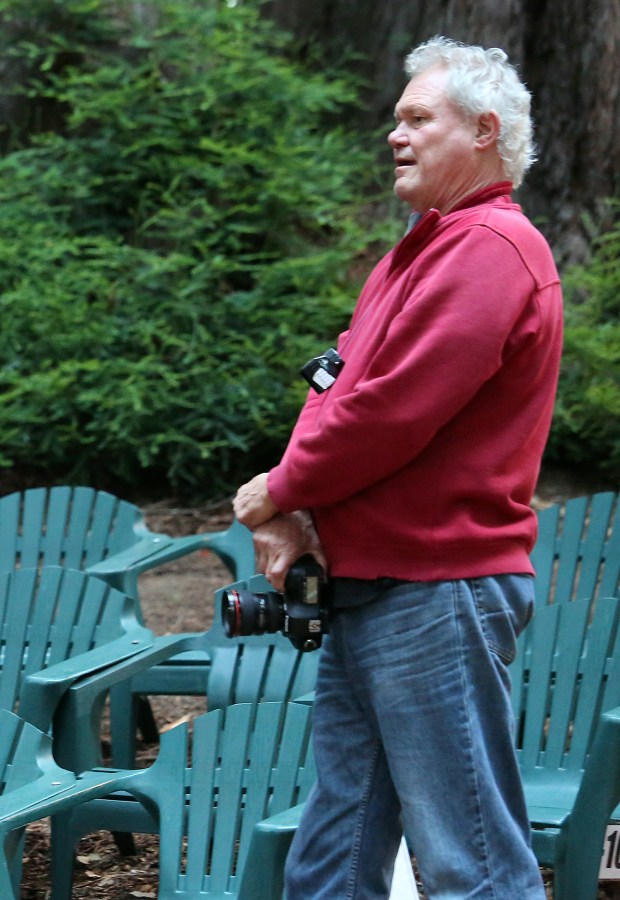 Photographer Ron “R.R.” Jones in 2014. (Shmuel Thaler — Santa Cruz Sentinel file)
Bennett Jackson, Kuumbwa Jazz’s creative director and Tim Jackson’s son, said Jones had been a fixture at the venue for decades.
“He was as much of an artist as the musicians who played the Kuumbwa stage,” he said.
Bennett Jackson said Jones was generally conservative with taking photos but always knew when to capture the key emotional moments during performances.
“He knew when to wait and when to press the shutter right at the moment that would capture the height of the emotion that was taking place between the artists on stage,” he said.
Ellen Primack, former executive director of the Cabrillo Festival of Contemporary Music, appreciated how quickly Jones was able to gain the trust of the musicians and composers he photographed.
“He just was disarming and endearing, and people loved him,” she said. “He captured the magic in everyone. It was through his eyes, so he saw people as beautiful. He saw things for the energy they had and the artistic accomplishment that was happening in the moment.”
The skills Jones brought to his Mexico photography were also prevalent in his Southeast Asian photography. He captured grim images like the Khmer Killing Fields in Cambodia and refugee camps in Thailand but also spiritual images like a young monk getting his head shaved, various Buddha statues and the Balinese Day of Silence, a Hindu commemoration of the new year.
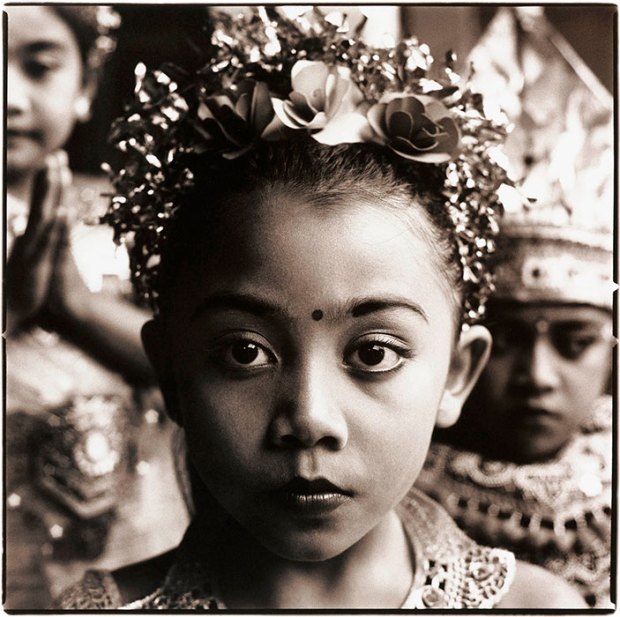 A young dancer in the Balinese town of Ubud captured by Santa Cruz photographer Ron “R.R.” Jones. Jones frequently visited Bali and other foreign locales to document the cultures. (Contributed — Ron Jones photo collection)
Jones’ daughter, Sarah Jones Albert, recalled tagging along with her father at 17 to photograph priests in remote villages in Bali, which she described as a major “culture shock.”
“We would go to places where they didn’t stereotypically have tourists,” she said. “They would come running out and bring all these foods I had never seen. … They just wanted to have you there and interact with you.”
Albert said it was overwhelming after a bit, and her father arranged for someone to take her to the beach on a few days, but she appreciated the work her father was doing.
“He certainly had a way of finding very unique people and allowing them to express the things that are most important to them or their way of life and capturing it in a photograph,” she said.
Jones’ photos have been featured at the San Francisco Museum of Modern Art, Denver Art Museum and in the collections of Stanford University and UC Santa Cruz. In 2001, he was the recipient of a Gail Rich Award which honored those who exemplified artistry in Santa Cruz County.
Joel Leivick, Stanford photography professor emeritus, said he first knew Jones as the two would see each other exercising at 24 Hour Fitness in the ’90s but were unaware of each other’s photography work. It was not until Leivick curated a show at the Santa Cruz Museum of Art & History that Jones attended that they got to know one another after passing each other on the staircase, prompting both to ask, “What are you doing here?”
“I said ‘I’m Joel Leivick,’ and he said ‘No, you’re not,’” said Leivick. “He’d been told by a mutual friend, somebody that I know in Texas, that he should look me up, but he assumed that I was just some other person.”
Nonetheless, the two became friends afterward, and Leivick appreciated that Jones was able to capture the essence of his subjects.
“Technically, they were fantastic and he was a prolific artist,” he said.
Leivick said Jones would often give him advice, even as recently as a few months ago as Leivick was preparing for an exhibit that will open at M.K. Contemporary Art Gallery in November.
“He had a couple of very salient points to make that I took to heart,” he said.
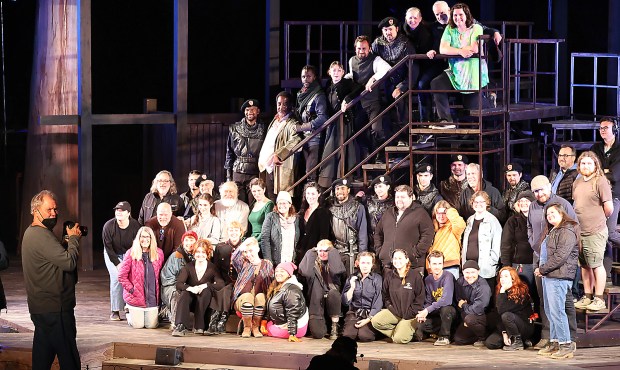 Ron “R.R.” Jones, far left, working to take a cast photo of “King Lear” when it was presented by Santa Cruz Shakespeare in 2023. Jones was often seen wearing a mask once issues with his health were diagnosed. (Shmuel Thaler — Santa Cruz Sentinel file)
Paul Schraub, a local photographer who shared studio space with Jones for 25 years, appreciated his portraits.
“He got intimate and made a connection with the people he’s photographing, which is not an easy thing to do,” he said. “I find it hard, especially if you’re doing somebody from a different culture and there’s a language barrier. His technique was good, his framing and printing technique was good, but the brains behind it and the heart behind it was something that I really admired.”
Additionally, Schraub said Jones was somebody he could easily talk to.
“He was a pretty good sounding board,” he said.
Alexander met Jones when both were exhibiting at the Art4Art fundraiser at The Mill Gallery in 2008. He worked with artists and galleries to take photos of artwork, including Alexander’s, and determine how each piece could best be presented.
“He had an amazing eye,” she said. “He could spot what was right or wrong with a composition in a second.”
In May 2025, after years of struggling with heart issues, Jones was diagnosed with a rare condition called cardiac amyloidosis, in which abnormal proteins build up in the heart muscle and restrict blood pumping. This caused complications over the next year until his death Oct. 3.
Albert said her father was unlike himself after the diagnosis but had a very jovial personality beforehand that she will always choose to remember.
“He really lived his life in the moment,” she said. “That is a way to live your life that allows you to find these beautiful, magical moments and document them. It’s just something that a lot of adults don’t have, that playful, fun nature.”
In addition to Alexander and Albert, Jones is survived by his granddaughter Paige Albert. His work can still be viewed at RRJones.com and RRJonesPhoto.com.
“It was hard to integrate any notion that that big presence is no longer here, and I’ve been trying to live with that,” said Primack. “His presence is here in every photo he took and every gift he gave, and we’re all missing the physical part of him in our space right now.”
A celebration of life is scheduled for 2 p.m. Nov. 22 at Kuumbwa Jazz, 320 Cedar St., Santa Cruz.