
Posted on October 27, 2026
Posted by John Scalzi
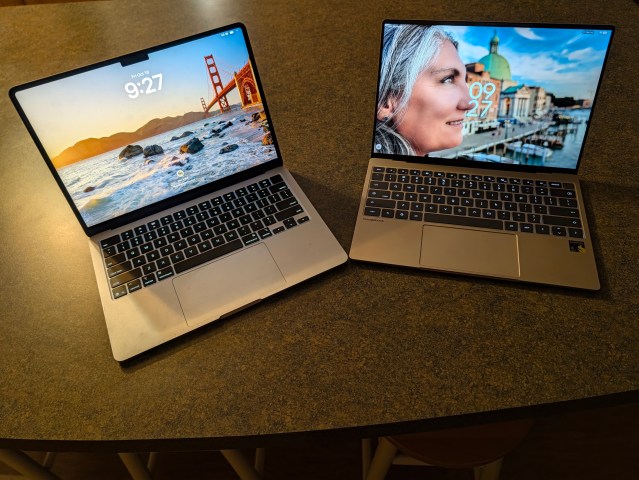

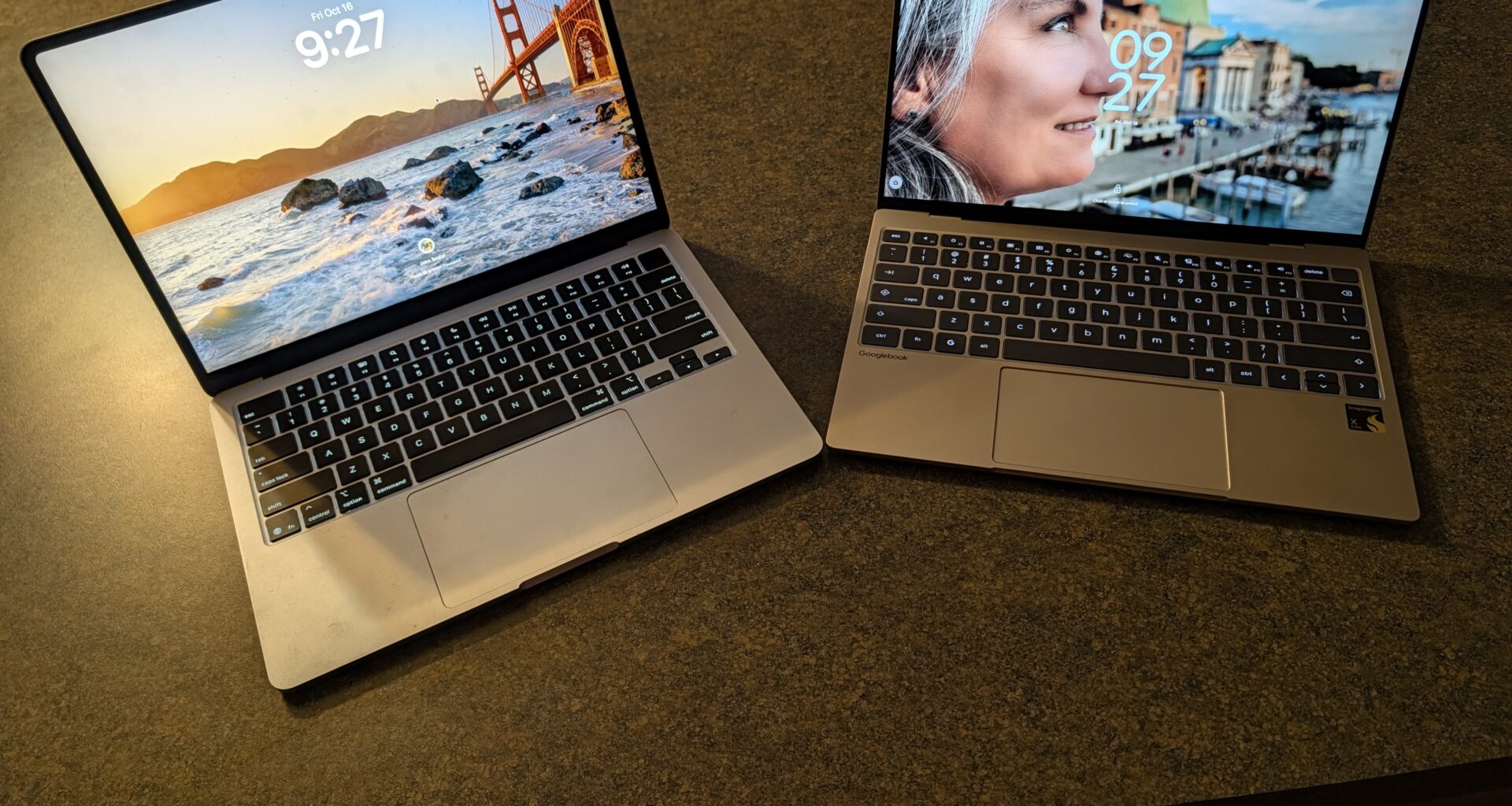
I’ve had the Googlebook now for a couple of weeks, and I have gotten a chance to both use it on a regular basis, and compare it with the MacBook Air I have (it sports an M4 processor). One of the things that I was curious about is which of them I would end up using more often, and which I would prefer over the other, if indeed there was a preference at all.
I’m not going to stretch this out for you: I prefer the MacBook Air over the Googlebook. This is because of a number of factors, some relating to software and some relating to hardware. The Googlebook is a fine little machine, and I’m mostly happy to own it, but it is not entirely baked, and it shows. For a day-to-day use case, the Mac Air is still the one that I reach for.
This is not just theoretical: I was actually away this weekend for a convention in the Denver area. At first, I gave some thought to taking the Googlebook, but at the last minute I made the switch to the Mac Air. I was worried about things like connectivity while I was traveling, and also the ability to pull up certain applications that I would need while I was away. I ended up pulling the Googlebook out of my backpack literally as I was leaving the house, and slipping the Mac Air in. I don’t regret the choice.
There are things I like about the Dell XPS version of the Googlebook over the MacBook Air that I have. For one, I like the keyboard a lot better. The one on the Air is just a smidge too squishy for me, whereas the XPS’s keyboard feels punchy and has snap to it. If we were going straight on the keyboard, I don’t think it would be a question for me.
I also like the ever-so-slightly smaller form factor of the XPS over the Air. This is very much a six-of-one, half-bakers-dozen-of-the-other sort of thing, because, of course, the Air is also very small and very thin and very light, just like the XPS Googlebook. But the form factor for this one, a 13-inch screen as opposed to a 14-inch screen and so on, means that the XPS is just a little bit more convenient in places like airplanes, or anywhere else where space is at a premium. Again, both of them are perfectly small enough for most use cases, but if that is a consideration, then the Googlebook has an edge.
Finally, and as I mentioned in my previous write-up of the Googlebook, the Rambler feature of the Googlebook, ported over from the latest edition of Android on the Pixel phones, really is kind of magical. I wish that every laptop had this. The ability to actually just dictate and have it come out as text with very little need to copy-edit is kind of spectacular. If it weren’t for all the other issues that the Googlebook currently has, the Rambler would in and of itself be enough to make me want to choose the Googlebook over other laptops. It’s genuinely one of the best voice-to-text applications I’ve ever used.
In terms of hardware, most of the other issues are very small in comparison to the MacBook Air. The trackpad is not nearly as smooth and nice as the MacBook Air trackpad, but of course, almost no other laptop has a trackpad that’s as nice as the MacBook trackpads. The screens are pretty much a wash in terms of quality. Both are nice and clear and have more than good enough resolution. The Googlebook has a 120 Hz screen refresh rate, which is twice that of the Air, but honestly on a day-to-day basis if you’re not playing video games, you’re probably not going to notice. Both computers are very limited in terms of I/O, with both of them only having two USB-C ports, although the Googlebook pulls ahead by having a USB-C ports on either side of the chassis, whereas the MacBook Air only has them on the left side. On the other hand, the MacBook Air does actually have a headphone jack, which the XPS does not. So they’re both slightly inconvenient in their own ways.
The only major hardware fuckup for the XPS Googlebook, which is also a software fuckup, lies in the speakers. The volume of anything you play gets louder and softer for no goddamn reason at all, and there’s no easy fix for it yet. When I first wrote about it the laptop, I didn’t notice there was an issue with the volume, but it’s there and it’s really, really fucking annoying. At first, I thought it was just an issue with YouTube, and I went into the YouTube settings to fix it, but as it turns out, it’s a problem with other programs as well.
It’s a known issue; if you go to the Dell site, they have it registered as being something that they’re aware exists and that they are going to work to fix, but apparently the update won’t be ready until December at the earliest. It’s so noticeable and so annoying that it actually makes me not want to use the XPS. It’s just that bad.
Beyond that, when the volume is near maximum on the XPS, the entire chassis vibrates and the sound distorts. It is genuinely bad, as opposed to the MacBook Air speakers, which are actually quite good. It’s not even a comparison; the MacBook Air blows the Googlebook out of the water in this case. For both the volume intermittency and the distortion, the current “fix” for the XPS Googlebook is to use a Bluetooth speaker or headphones. But I shouldn’t have to do that in order to get decent sound out of a $1000 laptop. This should have been solved before these shipped.
When it comes to software, the disadvantage the Googlebook has over the Air is simply that it mostly relies on Android versions of software, which are just not fully featured as the versions that are on the MacBook. The two programs that I use on a daily basis are Microsoft Word and Adobe Photoshop. On the Googlebook, the Android versions of these programs are just fine for quick and dirty stuff, but it doesn’t have the full set of features that I actually want and need to do my work. This is fine if I don’t have a lot of work to do, like if I’m on vacation or if I’m just doing something that I can use Gmail or Google Docs for. But this weekend, when I went to that convention, and later when I’m going to be on tour, I’ll be working on my upcoming novel. I need fully featured Word, at least.
Now, to be scrupulously fair about it, I’m not going to give the Googlebook too much shit about relying heavily on Android. It’s just a fact of life for this very early version of this operating system. I don’t think you should come to the Googlebook thinking that you’re going to get anything other than perhaps slightly gussied-up versions of Android apps. But from a purely practical point of view, which is what I have to have when I’m actually trying to get work done rather than just doing email, it’s an issue. You have to factor that in. For now at least, the Air still wins for practicality.
(You’ll notice that I’m not giving much time or space to any of the Googlebook’s “AI” functionality, and that’s just because I’m mostly not using it. In this case, it’s no different from the Air, on which I also don’t use any of Apple’s most recent “improvements” through the use of “AI”. So for my use case, they’re both about even on this score.)
As hinted above, in many ways it’s fundamentally not fair to compare a Googlebook with a brand new operating system to a MacBook Air that is several generations in with an OS that has been developed over the space of decades. I’m reasonably optimistic, even with Google’s tendency to kill things off, that the Googlebook will improve, and that its OS will get better and smarter. Google has committed to 10 years of updates on this machine, and we’ll see if that’s actually going to be the case. But certainly we can expect at least a year or two of refinement out of the company. So maybe in a year’s time, or two, it might actually become a laptop that I would take with me on a long business trip.
But for now, I will have to stick with my MacBook Air for any travel that requires more than the most casual of Gmail and Google Docs use. I often do have to work when I travel, and that means I need a laptop that can do everything I need it to do. That’s still the MacBook Air.
— JS