
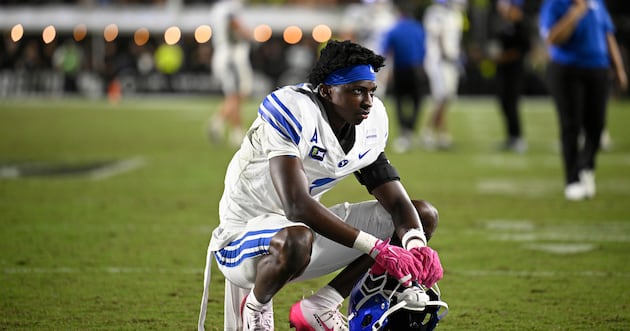
Sitake emphasizes developing men beyond football, saying the goal is to improve in every area of life.Losing to UCF exposes weaknesses that winning against Notre Dame hid, helping BYU identify growth areas.When winning becomes our identity, losing becomes an identity crisis.
As a former NFL and BYU football player, I love competing. And I love winning.
But my Christian convictions compel me to believe that God is more concerned about the character of the coaches and the young men playing football than the scoreboard.
After BYU’s emotional roller coaster of defeating Notre Dame and losing to University of Central Florida, I had to do a lot of online grief counseling. BYU football fans, we need a healthier perspective.
From heroes to villains in 7 days
On a beautiful autumn night at LaVell Edwards Stadium, BYU shocked Notre Dame. The Cougars competed with discipline and determination. Tight end Walker Lyons caught what became the game-winning touchdown.
Seven days later, against UCF, Lyons couldn’t secure a potential game-tying touchdown. Suddenly, everything changed.
After Notre Dame, offensive coordinator Aaron Roderick was celebrated for his brilliant play-calling. After UCF, some fans wanted him fired.
Defensive coordinator Kelly Poppinga went from receiving praise to facing criticism.
Even Kalani Sitake’s culture of humility, hunger and love was questioned.
What changed?
The scoreboard changed.
But here’s the thing, fellow BYU fans: When winning becomes our identity, losing becomes an identity crisis.
That’s an exhausting way to follow football.
What makes BYU football special? 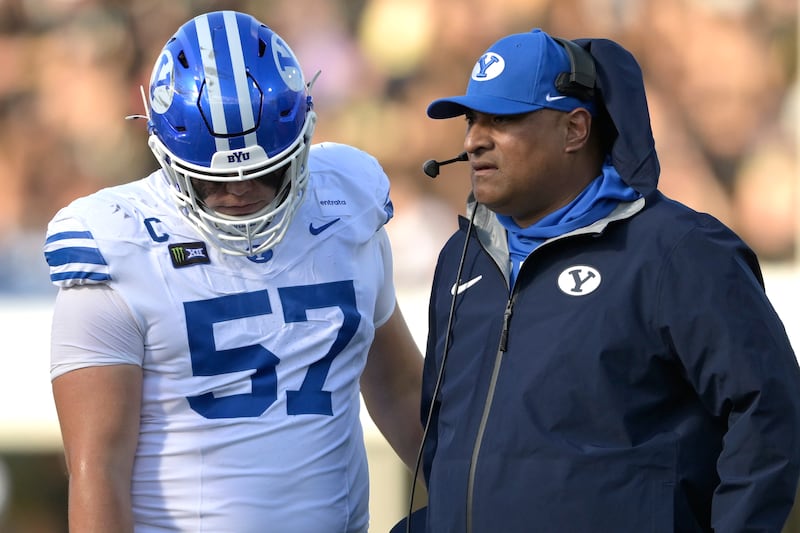 BYU head coach Kalani Sitake, right, talks with defensive tackle Keanu Tanuvasa (57) during the first half of an NCAA college football game against Central Florida, Saturday, Oct. 24, 2026, in Orlando, Fla. | AP Photo/Phelan M. Ebenhack
In today’s NIL-driven, transfer portal era, what makes BYU successful?
Here are some things that matter more than championships.
First, Kalani Sitake develops men, not just football players. As BYU’s head coach said at Big 12 media days, “The goal for us is to get better, and not just in football. How can we improve in every area of our life?”
Sitake is an outstanding coach and an exceptional role model. His journey as a Tongan-born leader who has climbed to the top of college football reflects resilience and humility.
Most college athletes will go professional in something other than sports. Their football careers will end. The ultimate question isn’t simply whether Sitake prepares them to win on Saturday. It’s whether he helps prepare them to flourish for a lifetime.
Second, BYU’s culture is a competitive advantage. “Stay humble, stay hungry and keep working our culture of live and learn,” Sitake said before Saturday’s game — reiterating themes he’s emphasized from the beginning of the season. He’s also said: “Our culture is built on love and learn.”
Some think humility and love are incompatible with Big 12-caliber championship football.
I disagree. Humility isn’t thinking less of yourself. It’s thinking about yourself less.
Humble players sacrifice personal glory for team success. And hunger means pursuing excellence through disciplined preparation and relentless effort.
And love? Love isn’t weakness. Look at the cross of Jesus. There, God the Son willingly suffered for sins he did not commit so all those who trust in him can be redeemed.
Love is sacrificial strength. Imagine a team where players genuinely love one another, hold each other accountable and refuse to abandon one another after failure.
That’s not a soft culture. That’s a championship culture.
But more importantly, it’s a culture that prepares young men for life.
Jesus is not a good-luck charm
When I played at BYU and up until my fifth year in the NFL, I treated God like a rabbit’s foot.
I wanted God to bless my performance, protect me from injury and help me win.
I wanted God to be about my agenda, but I was not about his.
That changed on Aug. 2, 1997, when I encountered Jesus in a life-transforming way.
I discovered that Jesus wasn’t interested merely in improving my performance. He wanted to transform my life to reflect his kingdom’s ethic of love.
Why losing to UCF might be a gift
Losing to UCF could help BYU more than beating Notre Dame, because winning sometimes hides weaknesses that losing exposes.
Notre Dame revealed what BYU can accomplish.
UCF revealed where BYU must grow.
When I spoke to the team before the Iowa State game, I shared with them what I call the Power of NOW:
N: No distractions. Don’t let yesterday’s success or failure steal today’s focus. O: Obsess over the details. Excellence grows through disciplined preparation. W: Win the moment. Control your effort, preparation and response.
These principles don’t just produce better football players. They develop better husbands, fathers, leaders and neighbors.
Getting off the emotional roller coaster
Let’s stop treating every victory as proof our coaches are geniuses and every defeat as proof they’ve forgotten how to coach.
Let’s pursue excellence without making an idol of winning.
Let’s demand accountability without abandoning compassion.
And let’s remember that the young men wearing those uniforms are human beings, not entertainment products.
Their worth to God doesn’t rise with a touchdown or fall with a dropped pass.
As someone who once wore Cougar blue, I know how much representing BYU means. But I also know something I didn’t fully understand then. Football is a classroom that prepares young men for life.
So yes, let’s compete for Big 12 championships.
Let’s win!
But the ultimate goal isn’t simply developing football players who win games. It’s developing men whose character, courage and love help heal a hurting world.
And no opponent can take it away.