
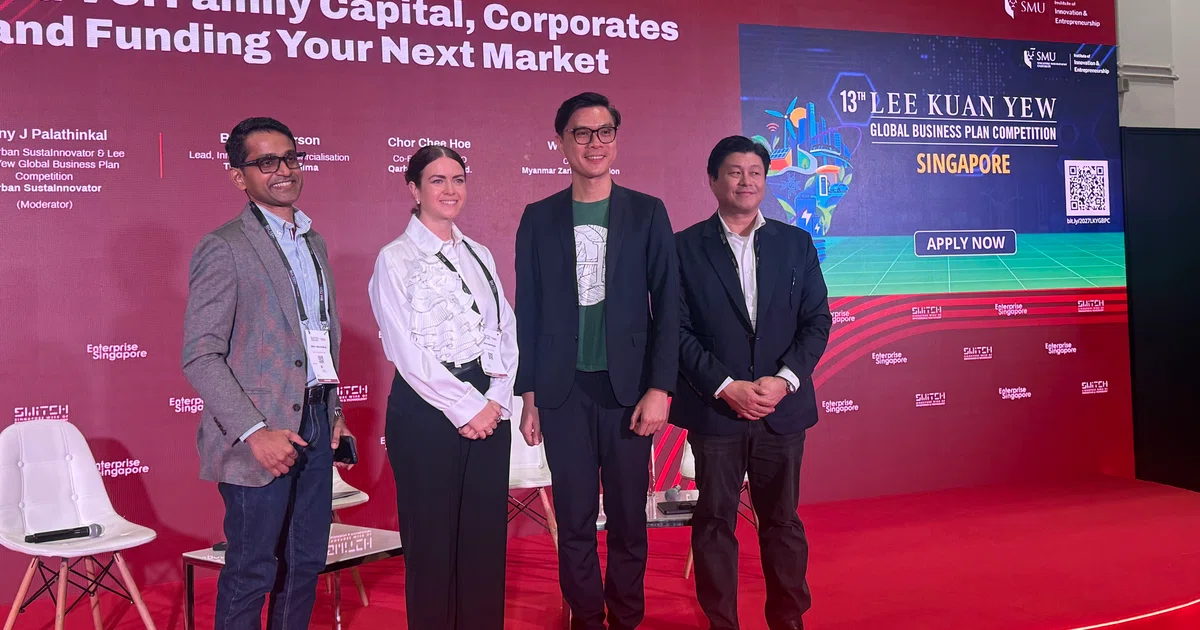
[SINGAPORE] Selected startup finalists of the Lee Kuan Yew Global Business Plan Competition (LKYGBPC) organised by the Singapore Management University (SMU) can access a US$10 million fund to pilot and scale their ventures.
The Urban SustaInnovator (USI) Fund, as it is called, was launched in May 2025 by the SMU Institute of Innovation & Entrepreneurship (IIE), an institute that offers companies training programmes, an equity-free incubator and networking opportunities.
The fund will be disbursed over multiple years, with up to US$250,000 allocated to each eligible startup.
It complements SMU’s USI accelerator programme, a post-competition pathway launched in 2025 and offered to selected LKYGBPC finalists to support their market access, pilot projects and strategic introductions in Asia, said Rony Palathinkal, the head of the LKYGBPC and USI at SMU IIE.
Unlike traditional venture capital investments, the fund acts as a “pure investment vehicle” where deep-tech startups do not face time pressure imposed by venture capital companies, he told The Business Times in an interview.
“For startups, it’s much more attractive than traditional venture capital, which could be looking at a limited time frame for when they want an exit. We don’t have that, we (allow them) to scale, and (this) will provide that learning opportunity,” he noted.
The Business Times turns 50
Five decades of milestones and moments that shaped Singapore’s success story – told through our headlines.
Explore BT50»
LKYGBPC is one of Asia’s most globally representative deep-tech startup competitions, spanning 12 focus areas including climate tech, energy, food and land use, urban mobility, longevity and health tech, and sustainable materials and circularity.
Competition finalists may continue to the nine-month accelerator programme, under which companies gain exposure to an ecosystem of investors, mentors and corporates.
To date, 10 pilots have been launched through the programme’s introductions, with 50 other potential pilots and contracts in talks.
SEE ALSO

One such pilot is by Malaysia-based food security startup Qarbotech.
Through talks with family offices, the company gained access to a large pilot – a sugar-cane plant – in the Philippines. Qarbotech was a finalist in the 12th edition of the LKYGBPC, and a member of the inaugural cohort of the USI accelerator.
The 13th edition of the LKYGBPC was announced at the Singapore Week of Innovation and Technology on Wednesday (Oct 28).
Singapore as a launch pad
Palathinkal noted that Singapore acts as the ideal “node” for companies to scale their businesses regionally and globally.
“Startups coming from US, China and so on, when they apply, there is an interest for them to look at Singapore as a point of entry to scale, whichever direction, East or West,” he said.
Moreover, due to Singapore’s leading regulatory standards, seeking out government partners within the ecosystem enables companies to access most regional economies, he added, citing the Building and Construction Authority’s Green Mark certification scheme as an example.
Building on Singapore’s position as a base for regional expansion, SMU further enables startups to scale quickly, with its overseas centres in Indonesia, Thailand, Vietnam and China.
“SMU created LKYGBPC as a platform to help founders bring their innovative ideas to life by connecting them with the partners, markets and opportunities needed to turn innovation into real-world impact,” said Palathinkal.