
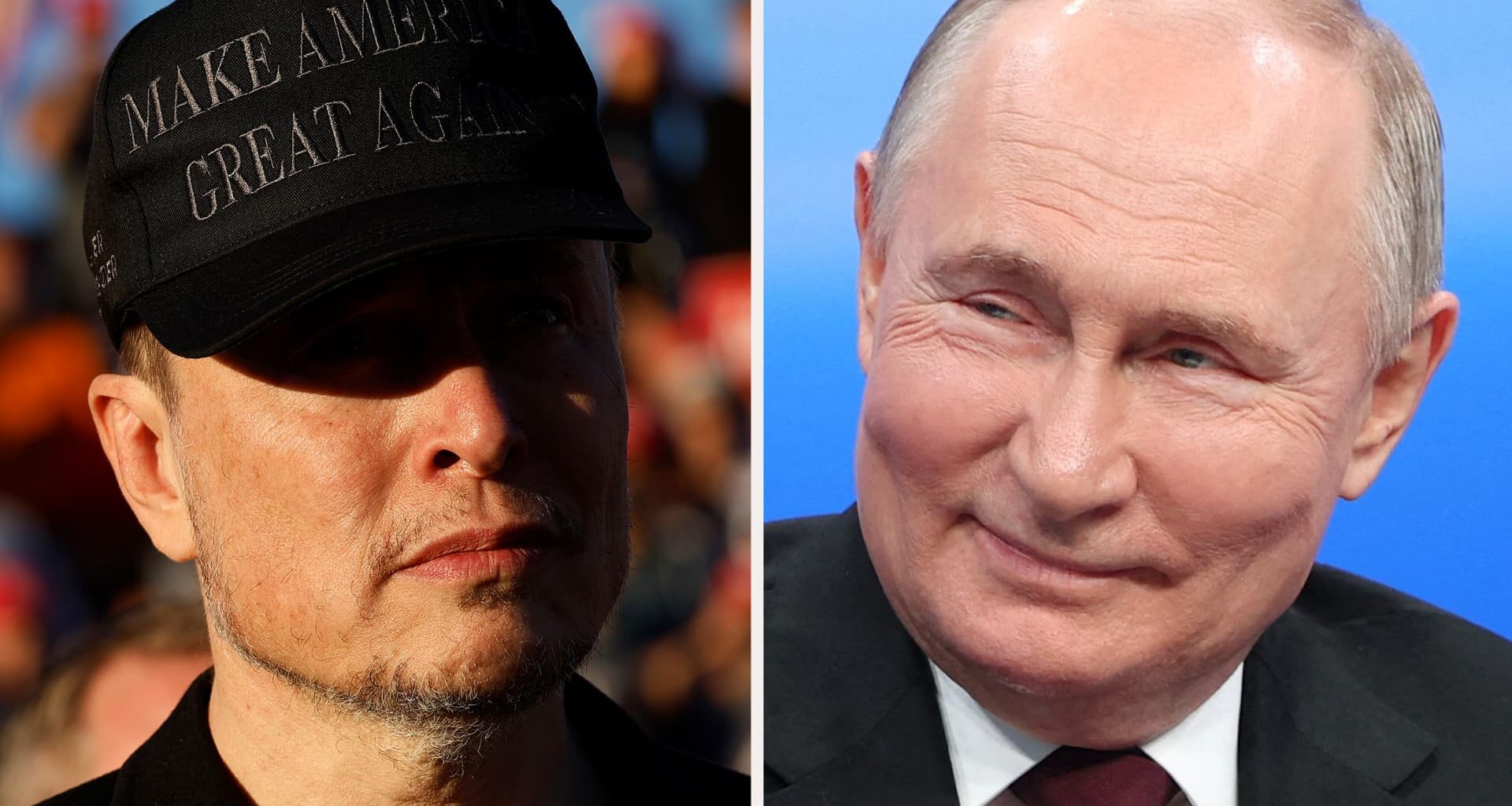
Russian President Vladimir Putin has called SpaceX CEO Elon Musk a “genius,” as he revealed the two are in “close contact” about developing a Russian alternative to Starlink.
“Elon Musk is a genius, truly a genius,” Putin said at the Russia-Africa Summit in Moscow on Wednesday. “He has already had more than 5,000 such satellites in orbit, while we are only taking the first steps,” he said at an event where he discussed Russia’s own satellite connectivity project, Rassvet.
Rassvet is a satellite internet constellation in low Earth orbit, built by the Russian private aerospace company Bureau 1440. It has 31 satellites in orbit currently, out of 32 launched since March of this year, according to satellite tracker Orbital Radar. Twenty-six are in their working orbit at about 509 kilometers.
“We are proud that we have begun doing this and that we have started doing it independently,” Putin said according to a translation. “We are in close contact with our U.S. partners, including Mr Musk.”
“In orbit, it is very important not to interfere with one another and to adhere to certain rules, discipline, and order. Both we and our U.S. partners value this mutual understanding. Together with Mr. Musk, despite all the political issues, we continue to work closely.”
SpaceX, Starlink’s owner, didn’t immediately respond to a CNBC request for comment.
Starlink operates a constellation of more than 11,000 satellites in orbit, providing high-speed internet access to 174 countries, according to the company.
 Musk’s clash with Ukraine accelerates demand for Starlink alternatives. Few exist
The service drew attention earlier this month after Ukraine accused SpaceX and Musk of imposing restrictions that slowed the country’s military satellite internet access, thereby harming its defensive capabilities.
The restrictions affected Starshield, SpaceX’s satellite communications service for governments, causing drones and other moving terminals to lose or experience degraded connectivity above roughly 100 miles per hour, according to Ukrainian officials.
President Volodymyr Zelenskyy blamed the restricted service for disrupting its air defense capabilities during frequent Russian air attacks.
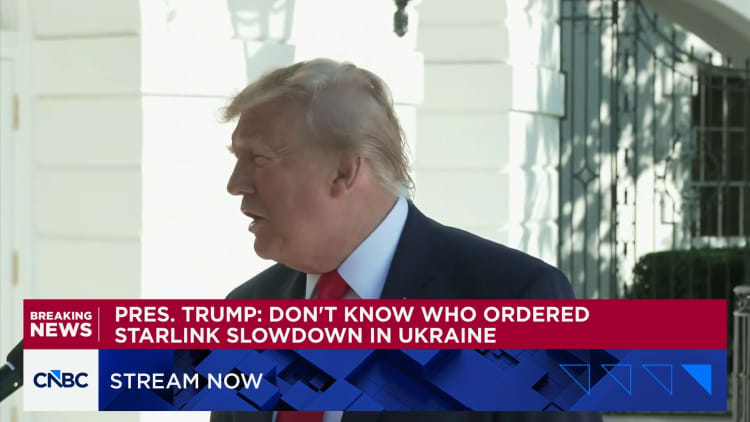
Musk has said Starshield is controlled by the U.S. government, and ultimately the president, while other reports have said the restriction was imposed by Musk. U.S. President Donald Trump has denied ordering the restriction.
The White House and SpaceX did not respond to CNBC requests for comment on whether the service had been limited and where such an order came from.
Musk later said Ukraine had breached Starlink’s terms of service by using a civilian commercial network for offensive drone strikes. Ukraine has denied doing so.
Putin’s remarks late Wednesday come amid continued strikes between Russia and Ukraine as the war closes in on five years.
Early Thursday, 13 people were killed and 10 injured in a Russian jet-powered drone attack on a railway station in Dnipro in eastern Ukraine, according to regional governor Oleksandr Ganzha.
Russia also attacked Ukraine’s second-biggest city, Kharkiv, damaging an educational institution, the city’s Mayor Ihor Terekhov wrote on Telegram, while Russia’s Ministry of Defense said it intercepted and destroyed 1,214 Ukrainian fixed-wing unmanned aerial vehicles overnight.
U.S.-brokered peace talks between Putin, Zelenskyy and Trump may happen next month.
Zelenskyy said on Wednesday that preparations are underway for a trilateral meeting in Abu Dhabi, to take place by Nov. 10.
Moscow has not yet proposed a specific date for the talks, which will depend on several factors, including the Iran war, Kremlin foreign policy aide Yuri Ushakov was quoted saying on Wednesday.
“It will also depend on the situation on the battlefield and the situation in general. You can see the situation now in the Middle East. It just doesn’t allow us to hold it in the near future. That’s my assumption,” Ushakov told journalists, Reuters reported, citing Russian media.
– CNBC’s Lora Kolodny contributed to this report.