
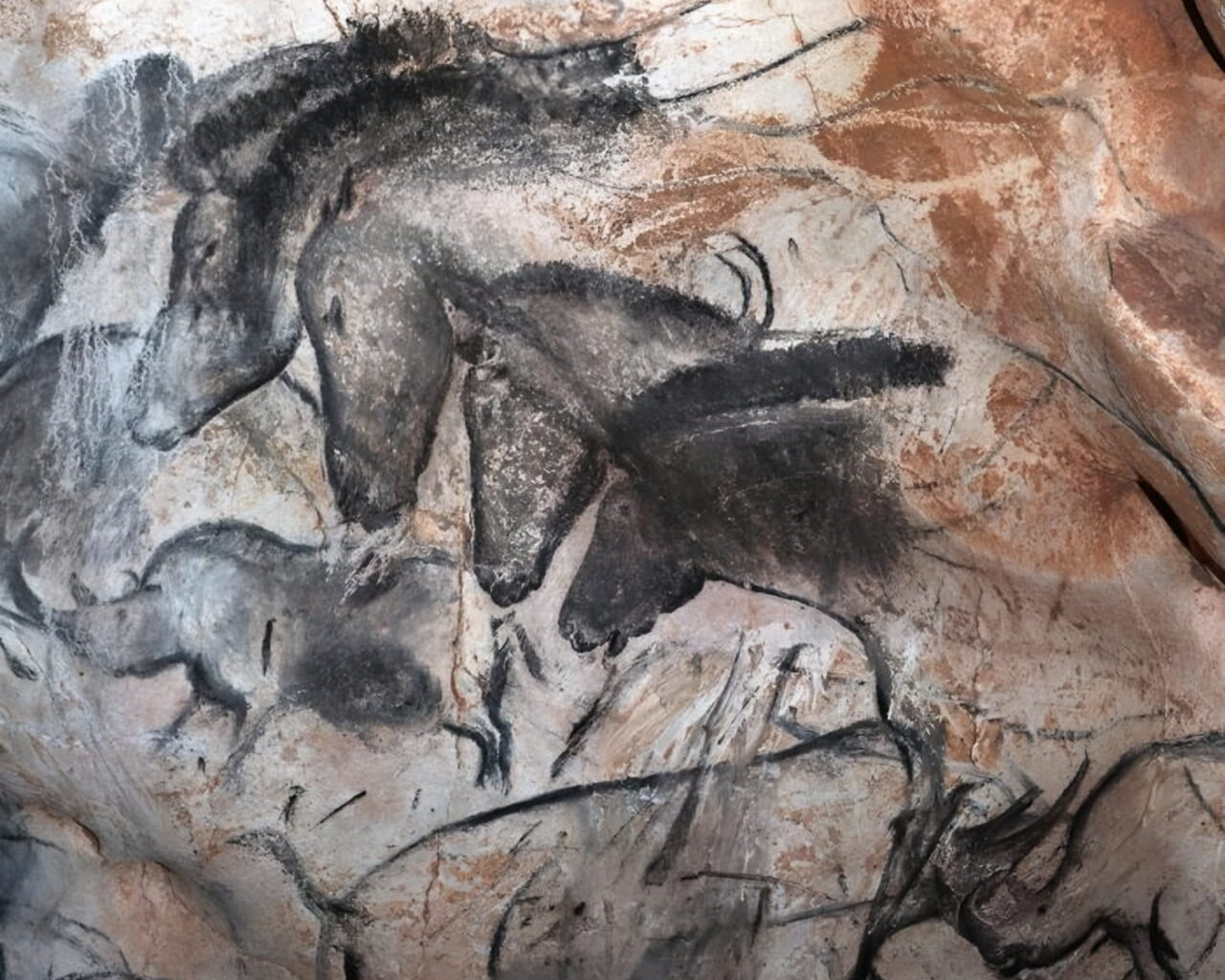
Deep inside a limestone cave in southeastern France sits some of the oldest art ever made by people. Chauvet Cave is fragile and important enough to history for officials to keep the location secret and lock the entrance behind a large steel door. Researchers have now found a safe way to study the paintings without touching them, and the results show how a thin natural coating has protected the art for thousands of years.
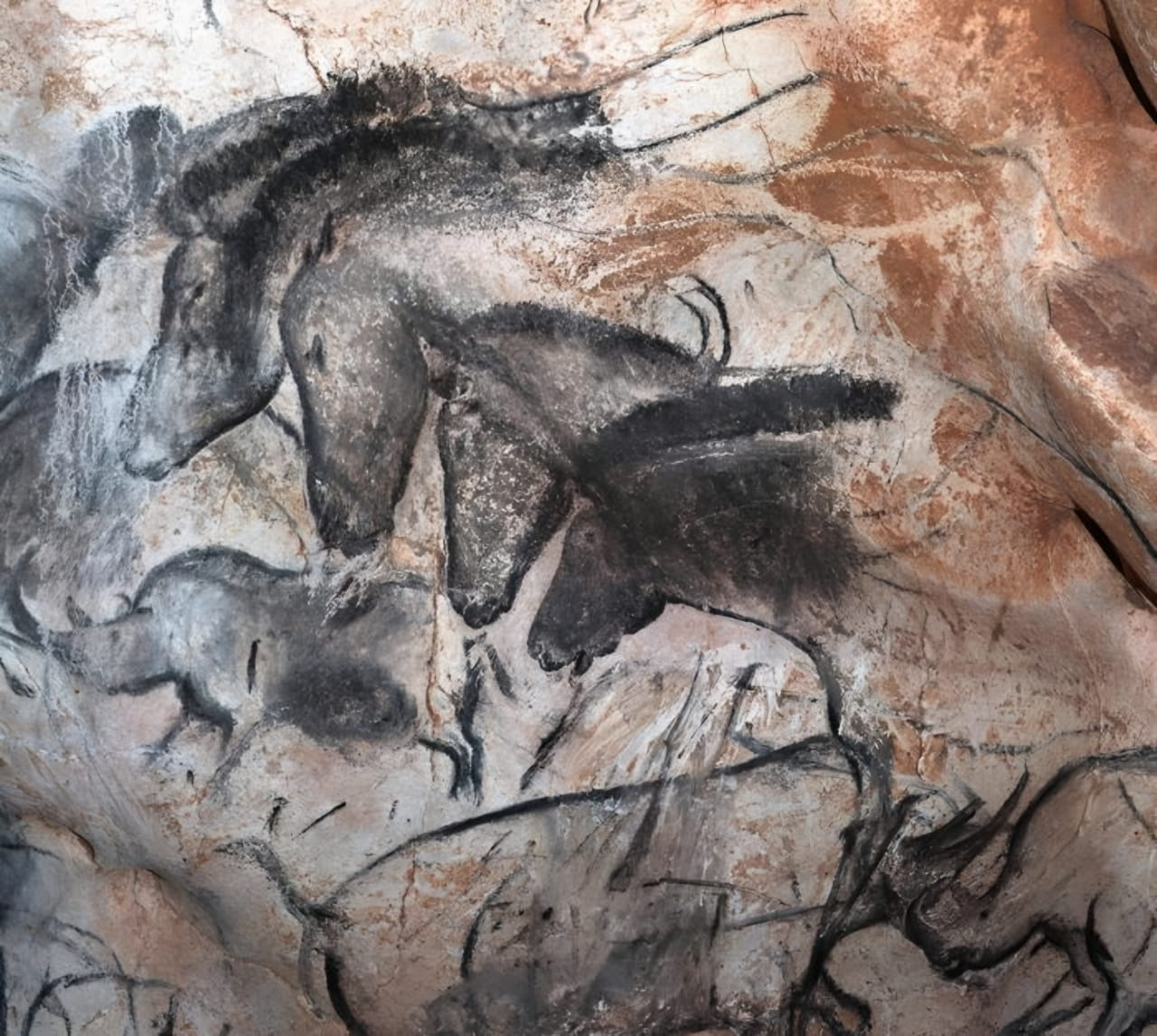 New analysis reveals that these cave drawings are partially covered by calcite mineral, which has kept them safe for tens of thousands of years. Credit: Y. Boulard et al., ACS Omega (2026). DOI: 10.1021/acsomega.6c05061
About 37,000 years ago, Ice Age people entered the cave and drew cave bears, cave lions, bison, and horses on the walls with charcoal. A rockfall later sealed the entrance, and nobody saw the drawings again until the 1990s.
A team led by Philippe Walter, reporting in ACS Omega, used UV fluorescence spectroscopy. The method shines ultraviolet light on a surface and measures the glow from minerals and pigments, including deposits the human eye misses. Prehistoric footprints still mark the cave floor in front of the art, so the researchers stayed back. They set up a portable spectrometer on a protective walkway about 8 feet (2.5 meters) from the wall, using a custom system built for the harsh conditions inside.
Limestone and the calcite formed by dripping water share nearly the same crystal structure, and older tools like X-ray fluorescence and Raman spectroscopy struggle to tell them apart. UV fluorescence works because tiny organic impurities trapped in each material glow differently. With a model of the decorated wall, the team separated the calcite signal and pulled out information about how the layers stack up.
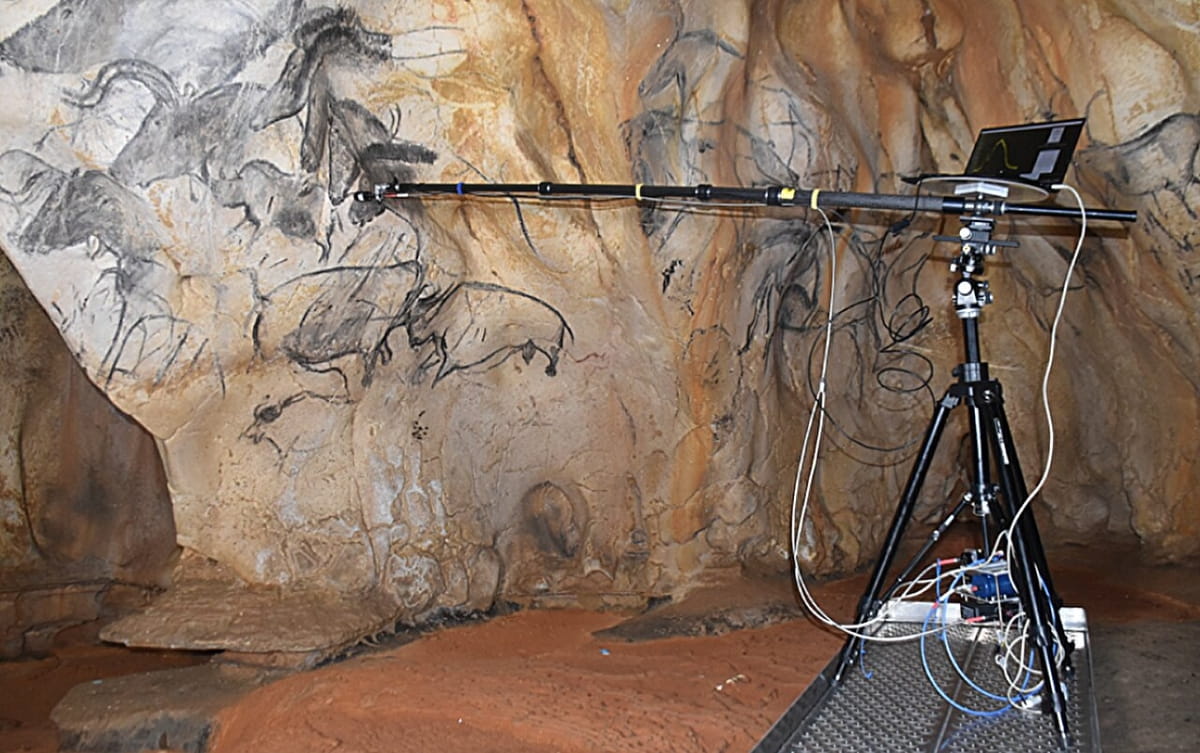 Due to the presence of prehistoric soil and footprints immediately in front of the cave walls, researchers had to set up their analysis instruments nearly 8 feet away. Credit: Y. Boulard et al., ACS Omega (2026). DOI: 10.1021/acsomega.6c05061
On the Horses panel, the readings showed a see-through calcite veil covering the charcoal drawings. Mineral-rich water flowed across the limestone and left thin layers behind, and these layers glowed blue under UV light. The veil acts as a natural varnish. Knowing the veil exists helps conservators judge how stable the paintings are today.
The calcite layer was uneven across the cave. In the Alcove of the Lions, the coating varied from spot to spot, and the charcoal drawings themselves changed how calcium carbonate built up on the wall.
The team also spotted patches of orange glow near some charcoal marks. The authors think hot or burning charcoal, such as a lit torch rubbed on the wall, altered the calcium carbonate and produced the color. This idea still needs confirmation through studies of how the charcoal burned and how heat changed clays with different amounts of iron oxide.
The method has a limit. Comparing layer thickness is hard when the amount of glowing impurities differs from place to place, so the results are approximate.
Walter compares the approach to forensic work, where every piece of evidence helps explain how prehistoric artists worked and how the paintings survived. The authors treat the rock, the pigment, and the coating as one system, and they say the findings will guide decisions about protecting the caves and limiting access. The technique also has uses in forensic science and in tracking biofilms aboard the International Space Station, a project already underway.
The study received funding from the French Ministry of Culture, the French National Centre for Scientific Research, and Sorbonne University. One author co-founded Lumentis, a company building imaging instruments to analyze historical artwork.
Publication: Boulard, Y., Guillou, T., Fritz, C., Tosello, G., Jaber, M., & Walter, P. (2026). In situ ultraviolet fluorescence spectroscopy for the characterization of translucent calcite coatings over prehistoric cave art. ACS Omega, 11(40), 60980–60990. doi:10.1021/acsomega.6c05061