

Bear with us as we enter the SEC’s version of The Twilight Zone.
If you’ve been exhausted this season, try to power-rank college football’s most competitive league; join the club. Never before have we seen this much parity at the top of the sport, and it could get even more zany over the next few weeks.
Are you strapped in?
Earlier this month, I was sifting through the remaining SEC schedules for every team and noticed a potential — far-reaching — Armageddon scenario in which nine different teams could finish with matching 9-3 records.
Waiting until Week 8’s games were over felt like the best way to proceed, since the initial outcomes involved several ranked teams and the likelihood of the league going 5-for-5 over the weekend was minuscule.
Well, the conference obliged by keeping the scenario active after South Carolina’s win over Tennessee and Texas‘ win over Ole Miss, among others.
2026 CFP bracket projection: Chaos reigns as SEC logjam muddies race for final spots
John Talty
How nine SEC teams could finish 9-3
While several outcomes would have to align perfectly down the stretch, it remains possible entering Week 9 that nine SEC teams could all finish with nine wins (conference records in parentheses).
Alabama (6-2): Beats Vanderbilt, Chattanooga and Auburn; loses to LSU
Florida (5-2): Beats Georgia, Oklahoma, Vanderbilt and Florida State; loses to Kentucky
Georgia (6-1): Beats Ole Miss, South Carolina and Georgia Tech; loses to Florida and Missouri Kentucky (7-1): Beats Florida and Louisville; loses to Tennessee and Missouri LSU (6-2): Beats Alabama, Texas and Arkansas; loses to Tennessee
Missouri (5-2): Beats Arkansas, Georgia, Kentucky and Oklahoma; loses to TexasOle Miss (6-2): Beats Auburn, Oklahoma, Wofford, and Mississippi State; loses to GeorgiaTennessee (6-2): Beats Kentucky, LSU and Vanderbilt; loses to Texas A&M Texas (5-2): Beats Mississippi State, Missouri, Arkansas and Texas A&M; loses to LSU
For those keeping up here, that’s 31 different outcomes that need to hit over the final five weeks of the season for this outlandish scenario to come true.
Why was South Carolina (4-3) not included in this as a potential nine-win finisher? The Gamecocks would hit that magic number by winning out, but that would change the math a bit and add another combination here based on Georgia and Missouri’s results.
How CFP committee would rank this cluster
Should this diabolical hypothetical scenario come into play, this is where it gets really interesting, even more so than diving into convoluted SEC Championship tiebreakers.
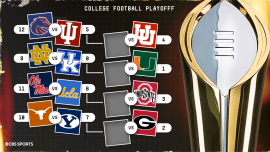
In our latest bowl projections, there are four SEC teams in the 12-team bracket — Georgia, Kentucky, LSU and Texas. These are the teams with the clearest paths to an at-large (or an auto-berth league title) appearance. Those picks do not address this nine-win elephant, however, with only two of those squads projected to be in that cluster (LSU, Texas).
For CFP consideration, the selection committee will look at top-25 wins, comparable outcomes, head-to-head results, schedule strength and other metrics to determine their rankings. Five SEC games made our list of the 10 most important matchups left this season, and each is included up there in the Armageddon scenario.
Ahead of Saturday’s Week 9 games in the conference, Texas has the best resume right now of any SEC team because the Longhorns have beaten a nation-leading three ranked teams — based on this week’s AP poll — and hold the league’s second-highest strength of schedule.
Only Georgia and LSU have a higher game control ranking than the Longhorns (6th), and Texas is No. 12 nationally in strength of record, fifth-best in the conference.
While nothing’s set in stone and the CFP Selection Committee has never been predictable, we’re under the belief 10 wins is the magic number in the SEC to get you in this season. The new strength-of-conference metric, to be applied in the coming weeks, is the trump card the selection committee can use to push any 10-2 SEC finisher above other at-large options.
Finish with nine wins? That’s where it gets dicey in a grouping with various other at-large candidates, including potentially a few with more victories overall from the Big Ten, Big 12 and ACC who didn’t win their respective leagues.