
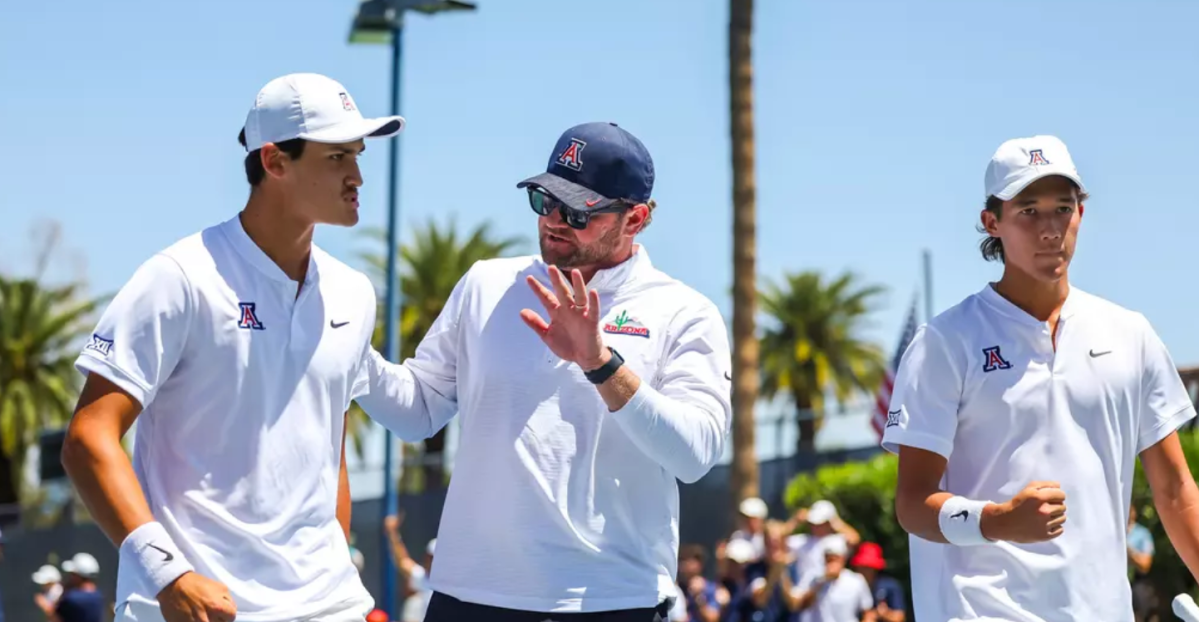
For the better part of a decade, Arizona men’s tennis was knocking on the door of college tennis’ version of the promised land, the NCAA Championships.
This spring, Clancy Shields’ program broke through by advancing to the NCAA quarterfinals for the first time in history. The achievement affirmed Arizona’s status as one of the sport’s rising programs.
The experience also affirmed Shields’ desire to stay in Tucson and build out a program he thinks can compete with anyone nationally.
Shields, who is entering his 11th year as Arizona’s head coach, signed a contract in August that runs through the 2030-31 season. The announcement may have gone under the radar, but it was one of the biggest moves athletic director Desiree Reed-Francois made during the offseason.
Not that Reed-Francois needed to do a lot of selling.
“I told Desiree, ‘I want always to be — if I can and if you guys are willing to do it — I want to have a contract that the players who end up coming here feel like I’m going to be here and that there’s stability,’” Shields said last month. “If you come to play for Arizona you’re going to come play for me for the entirety of your career.”
Shields’ decision to staying in one place comes off as refreshing in an era where coaches and players are all too often willing to jump at the highest-paying suitor, even when they’ve got a good thing going where they are.
Shields has no doubt had chances to look elsewhere after taking over a program with a lackluster history and turning it into one of the best programs in the Western states.
Shields’ program is coming off a fifth consecutive conference championship. The Wildcats concluded 2026 with a No. 7 ranking, the highest final ranking in program history.
And for the second year in a row, Arizona produced an All-American standout — first Colton Smith followed by Jay Friend.
“The grass isn’t always greener somewhere else,” Shields said. “As much as people will try to come poach you or say ‘Hey, come to this place, you can do things here,’ I always say that with (players), If you’re looking to get in the portal or doing this, we’ve all had the opportunity to look around and do things.
“This is what makes this place special is that we’ve all committed to being here and to grow this place, to grow this program and the culture that we’ve built.”
Shields’ philosophy defies the transactional culture that defines much of college athletics. He applies it to his recruiting strategy, opting for players who he believes want to come to Arizona for the school as much as the chance to chase titles.
“We talk to recruits and say, ‘Look, this isn’t a mercenary thing where we hire somebody and try to pay them a bunch of money and hope they win a bunch of matches for us,’” Shields said. “This is a developmental program where we bring you in, you go through your time here, and by the time you leave, you’ve got the tools to go out and make a deep run and play professionally.”
The message gets through to the team, as evidenced by the fact that Arizona didn’t lose any key players to the transfer portal last season. Though Arizona doesn’t have an elite player the likes of Smith or Friend, the Wildcats bring plenty of experience and depth.
Senior Sasha Rozin and juniors Zoran Ludoski and Filip Gustafsson are all ranked in the top 70 of ITA’s preseason individual rankings, with Rozin ranking the highest at No. 37.
Junior Glib Sekachov will be counted on as a key contributor after performing well last spring. The Ukrainian emerged as one Arizona’s top players before contracting mono. He managed to play through the virus to the amazement of the Arizona coaching staff whey learned after the season of the diagnosis.
Senior Cole Stelse, juniors Oskar Jansson and Matthias Uwe Kask and sophomore Alejandro Arcilla should also compete for spots in Arizona’s starting lineup.
“Everybody got older, everybody got better,” Shields said. “Whenever you have an older team of juniors and seniors, and they’ve been in your program for a couple years, you hope that you’re going to have a great year because maturity and experience counts for something.”
Arizona’s roster is elevated by GCU transfer Tristan Berard, a junior from France who anchored the Lopes’ No. 1 singles position last year. Then there’s freshman Sander Juuhl-Siversten, a former top Norwegian prep player.
“This group is really focused,” said Shields. “They’re ready to get to work, they get after it, and it’ll be interesting to see what we can do this year.”