
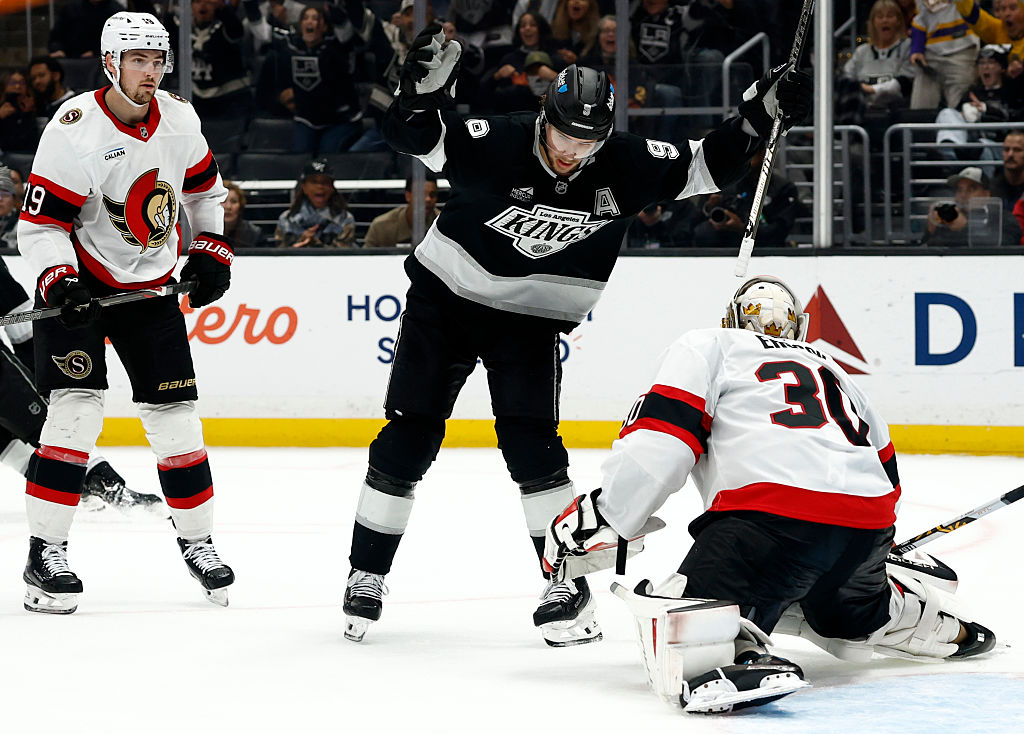
Over the summer, after joining Peter Laviolette’s staff in Los Angeles, Associate Coach Phil Housley knew he had his work cut out for him in a specific area of the game.
That was 3-on-3 play.
The Kings were record-setting in that area the season before and not in the right way. The Kings set NHL records for overtime games played and defeats in either overtime or the shootout. Over the course of a season, 20 defeats beyond the scheduled 60 minutes adds up. You can look at it as 20 points gained, which it technically is, but it’s also 20 points dropped. When you finish three points shy of home-ice advantage and five points shy of a division title, it becomes that much more glaring.
With the coaching change over the summer, it was an area that needed to change. Housley said he watched several hours of film specifically in 3-on-3 situations. I want to share his full quote from back in August, lightly edited, which I think shows just how much emphasis and importance the Kings’ coaching staff put into those situations, even before a single player stepped foot on the ice for training camp.
“Lavi and I have a huge agreement on having a plan 3-on-3 and 4-on-4, it’s really important that guys understand the situation 3-on-3,” Housley said. “I mean, we can talk about possession till we’re blue in the face, right? That’s the main thing, possession, but I think there’s got to be some plans in certain areas of the ice, especially n the defensive zone. In the offensive zone, when you’re getting into certain areas, you better have a plan where they can’t double up and now you lose possession. So, we have a really good, structured plan 3-on-3 and 4-on-4 and I think it’s going to help. I know in New York, our first year, when we won the President’s Trophy there, we had great success in overtime. I think you’ve got to allow the players to use their skills, that’s why they’re out there, but also within that framework is just have an idea what certain things might be a breakout, might be a neutral-zone regroup. What are we going to do with the puck when we have total possession in the offensive zone and it’s man-on-man? What are the ways we can create confusion and maybe see some better ice? There’s a lot of things that go into it. [In watching last season’s 3-on-3] footage, I can see that just the structure a little bit could be better. I’m not trying to knock anybody but I think that played into it. I think they were attached to their guy too much. You can be in a 1-2 sort of a triangle and that will eventually evolve when you get in the defensive zone. So, there’s some ways I think we can improve, especially when we don’t have the puck.”
The planning element is one thing but the proof has to be in the pudding.
During training camp, the Kings practiced 3-on-3 play. Into the regular season, the Kings practiced 3-on-3 play. They are tough situations to replicate, but the Kings did it in what I felt was a pretty unique way. They played it like an actual 3-on-3 session, with time on the clock and line changes. They went to a shootout after, to replicate that feeling as well, and then ran it back again. We saw this multiple times. Five-minute increments, different three-man units and they tried their best to replicate game situations.
There is a lot about overtime that you really cannot practice. In the moment, players have to make plays based on how they see the game unfold. However, I think it always works better when you do it with a structure, with a plan, with an idea of what you want to accomplish. That seems to be what the coaching staff here feels as well, with Laviolette talking about the same kind of thing.
“There’s definitely a method to the madness and there’s got to be a buy-in to that and I think the players bought in,” Head Coach Peter Laviolette said. “There is a lot of review that went through it. There’s things that we talk about prior to games and then after games, the overtime games, and reviewing that. I think the players have done a really good job of executing them. I actually think that we should be better than 2-2 in overtime, just based on the fact that we controlled a lot of the play. We’ve played 12 minutes and I thought we controlled 10 of it, but we’re 2-2. So, we go back and we look at the ones that we didn’t win and maybe things we could have done better inside of those.”
QUINTON. BYFIELD. https://t.co/Wyxl1fs6e1
— LA Kings (@LAKings) October 30, 2026
Laviolette is accurate on two counts.
The first is that the Kings are executing better in overtime.
Sure, they have two wins and two losses. But in looking at the defeats, they had the better of the chances both against San Jose and Vegas. They probably needed a save in the former and in the latter, they had two Grade-A looks before allowing a 4-on-3 power-play goal. In wins since against New York and Ottawa, the Kings controlled the play and got rewarded for it.
Per SportLOGIQ, the Kings rank third in the NHL in puck possession time in the offensive zone in 3-on-3 situations. The same website has the Kings ranked second in the league in possession rating at 3-on-3. Now, possession is good and part of the game, but if it’s possession for the sake of possession, you’re probably not witnessing a ton of offensive opportunities. The Kings have also been a Top-10 team in shot attempts from the slot, with a good percentage of those chances coming off the cycle, generated by offensive-zone possession time.
Across the board, the Kings rank in the Top-10 in the league in just about every offensive category in 3-on-3 situations. It’s probably an oversimplification, but when you possess the puck more than your opponent and you turn that possession into changes, you’ll probably have success. That’s what the players on the ice are seeing.
Quinton Byfield – We’re just trying to handle the puck as much as we can, taking the right shots. We went over it during training camp, in some practices as well. You want to possess the puck, kind of tire them out and let the next guy up come on. We’ve gone a great job of that.”
Trevor Moore – I think we’ve talked about the puck possession and making sure that in certain areas, just knowing where the puck should go. Possession is everything in overtime and then it’s having the skill guys make good plays [off of that possession].
The second point is that the players are buying in.
In speaking with Kings captain Drew Doughty last night, he said that throughout his career, he’s never had this kind of dedicated, 3-on-3 practice time. He credited the coaching staff for almost force-feeding it to the players and making sure they worked on it. It probably sacrificed a bit of time that could have been dedicated elsewhere, but when you really think about how important 3-on-3 play is, with regards to wins and losses, it makes sense.
In terms of preparation, practice time and strategy, the buy-in from the players is there, as Laviolette said.
“It’s the first year in my whole career that we’ve ever actually worked on 3-on-3, so a lot of credit to the coaches in that area. We worked on it in camp. We worked on it before the season started and they had a bit of a game plan, which we didn’t really have before either. So, a lot of credit to them for making us work on it.”
There’s a long way to go, especially when you factor in how often the Kings went into overtime last season. They actually won three of their first five games that went beyond 60 minutes last season as well, so it’s not like the start wasn’t okay in that area. But even with that, I think that it just feels like things have been on another level. The preparation and buy-in have both been there, which is important. The execution is there too, which has been noticeable. Players are on board with what is being asked of them and, in 3-on-3 situations, they’re executing it on the ice.
A good sign, just in case the Kings want to try and break only one of their NHL records this time around.