
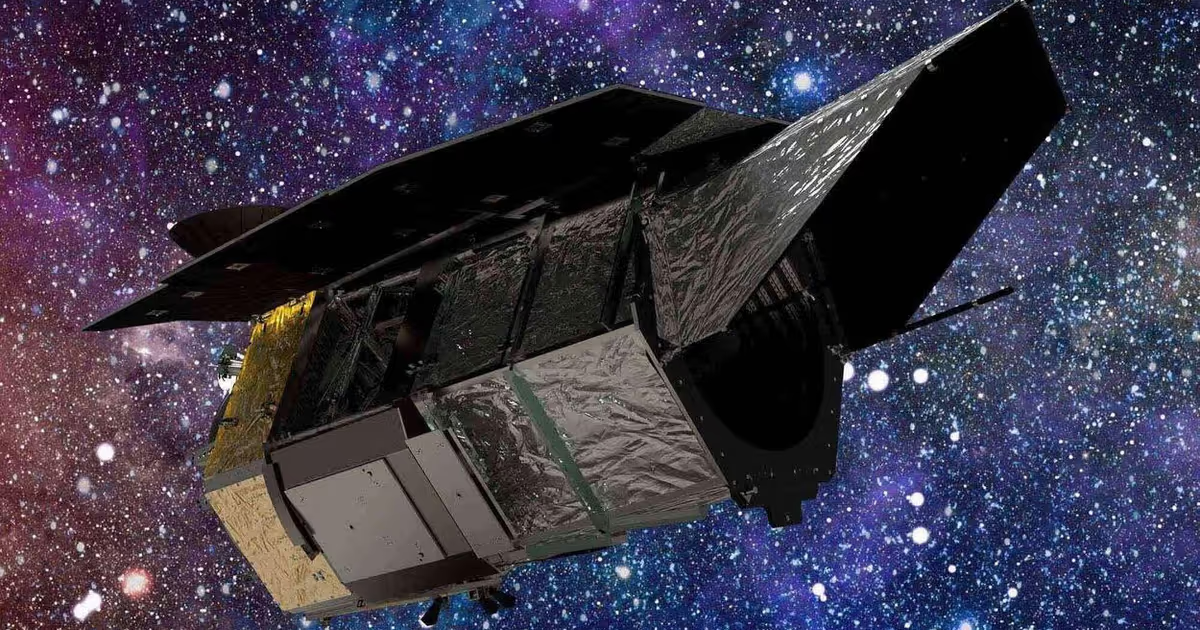
NASA’s Swift space observatory is expected to reenter Earth’s atmosphere within days, ending a nearly 22-year mission studying some of the universe’s most powerful explosions.
The Aerospace Corporation’s latest forecast estimates Swift will renter the atmosphere sometime between Tuesday Nov. 3 at 2:30 a.m. and Nov. 5 at 4:30 a.m. Eastern time. A separate forecast from NASA’s Space Weather Operational Readiness Development Center estimates Swift will burn up in the atmosphere sometime during a 24 hour window beginning on Tuesday at 12:18 a.m. Eastern.
The forecasts can and likely will shift as Swift’s orbit rapidly decays and unpredictable density of the upper atmosphere begins to add more drag to the spacecraft . Because the observatory has no control over its descent, the time and location of reentry may not become clear until the final hours.
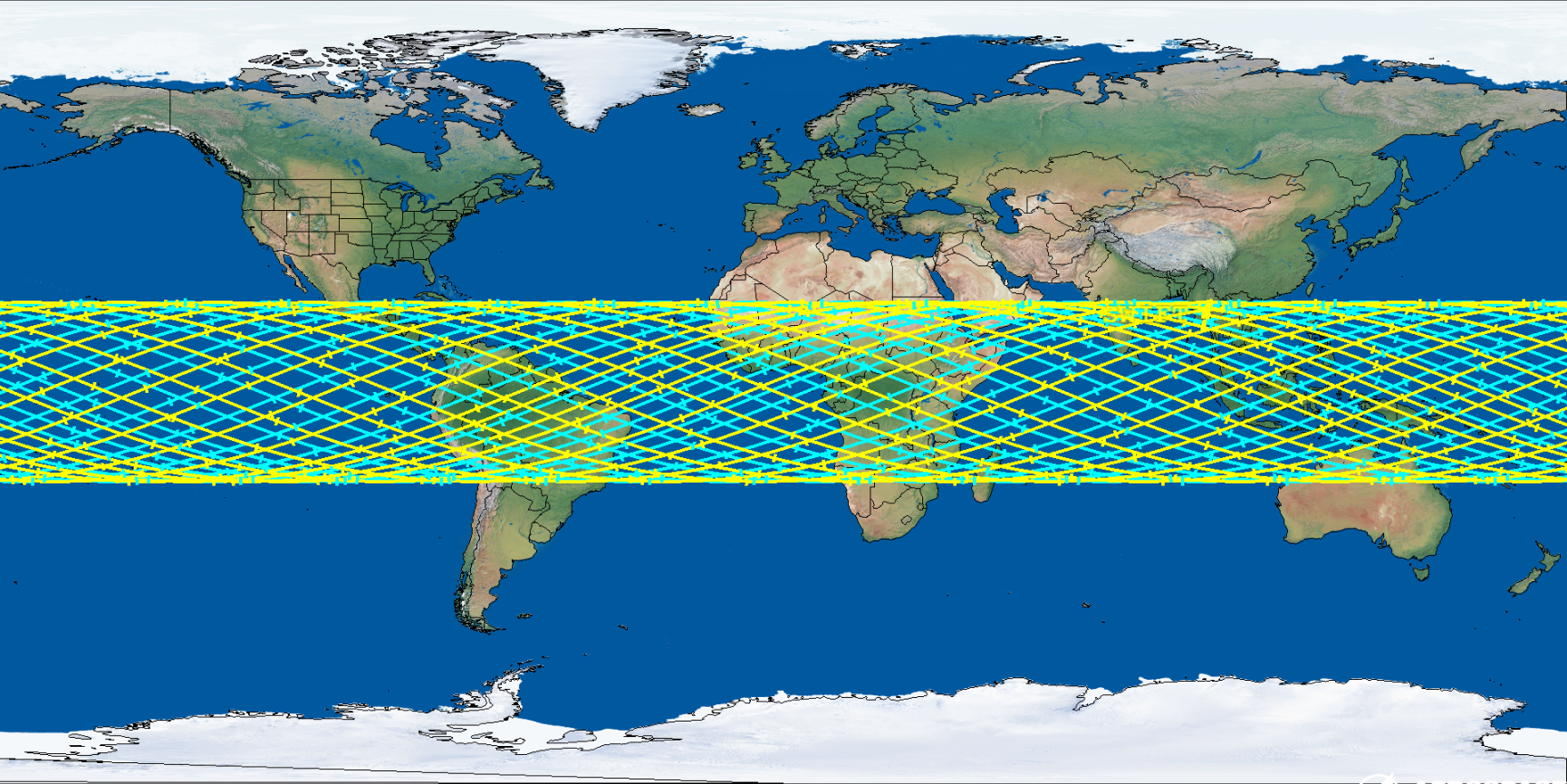 the spacecraft’s ground-track map shows possible paths, not a precise impact point. (© Credit: Aerospace Corp.)
Swift’s orbit is tilted about 21 degrees to Earth’s equator, limiting possible reentry locations to a band between 21 degrees north and south latitude. That area includes parts of Hawaii, Puerto Rico and southern Mexico, but is mostly ocean or desert.
Most of the 1.5-ton observatory is expected to burn up in the atmosphere. Some denser components, including tungsten pieces and parts of the mirrors, could survive, mission chief scientist Brad Cenko has said.
A rescue mission that came up short
NASA tried to extend Swift’s life with a first of its kind rescue mission. In July, Arizona-based Katalyst Space Technologies launched LINK, a robotic spacecraft designed to rendezvous with Swift and push it into a higher orbit.
The effort was called off in August after LINK experienced control problems and spun in orbit. Engineers regained some control, but the spacecraft could not safely capture and boost Swift. LINK later came within about 9 miles of the observatory to capture some images of the ailing spacecraft, but the rescue attempt was over.
The same increased active space weather that produced aurora visible as far south as Florida, accelerated Swift’s fall.
Increased solar activity heats and expands the upper atmosphere, increasing drag on satellites in low Earth orbit. NASA said Swift reached an altitude of 171 miles on Oct. 20, entered safe mode that could no longer compensate for the drag, beginning the reentry process. The agency then ended operations ahead of reentry.
Launched in November 2004, Swift was designed for a two-year mission. It studied gamma-ray bursts, supernovas and other fast-changing cosmic events, and its observations contributed to thousands of scientific papers. NASA announced the mission’s end in an Oct. 23 update.