
It is Christ alone who gives meaning to the multitude, but within it, each and every person matters.
Copy linkArchive articlePrint article
Not too long ago, I had the privilege of celebrating Holy Mass at St. Mark’s in Florence, which is the conventual chapel where Blessed Fra Angelico lived and painted. The cloisters next door to the church are full of his paintings, one original artwork in each monk’s cell. The paintings are made directly onto the wall and visually they are quite simple. They almost have an iconographic quality that I’m sure provided many fruitful hours of meditation for the monks as they prayed in their cells.
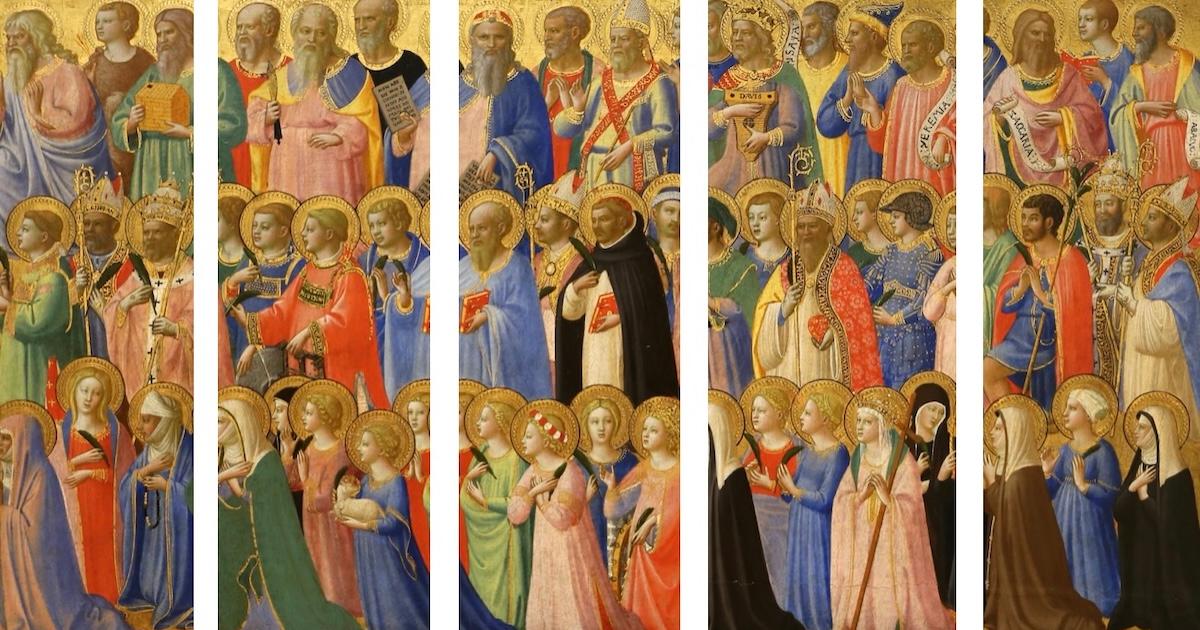
Up the road from St. Mark’s is the convent of St. Dominic. The church there has a very early work of Angelico’s, a painting he made on the altarpiece. The main panel depicts the Blessed Virgin surrounded by St. Peter and a few Dominican saints. On this All Saints Day, though, I’m interested in the lower panels, which are quite small (as you can see in this video of a recent restoration), and are densely crowded with a parade of saints streaming to Christ in the center. See a professional image that includes the entire panel here; the image below is the right-hand side.
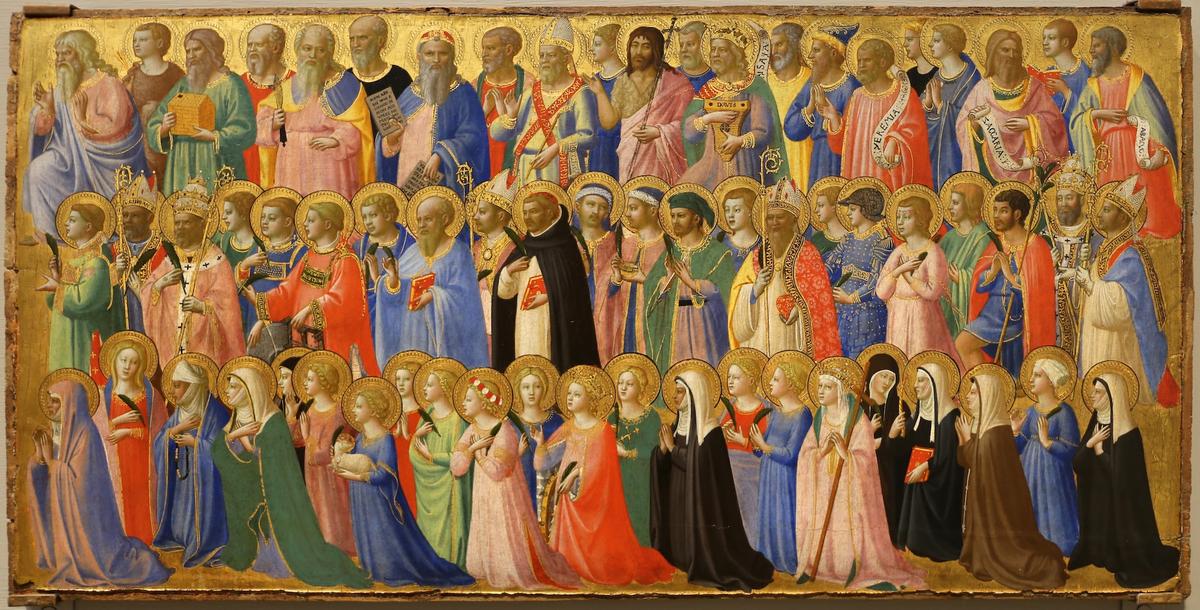
I don’t know who all the saints are, although I’m sure they could all be identified. I don’t think the point of the painting, though, is to isolate the individual figures. The point is to create a sense of a great multitude. The saints in the scene are all shapes and sizes, men and women, from different times and places, different manner of dress, each one holding a different symbol of virtue. The only figure who stands out from the procession is Christ himself. It is he who is central, and yet, as small as the painting is, Angelico takes the time to personally paint each individual person in great detail. It’s a sort of visual paradox – it is Christ alone who gives meaning to the multitude, but within it, each and every person matters. Each person is unique and each one finds his or her place and meaning within the great gathering.
You read Aleteia. You can help others discover it.
Every day, Aleteia shares the Gospel, free for everyone. Your donation helps us continue this mission and reach more hearts.
We all strive for sainthood in our own particular way. Some through religious life, others in the priesthood, some in marriages and as parents, others in the single life or in widowhood. There is no single way to become a saint, but in becoming more fully ourselves as we approach Our Lord, we are knit into the unity of the sainthood.
Gold everywhere
What really stands out to me is how the saints are immersed in gold. Not only is the atmosphere gold, but so are their halos of light, their shoes, their hair, and the hems of their garments. The painting is radiant and luminous with gold. Angelico made this painting 600 years ago and, because of the particular structural qualities of gold as a material, it still shines.
This luminosity is highly symbolic. The saints are immersed in golden, divine light. The light is God’s glory. It’s the light of another world. As St. John says when he sees the New Jerusalem in his vision, Heaven has no need of the sun anymore because everything has become pure light. In the same way, the Holy of Holies in the temple in Jerusalem was plated in gold, and the tabernacle in a Catholic Church is also often made of gold. Further, the candles and sacred vessels are gold. These are symbols of the nearness of glory and the presence of the saints. The light that shines around a Catholic altar is heavenly. It is bright with saints and angels.
The saints are not only present in the light, but they participate in it. They themselves have, spiritually, become heirs to the treasure and like blazing furnaces white hot and gold. Their halos of light are clearly small, localized expressions of the one, great light that comes from Christ.
I would think that for a medieval worshiper in that church of St. Dominic in the days before electric lighting, the interior would have been somewhat dim even on sunny days. Think about how the candles when they were lit at the altar would have shone, how the gold painting would have caught the light and stood out from the darkness. All attention would have been drawn towards the altar area because of the otherworldly quality of the light.
This is, perhaps, why this painting of Angelico’s continues to exude mystical intensity. I often see it shared on social media for All Saints Day. I always love to see it. The crowd of saints is encouraging to people like me who are still very much struggling to become holy and who, some days, doubt if I’m going to make it. When I look at this picture, I see Christ at the center with his victorious resurrection banner, framed by his saints. Fra Angelico creates a visual window into the heart of the mystery, beckoning us from the periphery to the center, from the surface to the interior. Even if there are days it seems like we are far from the goal, that we are not yet the people we want to become, and the journey before us is long and arduous, the truth remains. It shimmers with light. You, too, can be gold.