

 Sen. Dan Sullivan and Mary Peltola at their respective Election Night watch parties on November 3, 2026. (Anne Raup and Marc Lester / ADN)
Republican U.S. Sen. Dan S. Sullivan narrowly led former U.S. Rep. Mary Peltola, a Democrat, in one of the nation’s most closely watched Senate races Tuesday night after preliminary results were reported in Alaska’s general election. Tens of thousands of ballots are still to be counted, and additional results were expected to be reported Tuesday night.
The final result of the tight race likely won’t be known until mid-November, after ranked choice tabulation.
With 209,793 ballots counted out of about 605,000 registered voters, and over 84% of precincts reporting, the incumbent Sullivan had 100,751 votes, or 48.3% of the vote so far.
Peltola had 99,074 votes — or 47.5% of the vote — in preliminary results as of about 11:30 p.m. Tuesday. Many of the precincts that hadn’t reported results yet are in rural Alaska communities expected to favor Peltola.
The Senate race has featured record spending, unprecedented fundraising by Peltola, and campaign rallies held in Alaska by Republican President Donald Trump and his vice president in an effort to boost Sen. Sullivan.
In third place was Gerald Heikes, a Republican perennial candidate from Palmer, who received 4,495 votes, or 2.2% of the vote.
In fourth was Dan J. Sullivan, the namesake challenger to the senator and a retired teacher from Petersburg, who was running in fourth with 3,448 votes, or 1.7%.
The Petersburg Sullivan’s candidacy has generated a so-far-unsuccessful Trump administration lawsuit that asserts he’s part of a plot by Democrats and the Peltola campaign to mislead voters, as well as ongoing criminal investigations into the alleged ploy by the Justice Department and the Alaska Department of Public Safety.
Dan J. Sullivan was listed on Tuesday’s ballot without a party affiliation, one of the steps the state Division of Elections took to distinguish him from the senator. In August he switched his party affiliation to undeclared, apparently without meaning to, after initially filing to run as a Republican.
Tuesday’s initial preliminary results only reflected voters’ first-choice rankings, even though voters are able to rank all the candidates in order of preference.
If the top vote-getter does not receive more than 50% of first-choice votes, the election will be decided in a ranked choice tabulation scheduled for Nov. 18. Results could change as votes are tabulated in future rounds: Under ranked choice tabulation, the candidate with the fewest votes is eliminated and votes are redistributed to their supporters’ second-choice candidates. The process repeats until one candidate receives more than 50% of the vote.
The results are set to be certified on Nov. 25.
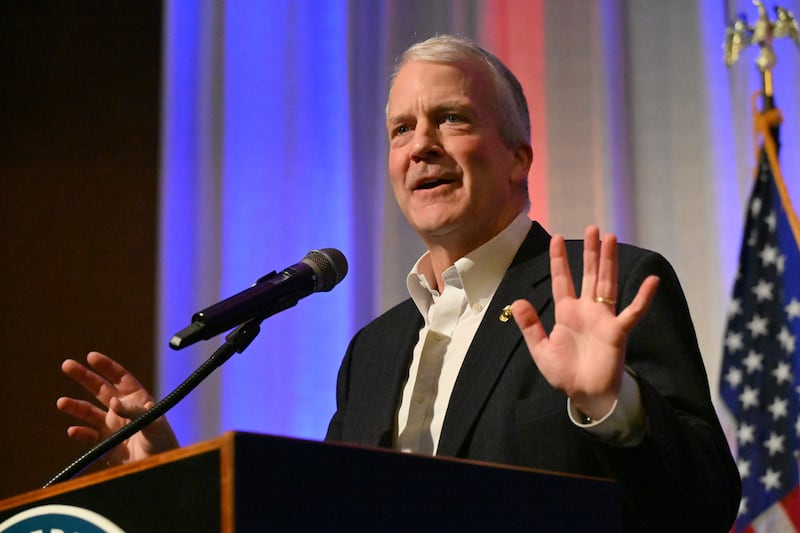 Senator Dan Sullivan makes remarks at the Hotel Captain Cook Tuesday evening November 3, 2026. (Photo by Anne Raup for ADN)
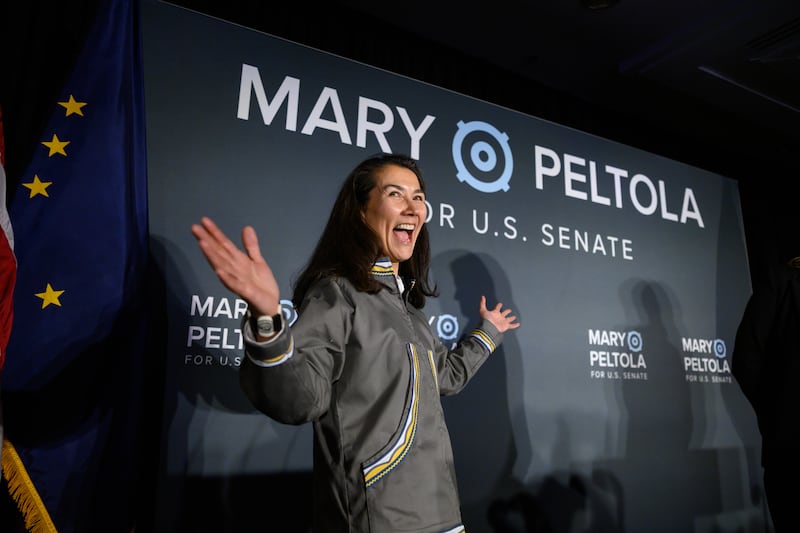 Mary Peltola walks on stage to speak to the crowd at her Election Night watch party at the Sheraton Anchorage Hotel on November 3, 2026. (Marc Lester / ADN)
Peltola entered a ballroom at the Sheraton Anchorage Hotel downtown shortly after the initial count was released, showing her with a strong lead that later narrowed.
A crowd of more than 300 people showered her with applause, chanted her name and waved fans with her photo.
In a speech, she acknowledged that it was still early in the ballot count, but she said votes follow trends — and the outlook is positive.
“The weather is changing,” she said. “We have seen it in our lifetimes. And now we are having a political change.”
The first Alaska Native to serve in Congress, she kicked off a speech by leading a chant of aarigaa, a word in the Iñupiaq language that means “wonderful” or “good.”
“We can wrestle our country back,” she said. “We can get our country back from corporate greed.”
 Mary Peltola supporters cheer at her Election Night watch party at the Sheraton Anchorage Hotel on November 3, 2026. (Marc Lester / ADN)
Often drowned out by roars from the crowd, Peltola touched on issues central to her campaign, such as the need to improve healthcare, provide more housing in Alaska communities and protect Social Security, which faces a funding shortfall in the coming years.
She said Alaskans are getting crushed by high prices for freight, fuel and groceries.
“When does it stop? When we stand up and fight back,” she said.
She seemed to reference the recent allegations that her campaign was behind the Dan J. Sullivan candidacy, likening it to “juicy gossip.”
“We know BS when we see it, we know distractions when we see it, and we are not falling for any of their funny business,” she said.
Sullivan: Blue wave is ‘a little depressing’
Sen. Sullivan, speaking in a ballroom at the Hotel Captain Cook, where his campaign was hosting an election night event, commented on the waves of progressive wins across the U.S. on Tuesday night that flipped control of the U.S. Senate and House into Democratic hands.
[Democrats win the U.S. Senate as voters deliver a strong rebuke to Trump and his party]
“It’s a little depressing out there, but we don’t think that ‘blue wave’ is going to crest up in Alaska,” Sullivan said during an energetic two-minute speech in which he reiterated the campaign’s confidence in its prospects.
Shortly after 10 p.m., as new results showed him taking the lead, Sullivan said:
“Our internal tapes right now have us up. So that’s what’s important,” Sullivan said to the crowd of attendees at a party hosted by the Alaska Republican Party for both his and Congressman Nick Begich’s campaigns.
Despite his optimism, Sullivan said it could be a long time before the race has definitive results.
“We’re gonna have a long night, we’re probably gonna have some long weeks,” Sullivan said.
According to Sullivan, there were lines to vote at some sites on the Kenai Peninsula, and there was indication of strong turnout from parts of the state that tend to drive up some of the largest Republican margins in elections.
“The night is very young. The night is very young,” Sullivan said. “We’re, like, confident. Confident.”
 Sen. Dan Sullivan speaks with supporters and waves at passing vehicles at the corner of Northern Lights Boulevard and the Seward Highway on Election Day, November 3, 2026. (Marc Lester / ADN) Certification questions loom
Peltola has focused on issues such as inflation and record-high fuel prices caused by the unpopular war in Iran, income inequality, and cuts to Medicaid in the One Big Beautiful Bill Act. She has highlighted her accomplishments, such as playing a role in getting the ConocoPhillips’ giant Willow oil field approved.
Sullivan has acknowledged that Alaskans are suffering, but he has highlighted tax cuts in the One Big Beautiful Bill and other accomplishments, such as the state’s military buildup and efforts to expand oil and gas opportunities on federal lands in Alaska, including future royalty income for the state from those lands.
But the contest intensified late last month, when the Trump administration filed its lawsuit against the Alaska Division of Elections, asking for the election not to be certified if the senator narrowly loses as a result of voter confusion caused by the namesake challenger. The New York Times also reported that the Democratic Senatorial Campaign Committee and Peltola campaign staff were allegedly involved in the effort to recruit the Petersburg Sullivan. Both the campaign and the Democratic committee have denied any involvement, and Dan J. Sullivan has said he decided to run on his own accord.
A federal judge on Sunday swiftly dismissed the Justice Department’s lawsuit without a hearing, ruling that it lacked a legal foundation and could hurt the constitutional right to ballot secrecy. (The Alaska Supreme Court also ruled this summer that the namesake challenger was eligible to appear on the ballot.)
The federal government has said it plans to appeal Sunday’s decision, raising questions about whether it could pose as an obstacle to certifying the election.
The lawsuit is one of multiple unsuccessful legal efforts by the Trump administration to intervene in state elections this election cycle, amid allegations of voter fraud.
At the same time, state investigators, at the order of Republican Gov. Mike Dunleavy, and the FBI have launched investigations into the alleged candidate recruitment effort reported by The New York Times.
Sullivan asserted to reporters Tuesday, after voting at the Alaska Zoo in Anchorage, that Peltola has long been lying to Alaskans and was involved in the effort.
Peltola has described the investigations and lawsuit as baseless, and a sham.
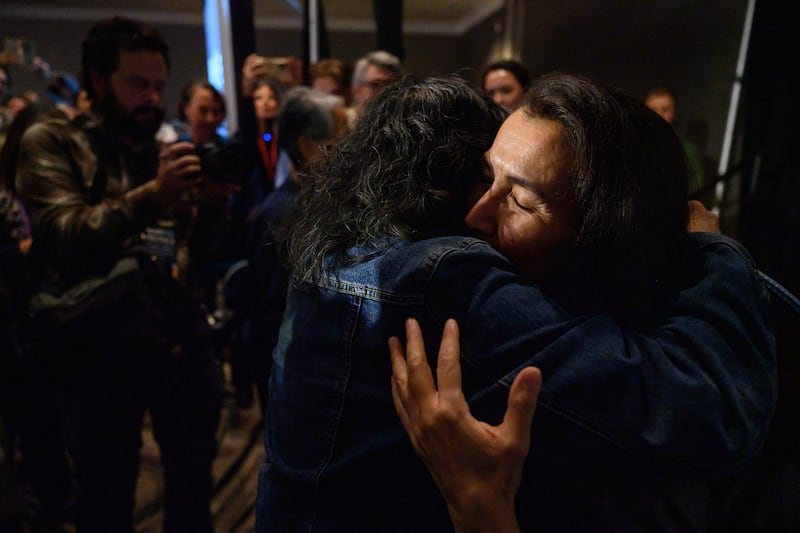 Mary Peltola is greeted by supporters at her Election Night watch party at the Sheraton Anchorage Hotel on November 3, 2026. (Marc Lester / ADN)
Sullivan said he’ll accept the election results, whatever they may be, “once every legal vote is counted and certified.”
Dunleavy has declined to say whether the election will be certified if Peltola wins the race yet remains under investigation.
But Carol Beecher, the director of Alaska’s Division of Elections, and a Republican, is responsible for certifying election results under state law.
Meanwhile, the Petersburg Sullivan, who has asserted that he chose to run because he did not like the policies of the incumbent senator, has not been spotted at his home in Petersburg for some time, raising questions about his whereabouts.
Sen. Sullivan told reporters Tuesday that maybe the Petersburg Sullivan is in the “Bahamas somewhere or on the lam” while Trump, who has frequently attacked the namesake challenger, suggested on social media without evidence that he may have been kidnapped by Democratic lawyers.
[Voters weigh affordability and partisanship on Election Day in Alaska]
Record spending
In the August open primary, Peltola led with 49.5% of the vote while the incumbent Sullivan received 41.4%.
Dan J. Sullivan received 2.5% of the vote while Heikes received 1%.
The Senate race has been the target of well over $100 million in spending by the campaigns and super PACs.
The Peltola campaign has reported raising nearly $37 million in total receipts during the campaign, with spending of $32.8 million and $4.1 million cash on hand.
The campaign of the incumbent Sullivan has reported raising $11.6 million, with spending of $10.8 million and $2.1 million cash on hand.
 Sen. Dan Sullivan speaks to supporters at a campaign rally at Odd Man Rush Brewing Company in Eagle River on November 2, 2026. (Marc Lester / ADN)
This year’s Senate race breaks a fundraising record set when Sen. Sullivan last ran for office in 2020. At the time, the candidates raised a combined total of $28 million.
In addition to that money, independent groups have spent a combined total of more than $100 million on the race — including $43 million opposing Peltola and $40 million opposing Sullivan — according to the website OpenSecrets, which aggregates data from the Federal Election Commission.
Some of the outside spending has gone to support the long-shot candidacy of Heikes, part of a trend in this year’s election as super PACs seek to boost spoiler candidates to hurt potential winners.
Political groups have spent more than $2 million in ads to boost Heikes, including one that’s heavily funded by progressive organization Sixteen Thirty Fund, based in Washington, D.C.
Ads for the candidate have touted Heikes as a more socially conservative alternative to the incumbent Sullivan and encouraged voters to rank only Heikes on their ballot, instead of ranking multiple choices.
Heikes had finished fifth in the primary behind David Leslie, a Democrat from Fairbanks who could have drawn votes from Peltola.
But Leslie withdrew from the ballot after a visit from a Democratic political operative associated with the effort to also recruit the Petersburg Sullivan to run, according to The New York Times reporting.
Heikes also said he was recruited by someone from the Lower 48 to run against Sullivan early this year, after he had initially sought to run against Republican Rep. Nick Begich in the U.S. House race.
This is a developing story. Check back for updates.