
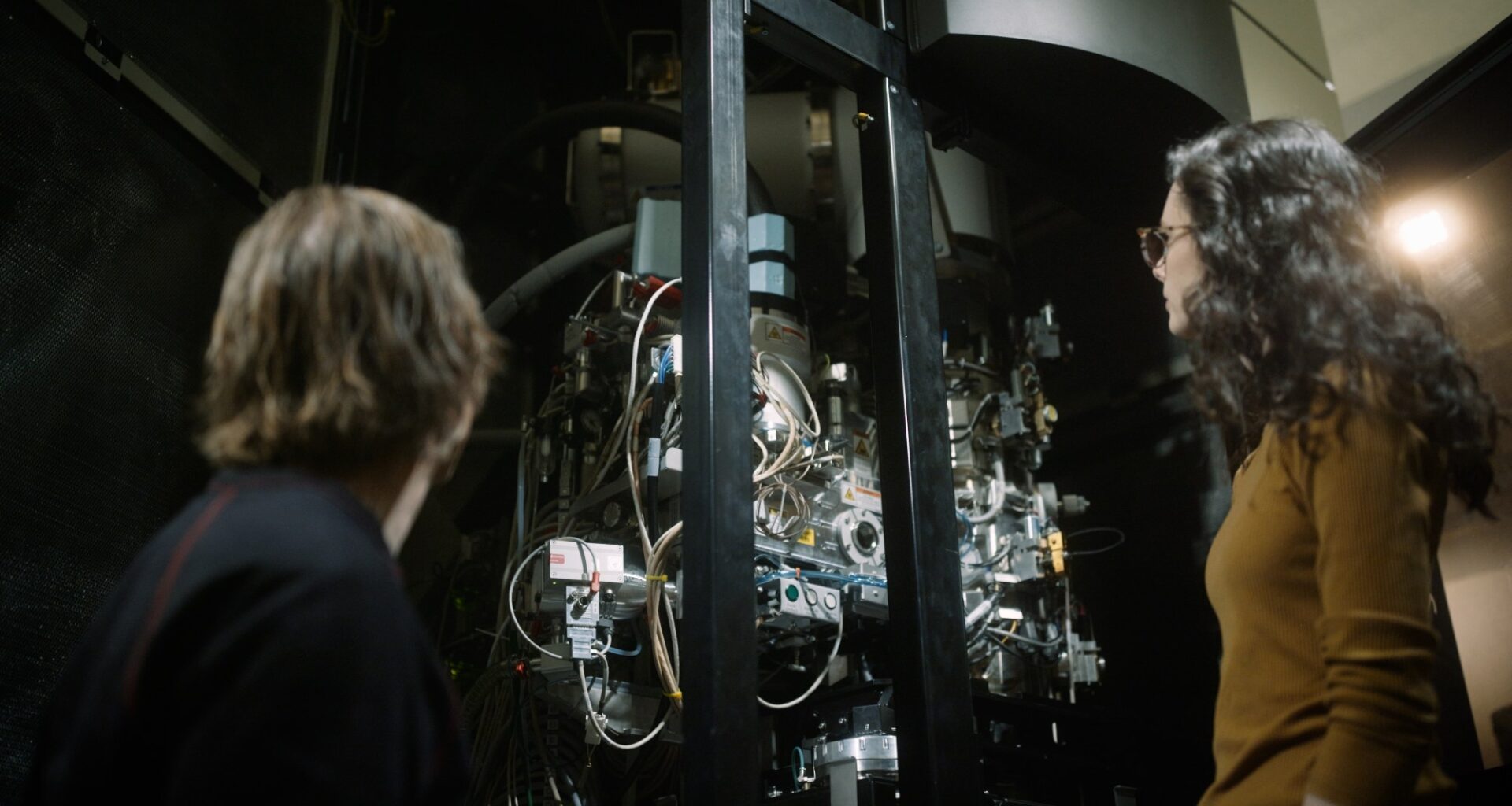
San Diego-based Scripps Research was recently awarded 14 million computing hours, which will supercharge the speed of foundational research for vaccines, antibody therapies and small molecule drug discovery.
This state-of-the-art computing power comes from the Jen-Hsun and Lori Huang Foundation, the personal philanthropy of Nvidia’s co-founder and his wife. This gift is equivalent to tens of millions of dollars, according to some estimates.
But the gift wasn’t made purely out of generosity. Scripps’ trove of deep scientific data may be worth equal, if not more, to its AI partners.
The multitrillion-dollar pitch to Wall Street by AI behemoth Anthropic leans on the biological discoveries and new treatments its models could one day produce. But without good data, the models can’t make those discoveries, and Nvidia can’t sell more chips.
The Jen-Hsun and Lori Huang Foundation’s grant solves both problems at once. With Anthropic’s AI model Claude, and 14 million hours of free computing power, Scripps can speed up the science it was already doing.
But what if one of Scripps’ competitors uses Anthropic’s models, allowing the San Diego institution’s intellectual property to be accessed by anyone with model access?
“We want to maximize impact for exploration and discovery,” said Andrew Ward, a professor at Scripps Research who is leading the project. “We need credit, of course, but it’s not exactly what we’re chasing,” he said. Ward is more focused on biological discovery, he says.
Today, early discovery looks like a lengthy sequence of trial and error. But all that guesswork could be done in minutes with the new grant.
Scripps is using the 14 million hours to build two new tools for its researchers: a virtual human immune system and a map of the “dark” proteome.
The first, which Scripps calls a “Virtual Germinal Center,” mimics how the body learns to fight a threat. Immune cells repeatedly mutate their antibodies and keep the ones that fight the “bad guy” best.
This process normally takes weeks of educated guesswork, according to Ward.
Professor Bryan Briney of Scripps Research is training AI on millions of real antibody sequences and structures to simulate that process on a computer, so researchers can test vaccine ideas and find promising antibody treatments before ever stepping into the lab.
The second tackles the elusive proteins in our body. Simply put, proteins are the “workers” in our body that execute tasks laid out by DNA.
Thousands of proteins constantly flex and shape shift, so traditional 2D photo modeling can’t capture them, and drug designers miss the brief pockets where a medicine could latch on.
Professor Stefano Forli of Scripps Research is also planning to use the new computing hours. His team will simulate these proteins moving under body-like conditions to catch those fleeting pockets, turning “undruggable” proteins into potential drug targets.
For Ward, the new project has meant thinking about infinity.
The question came up over coffee in Palo Alto last summer. Eric Jensen, chief operating officer of the Jen-Hsun and Lori Huang Foundation, asked Ward what he would do with unlimited computing power.
“Think bigger,” Jensen urged. “If we had infinity, what will that look like?”
It was difficult to imagine a world of no boundaries when all of Ward’s research had existed within the confines of money and time.
They discussed how to build foundation models for deep biology that every scientist could use. He characterized it as a democratization of knowledge that felt almost Promethean.
A few days later, on Oct. 19, the Huang Foundation granted Scripps 14 million computing hours.
Ward acknowledges that the models Scripps hopes to develop are far from perfect.
Recent studies show mixed results on whether AI models actually produce better data than simpler methods. Questions also remain about how accurate the models are at predicting outcomes in unfamiliar conditions.
Ward, though, pointed out that every AI prediction still has to be proven the old-fashioned way.
“You have to make it in a test tube, you have to do all the assays, and you have to validate them,” he said.
The AI models, he explained, only give you ideas on which candidates are worth physically testing. And in theory, the candidates that survive will be better suited for real clinical development.
“To go from an idea to a molecule would normally take years. Now we’ve compressed that timeline down, and we can at least have candidates for testing in a matter of weeks or months,” Ward said.
Scripps’ contribution may prove equally, if not more, valuable to the AI industry. Decades’ worth of deep scientific data could make AI models far smarter, which raises questions about academic and commercial ownership.
San Diegans may not feel the impact right away of this new research, but Ward knows it will pay off in the future, because it has paid off before, he said.
Back in 2016, Ward was studying coronaviruses, not toward any specific goal, but as foundational research. A few years later, that work was at the center of a newly arrived pandemic. Ward expects the foundational science he’s producing with these models to prove just as important down the road.
San Diegans “should feel good that scientists are now super powered and super enabled,” he said.